Department of Medical Oncology, The First Affiliated Hospital of Xi'an Jiaotong University, Xi'an, Shaanxi, 710061, People's Republic of China.
Department of Nutrition and Food Hygiene, School of Public Health, Tongji Medical College, Huazhong University of Science and Technology, Wuhan, China.
Ann Clin Microbiol Antimicrob. 2020 Nov 23;19(1):53. doi: 10.1186/s12941-020-00395-7.
The colonization of Extended-spectrum β-lactamase-producing Enterobacteriaceae (ESBL-PE) in bloodstream infections (BSIs) has been increased dramatically worldwide, and it was associated with worse clinical outcomes in patients with malignancy. We performed the meta-analysis to investigate the prognosis and risk factors in BSIs caused by ESBL-PE in oncological patients.
PubMed, EMBASE, and Cochrane Library were searched for related studies. All-cause mortality was considered as the primary outcome. Subgroup analyses, meta-regression analyses, and sensitivity analysis were used to investigate heterogeneity and reliability in results.
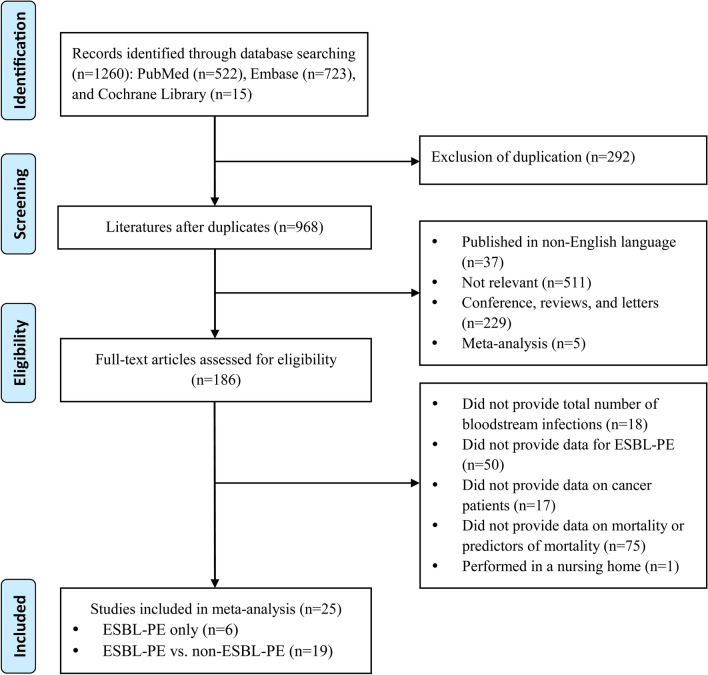
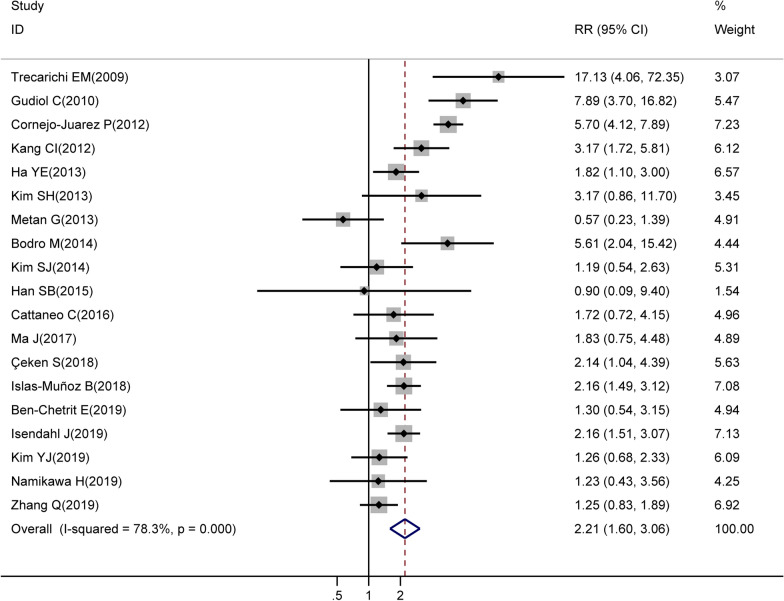
6,729 patients from 25 studies were eligible. Six studies enrolled oncological patients with BSIs caused by ESBL-PE only, while 19 studies both enrolled ESBL-PE and non-ESBL-PE infections. The results showed that BSIs caused by ESBL-PE in patients with malignancy was associated with higher mortality than non-ESBL-PE infections (RR = 2.21, 95% CI: 1.60-3.06, P < 0.001), with a significant between-study heterogeneity (I =78.3%, P < 0.001). Subgroup analyses showed that children (RR = 2.80, 95% CI: 2.29-3.43, P < 0.001) and hematological malignancy (RR = 3.20, 95% CI: 2.54-4.03, P < 0.001) were associated with a higher mortality. Severe sepsis/ septic shock, pneumonia, and ICU admission were the most common predictors of mortality.
Our study identified that BSIs caused by ESBL-PE in patients with malignancy were associated with worse clinical outcomes compared with non-ESBL-PE infections. Furthermore, children and hematological malignancy were associated with higher mortality. Severe sepsis/ septic shock, pneumonia, and ICU admission were the most common predictors of mortality.
产超广谱β-内酰胺酶肠杆菌科(ESBL-PE)在血流感染(BSI)中的定植在全球范围内显著增加,并且与恶性肿瘤患者的临床结局较差相关。我们进行了荟萃分析,以研究 ESBL-PE 引起的血液感染(BSI)在肿瘤患者中的预后和危险因素。
检索了 PubMed、EMBASE 和 Cochrane Library 中的相关研究。全因死亡率被视为主要结局。进行了亚组分析、荟萃回归分析和敏感性分析,以调查结果中的异质性和可靠性。
共有 25 项研究的 6729 名患者符合条件。有 6 项研究仅纳入了由 ESBL-PE 引起的血液感染的肿瘤患者,而有 19 项研究同时纳入了 ESBL-PE 和非 ESBL-PE 感染。结果表明,恶性肿瘤患者由 ESBL-PE 引起的血液感染比非 ESBL-PE 感染的死亡率更高(RR=2.21,95%CI:1.60-3.06,P<0.001),存在显著的研究间异质性(I=78.3%,P<0.001)。亚组分析表明,儿童(RR=2.80,95%CI:2.29-3.43,P<0.001)和血液恶性肿瘤(RR=3.20,95%CI:2.54-4.03,P<0.001)与更高的死亡率相关。严重脓毒症/感染性休克、肺炎和入住 ICU 是死亡率的最常见预测因素。
我们的研究表明,与非 ESBL-PE 感染相比,恶性肿瘤患者由 ESBL-PE 引起的血液感染与更差的临床结局相关。此外,儿童和血液恶性肿瘤与更高的死亡率相关。严重脓毒症/感染性休克、肺炎和入住 ICU 是死亡率的最常见预测因素。