Cornell Wildlife Health Center, College of Veterinary Medicine, Cornell University, Ithaca, NY 14853;
Boyd Orr Centre for Population and Ecosystem Health, Institute of Biodiversity Animal Health and Comparative Medicine, University of Glasgow, Glasgow G12 8QQ, United Kingdom.
Proc Natl Acad Sci U S A. 2020 Dec 15;117(50):31954-31962. doi: 10.1073/pnas.2000153117. Epub 2020 Nov 23.
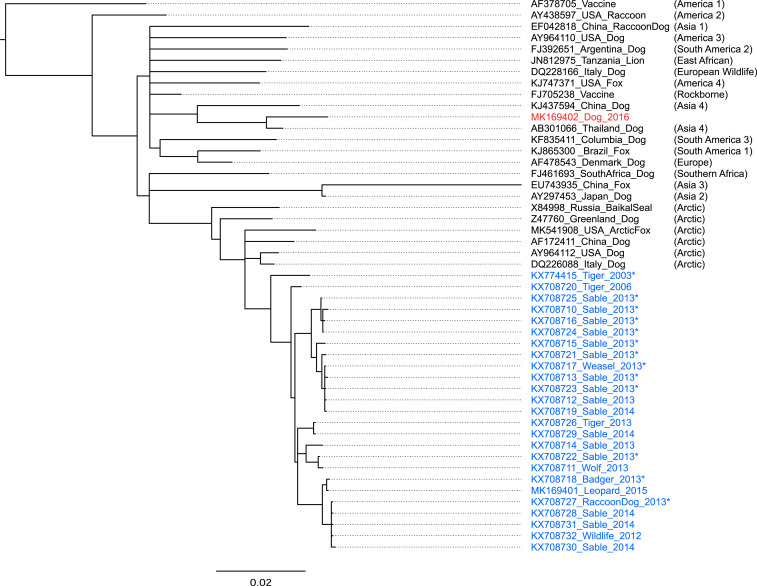
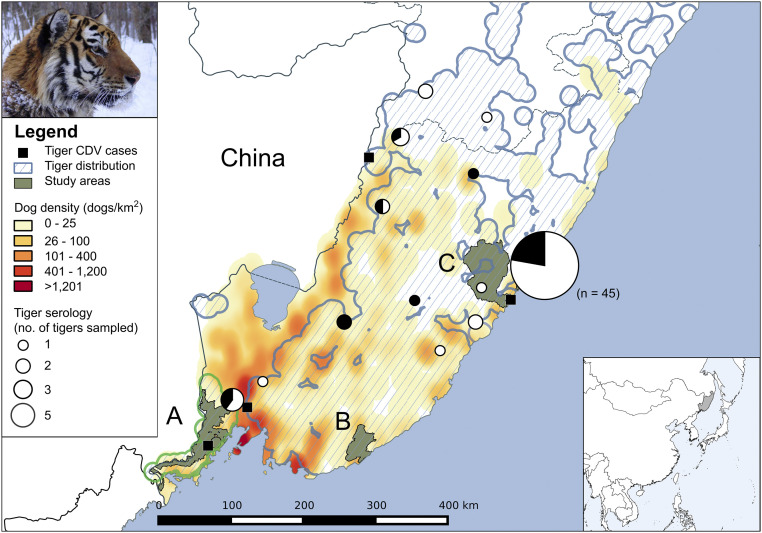
Canine distemper virus (CDV) has recently emerged as an extinction threat for the endangered Amur tiger (). CDV is vaccine-preventable, and control strategies could require vaccination of domestic dogs and/or wildlife populations. However, vaccination of endangered wildlife remains controversial, which has led to a focus on interventions in domestic dogs, often assumed to be the source of infection. Effective decision making requires an understanding of the true reservoir dynamics, which poses substantial challenges in remote areas with diverse host communities. We carried out serological, demographic, and phylogenetic studies of dog and wildlife populations in the Russian Far East to show that a number of wildlife species are more important than dogs, both in maintaining CDV and as sources of infection for tigers. Critically, therefore, because CDV circulates among multiple wildlife sources, dog vaccination alone would not be effective at protecting tigers. We show, however, that low-coverage vaccination of tigers themselves is feasible and would produce substantive reductions in extinction risks. Vaccination of endangered wildlife provides a valuable component of conservation strategies for endangered species.
犬瘟热病毒(CDV)最近成为濒危东北虎()灭绝的威胁。CDV 是可以通过疫苗预防的,控制策略可能需要对家养犬和/或野生动物进行疫苗接种。然而,对濒危野生动物进行疫苗接种仍然存在争议,这导致人们将注意力集中在家养犬上,通常认为家养犬是感染源。有效的决策需要了解真正的储存动态,这在宿主群体多样化的偏远地区带来了巨大的挑战。我们对俄罗斯远东地区的犬和野生动物种群进行了血清学、人口统计学和系统发育学研究,结果表明,一些野生动物物种比犬更重要,无论是在维持 CDV 还是作为老虎感染源方面。因此,至关重要的是,由于 CDV 在多种野生动物来源之间传播,仅对犬进行疫苗接种不会有效保护老虎。然而,我们表明,对老虎自身进行低覆盖率的疫苗接种是可行的,并且会大大降低灭绝风险。对濒危野生动物进行疫苗接种为濒危物种的保护策略提供了有价值的组成部分。