Bausch & Lomb Contact Lens Center; Bausch and Lomb School of Optometry, Brien Holden Institute of Optometry and Vision Sciences, L. V. Prasad Eye Institute, Banjara Hills, Hyderabad, Telangana, India.
Center for Epidemiology and Biostatistics, Prof. Brien Holden Research Center, L .V. Prasad Eye Institute, Hyderabad, Telangana, India.
Indian J Ophthalmol. 2020 Dec;68(12):2911-2917. doi: 10.4103/ijo.IJO_1522_20.
To estimate the time taken for topometric indices to stabilize in keratoconic corneas following cessation of habitual RGP contact lens wear.
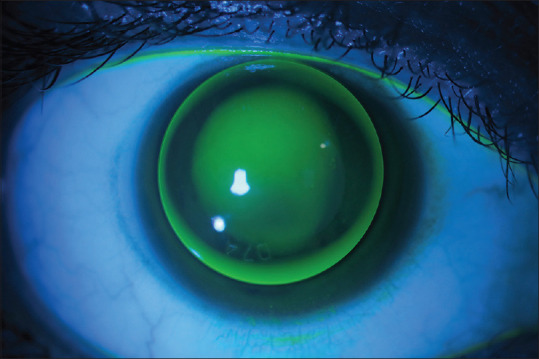
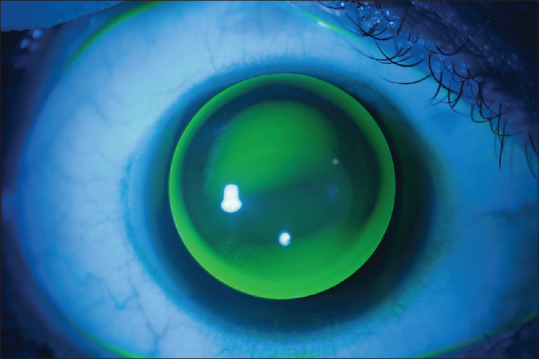
A total of 29 eyes of 20 patients, diagnosed with mild to severe keratoconus were included in this prospective observational study. All patients were experienced RGP contact lens wearers (either conventional RGP or Rose K2 lens) with each patient having used these lenses for at least a year. Corneal topography was performed immediately following discontinuation of habitual contact lens wear at baseline and each of four consecutive visits, 1-week apart.
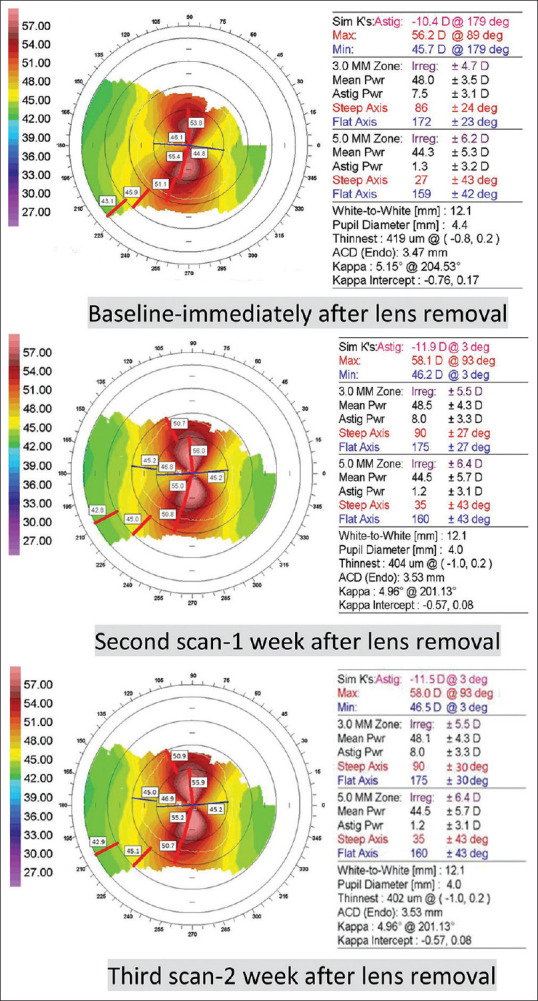
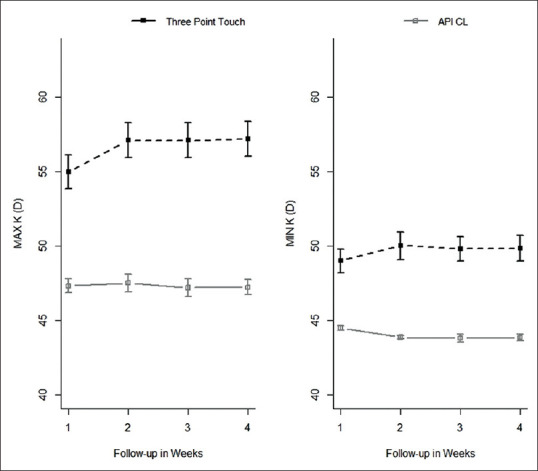
An overall reduction in the keratometry and thickness values were noted on tomography immediately following cessation of contact lens wear and these indices increased significantly in the 1 week (P < 0.001). Consecutive visits following the first visit did not show any significant change in the topometric parameters (P > 0.05). Subgroup analysis revealed a similar trend in eyes with "severe" keratoconus and in eyes fitted with the "three-point touch" philosophy. However, eyes with "mild-moderate" keratoconus and those fitted with "apical clearance" fitting philosophy showed marginal differences even within the 1-week period of lens cessation.
Maximum changes in keratometry and pachymetry values following discontinuation of RGP lens wear stabilize within the 1 week of cessation of rigid lens wear in a keratoconic cornea. These changes were more pronounced in patients with severe keratoconus and those with an apical bearing fit. This information would be useful for practitioners to assess the progression of keratoconus in RGP lens users before collagen cross-linking.
评估停止习惯性硬性透气性角膜接触镜(RGP)佩戴后,圆锥角膜角膜顶地形指数稳定所需的时间。
本前瞻性观察研究共纳入 20 例(29 只眼)轻至重度圆锥角膜患者。所有患者均为有经验的 RGP 接触镜佩戴者(传统 RGP 或 Rose K2 镜片),每位患者至少使用过这些镜片 1 年。在停止习惯性接触镜佩戴后即刻(基线)以及连续 4 次(每周 1 次)随访时进行角膜地形图检查。
停止接触镜佩戴后即刻,角膜地形图检查显示角膜曲率计和厚度值总体降低,这些指数在 1 周内显著增加(P < 0.001)。首次随访后连续随访时,顶地形参数无明显变化(P > 0.05)。亚组分析显示,“严重”圆锥角膜眼和采用“三点接触”理念配镜的眼有类似趋势。然而,“轻-中度”圆锥角膜眼和采用“顶点离焦”配镜理念的眼即使在停止镜片佩戴的 1 周内,顶地形参数也存在差异。
在圆锥角膜中,停止 RGP 镜佩戴后,角膜曲率计和角膜厚度值的最大变化在停止硬性镜片佩戴后 1 周内稳定。在严重圆锥角膜患者和具有顶点支撑拟合的患者中,这些变化更为明显。这些信息对于在交联治疗前评估 RGP 镜使用者圆锥角膜进展情况的临床医生来说很有用。