Max Planck Institute of Colloids and Interfaces, Department of Biomaterials, 14476, Potsdam, Germany.
B CUBE - Center for Molecular Bioengineering, 01307, Dresden, Germany.
Nat Commun. 2020 Nov 24;11(1):5971. doi: 10.1038/s41467-020-19739-0.
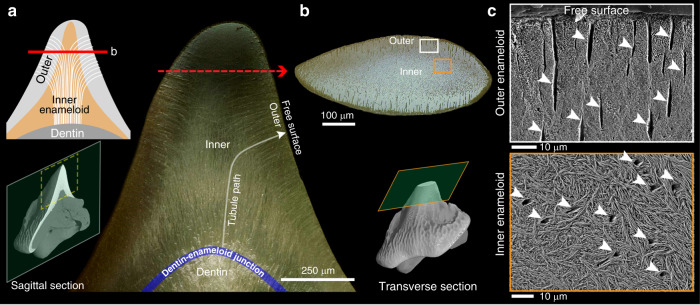
The teeth of all vertebrates predominantly comprise the same materials, but their lifespans vary widely: in stark contrast to mammals, shark teeth are functional only for weeks, rather than decades, making lifelong durability largely irrelevant. However, their diets are diverse and often mechanically demanding, and as such, their teeth should maintain a functional morphology, even in the face of extremely high and potentially damaging contact stresses. Here, we reconcile the dilemma between the need for an operative tooth geometry and the unavoidable damage inherent to feeding on hard foods, demonstrating that the tooth cusps of Port Jackson sharks, hard-shelled prey specialists, possess unusual microarchitecture that controls tooth erosion in a way that maintains functional cusp shape. The graded architecture in the enameloid provokes a location-specific damage response, combining chipping of outer enameloid and smooth wear of inner enameloid to preserve an efficient shape for grasping hard prey. Our discovery provides experimental support for the dominant theory that multi-layered tooth enameloid facilitated evolutionary diversification of shark ecologies.
所有脊椎动物的牙齿主要由相同的物质组成,但它们的寿命差异很大:与哺乳动物形成鲜明对比的是,鲨鱼的牙齿只有几周的寿命,而不是几十年,因此终身耐用性在很大程度上变得无关紧要。然而,它们的饮食多种多样,通常对机械有很高的要求,因此,即使在面临极高且可能造成损害的接触压力的情况下,它们的牙齿也应该保持功能性的形态。在这里,我们解决了需要操作的牙齿几何形状和在吃硬食物时不可避免的固有损伤之间的困境,证明了硬壳猎物专家——杰克逊港鲨鱼的牙齿齿尖具有不寻常的微观结构,以控制牙齿侵蚀的方式来保持功能齿尖的形状。牙釉质中的梯度结构引发了特定位置的损伤反应,将外釉质的碎裂和内釉质的光滑磨损结合起来,以保持抓取硬猎物的高效形状。我们的发现为一个主导理论提供了实验支持,即多层牙釉质促进了鲨鱼生态系统的进化多样化。