Jiangsu Key Laboratory of Oral Diseases, Nanjing Medical University, Nanjing, Jiangsu 210029, P.R. China.
Department of Cardiology, The First Affiliated Hospital of Nanjing Medical University, Nanjing, Jiangsu 210029, P.R. China.
Int J Mol Med. 2021 Jan;47(1):137-150. doi: 10.3892/ijmm.2020.4787. Epub 2020 Nov 11.
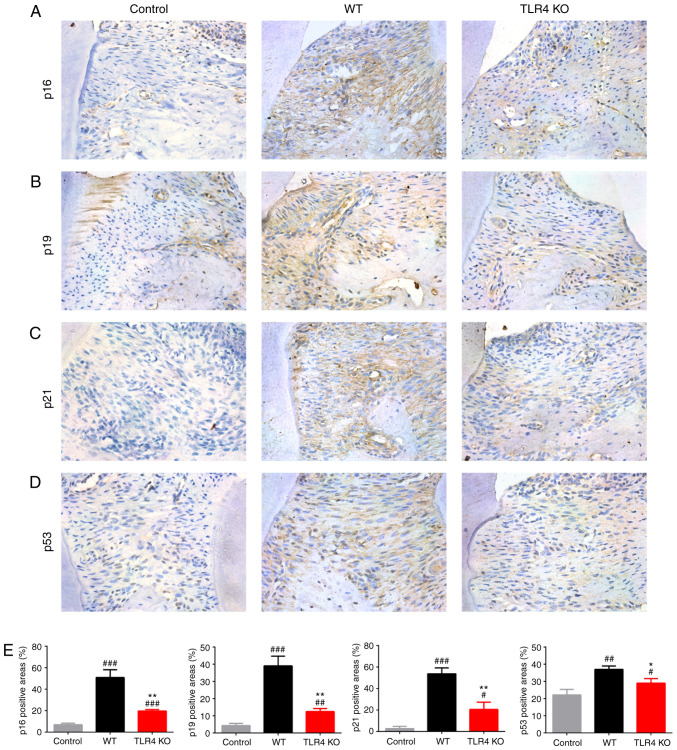
Overproduction of pro‑inflammatory cytokines in the aged, which is called inflammaging, leads to the deterioration of periodontitis. Toll‑like receptor 4 (TLR4) plays a role in the regulation of cellular senescence, and its expression increases with age. However, there has been limited research into the molecular mechanisms underlying the onset of periodontal inflammaging, and the interplay between TLR4 and inflammaging. In the present study, wild‑type and TLR4 gene knockout mice were used to investigate the activation of the TLR4 pathway in mouse periodontitis and the expression of the nucleotide‑binding and oligomerization domain‑like receptor 3 (NLRP3) inflammasome, an upstream immune checkpoint during the development of inflammaging. Activation of TLR4 in a mouse model of periodontitis enhanced the expression of a senescence‑associated secretory phenotype (SASP), which boosted the inflammaging process. Conversely, TLR4 activation downregulated the expression of B cell‑specific Moloney murine leukemia virus integration site 1 (Bmi‑1) and promoted the priming of NLRP3 inflammasome, both of which are regulators of SASP. Treating gingival fibroblasts with Bmi‑1 inhibitor PTC209, it was demonstrated that TLR4 activated the NLRP3 pathway and the inflammaging process by suppressing Bmi‑1. In addition, there was a significant reduction in the expression of Bmi‑1 expression in the gingiva of patients with periodontitis compared with healthy controls. In conclusion, the present study demonstrated that TLR4 acted by inhibiting Bmi‑1 to enhance the NLRP3 pathway and SASP factors. This cascade of reactions may contribute to the senescence of the periodontium.
在老年人中,促炎细胞因子的过度产生,即所谓的“炎症老化”,导致牙周炎的恶化。Toll 样受体 4(TLR4)在细胞衰老的调节中发挥作用,其表达随年龄增长而增加。然而,关于牙周炎炎症老化的发病机制以及 TLR4 与炎症老化之间的相互作用,研究还很有限。在本研究中,使用野生型和 TLR4 基因敲除小鼠,研究 TLR4 通路在小鼠牙周炎中的激活以及核苷酸结合寡聚化结构域样受体 3(NLRP3)炎症小体的表达情况,NLRP3 炎症小体在炎症老化发展过程中是一个上游免疫检查点。在牙周炎小鼠模型中 TLR4 的激活增强了衰老相关分泌表型(SASP)的表达,从而促进了炎症老化过程。相反,TLR4 的激活下调了 B 细胞特异性 Moloney 鼠白血病病毒整合位点 1(Bmi-1)的表达,并促进了 NLRP3 炎症小体的启动,这两者都是 SASP 的调节剂。用 Bmi-1 抑制剂 PTC209 处理牙龈成纤维细胞,结果表明 TLR4 通过抑制 Bmi-1 激活 NLRP3 通路和炎症老化过程。此外,与健康对照组相比,牙周炎患者的牙龈中 Bmi-1 的表达明显减少。综上所述,本研究表明 TLR4 通过抑制 Bmi-1 来增强 NLRP3 通路和 SASP 因子。这一系列反应可能导致牙周组织衰老。