Department of Radiology and Center for Imaging Sciences, Samsung Medical Center, Sungkyunkwan University School of Medicine, Seoul, Korea.
Department of Surgery, Samsung Medical Center, Sungkyunkwan University School of Medicine, Seoul, Korea.
Korean J Radiol. 2021 Feb;22(2):189-197. doi: 10.3348/kjr.2019.0750. Epub 2020 Nov 3.
Muscle depletion in patients undergoing liver transplantation affects the recipients' prognosis and therefore cannot be overlooked. We aimed to evaluate whether changes in muscle and fat mass during the preoperative period are associated with prognosis after deceased donor liver transplantation (DDLT).
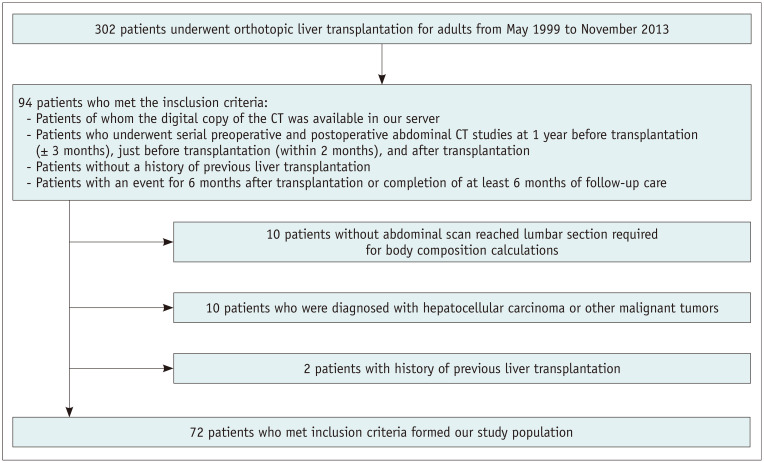
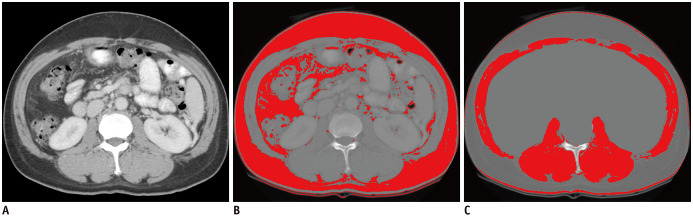
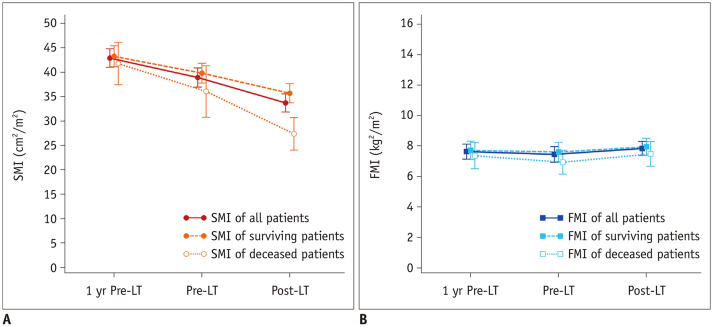
This study included 72 patients who underwent DDLT and serial computed tomography (CT) scans. Skeletal muscle index (SMI) and fat mass index (FMI) were calculated using the muscle and fat area in CT performed 1 year prior to surgery (1 yr Pre-LT), just before surgery (Pre-LT), and after transplantation (Post-LT). Simple aspects of serial changes in muscle and fat mass were analyzed during three measurement time points. The rate of preoperative changes in body composition parameters were calculated (preoperative ΔSMI [%] = [SMI at Pre-LT - SMI at 1 yr Pre-LT] / SMI at Pre-LT × 100; preoperative ΔFMI [%] = [FMI at Pre-LT - FMI at 1 yr Pre-LT] / FMI at Pre-LT × 100) and assessed for correlation with patient survival.
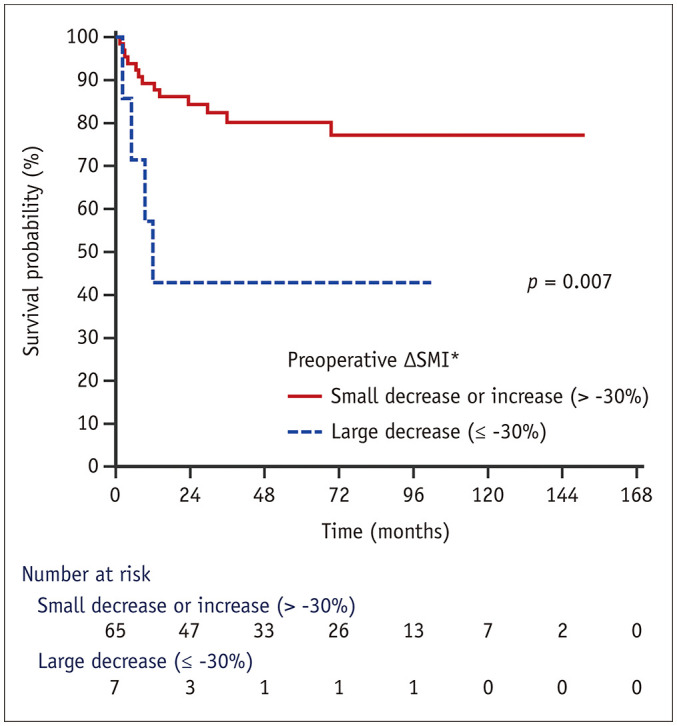
SMI significantly decreased during the preoperative period (mean preoperative ΔSMI, -13.04%, < 0.001). In the multivariable analysis, preoperative ΔSMI ( = 0.016) and model for end-stage liver disease score ( = 0.011) were independent prognostic factors for overall survival. The mean survival time for patients with a threshold decrease in the preoperative ΔSMI (≤ -30%) was significantly shorter than for other patients ( = 0.007). Preoperative ΔFMI was not a prognostic factor but FMI increased during the postoperative period ( = 0.009) in all patients.
A large reduction in preoperative SMI was significantly associated with reduced survival after DDLT. Therefore, changes in muscle mass during the preoperative period can be considered as a prognostic factor for survival after DDLT.
肝移植患者的肌肉耗竭会影响受者的预后,因此不容忽视。本研究旨在评估术前肌肉和脂肪量的变化是否与死后供肝移植(DDLT)后的预后相关。
本研究纳入了 72 例行 DDLT 并进行了连续 CT 扫描的患者。使用术前 1 年(1 yr Pre-LT)、术前(Pre-LT)和移植后(Post-LT)的 CT 肌肉和脂肪面积计算骨骼肌指数(SMI)和脂肪质量指数(FMI)。分析了三个测量时间点肌肉和脂肪量的连续变化的简单方面。计算了术前身体成分参数变化率(术前ΔSMI [%] = [Pre-LT 时的 SMI - 1 yr Pre-LT 时的 SMI] / Pre-LT 时的 SMI × 100;术前ΔFMI [%] = [Pre-LT 时的 FMI - 1 yr Pre-LT 时的 FMI] / Pre-LT 时的 FMI × 100),并评估其与患者生存的相关性。
SMI 在术前期间显著下降(平均术前ΔSMI,-13.04%,<0.001)。在多变量分析中,术前ΔSMI( = 0.016)和终末期肝病模型评分( = 0.011)是总生存率的独立预后因素。术前ΔSMI 阈值降低(≤-30%)患者的平均生存时间明显短于其他患者( = 0.007)。术前ΔFMI 不是预后因素,但所有患者的 FMI 在术后期间增加( = 0.009)。
术前 SMI 的大量减少与 DDLT 后生存时间显著缩短相关。因此,术前期间肌肉量的变化可被视为 DDLT 后生存的预后因素。