Tacey Alexander, Smith Cassandra, Woessner Mary N, Chubb Paul, Neil Christopher, Duque Gustavo, Hayes Alan, Zulli Anthony, Levinger Itamar
Institute for Health and Sport (IHES), Victoria University, Melbourne, VIC, Australia.
Australian Institute for Musculoskeletal Science (AIMSS), The University of Melbourne and Western Health, St Albans, VIC, Australia.
PLoS One. 2020 Nov 25;15(11):e0242774. doi: 10.1371/journal.pone.0242774. eCollection 2020.
There are conflicting reports on the association of undercarboxylated osteocalcin (ucOC) in cardiovascular disease development, including endothelial function and hypertension. We tested whether ucOC is related to blood pressure and endothelial function in older adults, and if ucOC directly affects endothelial-mediated vasodilation in the carotid artery of rabbits.
In older adults, ucOC, blood pressure, pulse wave velocity (PWV) and brachial artery flow-mediated dilation (BAFMD) were measured (n = 38, 26 post-menopausal women and 12 men, mean age 73 ± 0.96). The vasoactivity of the carotid artery was assessed in male New Zealand White rabbits following a four-week normal or atherogenic diet using perfusion myography. An ucOC dose response curve (0.3-45 ng/ml) was generated following incubation of the arteries for 2-hours in either normal or high glucose conditions.
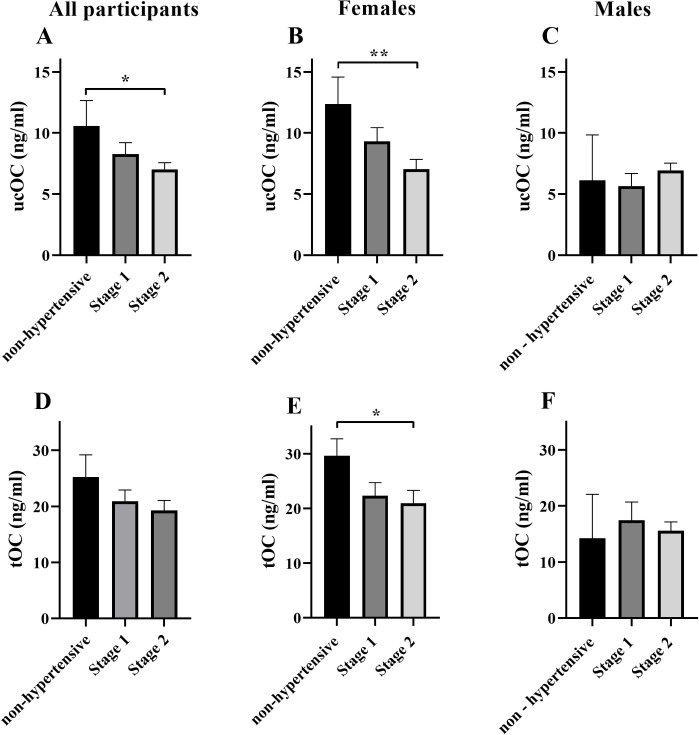
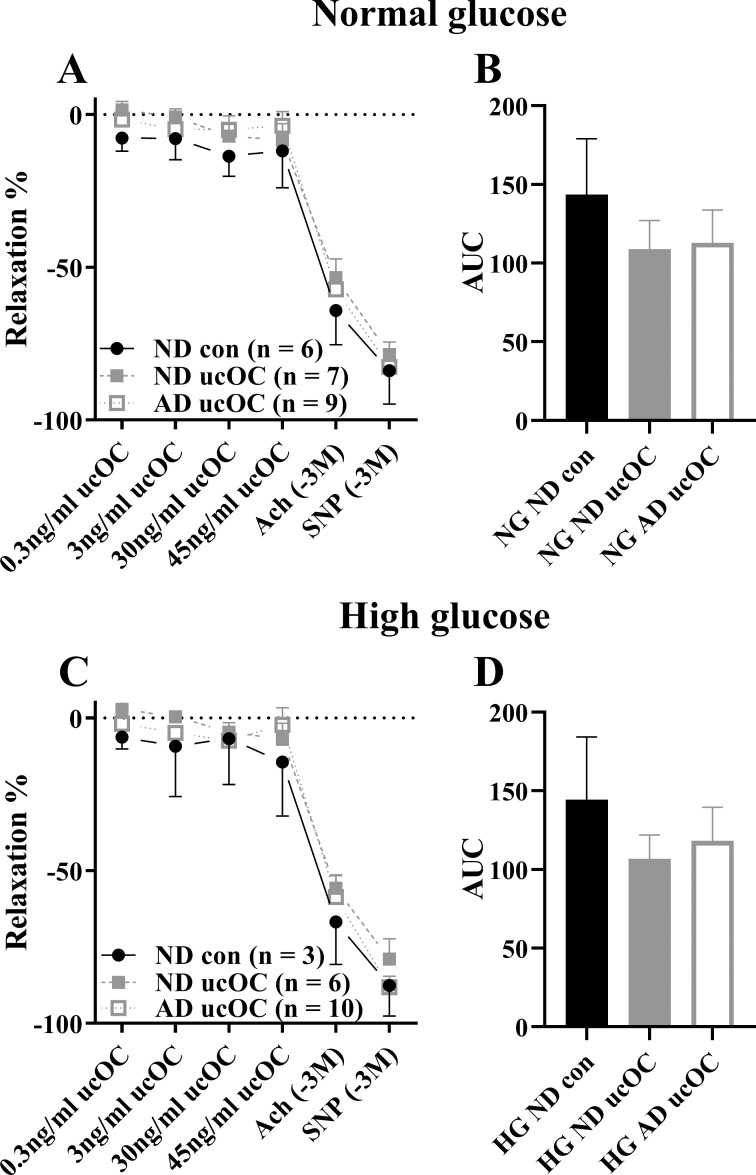
ucOC levels were higher in normotensive older adults compared to those with stage 2 hypertension (p < 0.05), particularly in women (p < 0.01). In all participants, higher ucOC was associated with lower PWV (p < 0.05), but not BAFMD (p > 0.05). In rabbits, ucOC at any dose did not alter vasoactivity of the carotid artery, either following a normal or an atherogenic diet (p > 0.05).
Increased ucOC is associated with lower blood pressure and increased arterial stiffness, particularly in post-menopausal women. However, ucOC administration has no direct short-term effect on endothelial function in rabbit arteries. Future studies should explore whether treatment with ucOC, in vivo, has direct or indirect effects on blood vessel function.
关于羧基化不足的骨钙素(ucOC)与心血管疾病发展(包括内皮功能和高血压)之间的关联,存在相互矛盾的报道。我们测试了ucOC是否与老年人的血压和内皮功能有关,以及ucOC是否直接影响兔颈动脉的内皮介导的血管舒张。
在老年人中,测量了ucOC、血压、脉搏波速度(PWV)和肱动脉血流介导的舒张功能(BAFMD)(n = 38,26名绝经后女性和12名男性,平均年龄73±0.96岁)。使用灌注肌动描记法,在雄性新西兰白兔接受四周正常或致动脉粥样硬化饮食后,评估颈动脉的血管活性。在正常或高糖条件下,将动脉孵育2小时后,生成ucOC剂量反应曲线(0.3 - 45 ng/ml)。
与2期高血压患者相比,血压正常的老年人中ucOC水平更高(p < 0.05),尤其是女性(p < 0.01)。在所有参与者中,较高的ucOC与较低的PWV相关(p < 0.05),但与BAFMD无关(p > 0.05)。在兔子中,无论接受正常饮食还是致动脉粥样硬化饮食,任何剂量的ucOC均未改变颈动脉的血管活性(p > 0.05)。
ucOC升高与血压降低和动脉僵硬度增加有关,尤其是在绝经后女性中。然而,给予ucOC对兔动脉的内皮功能没有直接的短期影响。未来的研究应探讨在体内用ucOC治疗是否对血管功能有直接或间接影响。