Biotechnology Research Institute, The Chinese Academy of Agricultural Sciences, Beijing, People's Republic of China.
Southwest Center for Natural Products Research, University of Arizona, Tucson, Arizona, USA.
mSphere. 2020 Nov 25;5(6):e00949-20. doi: 10.1128/mSphere.00949-20.
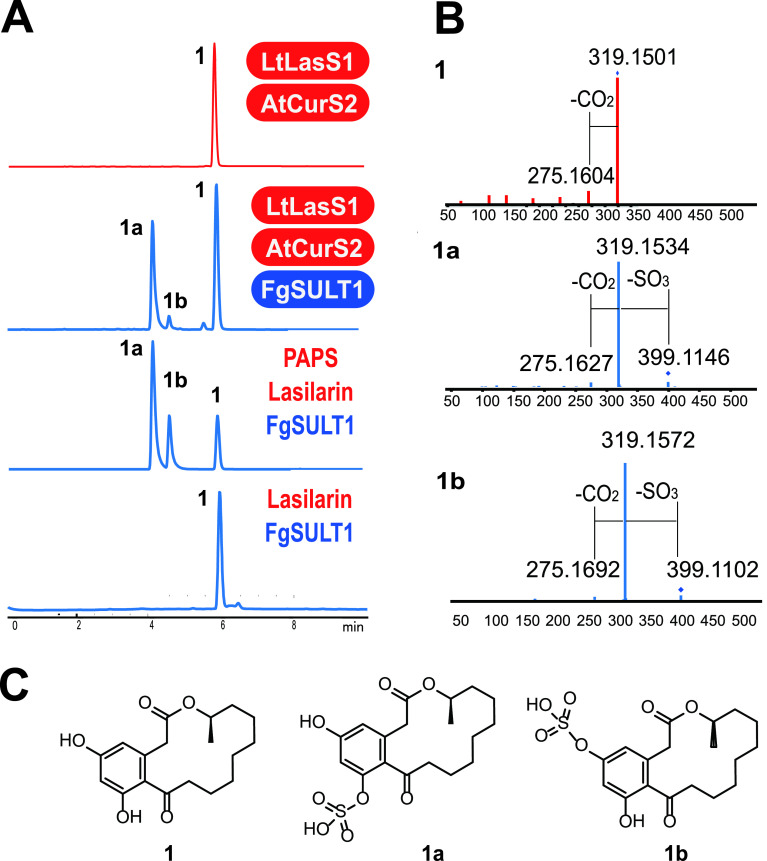
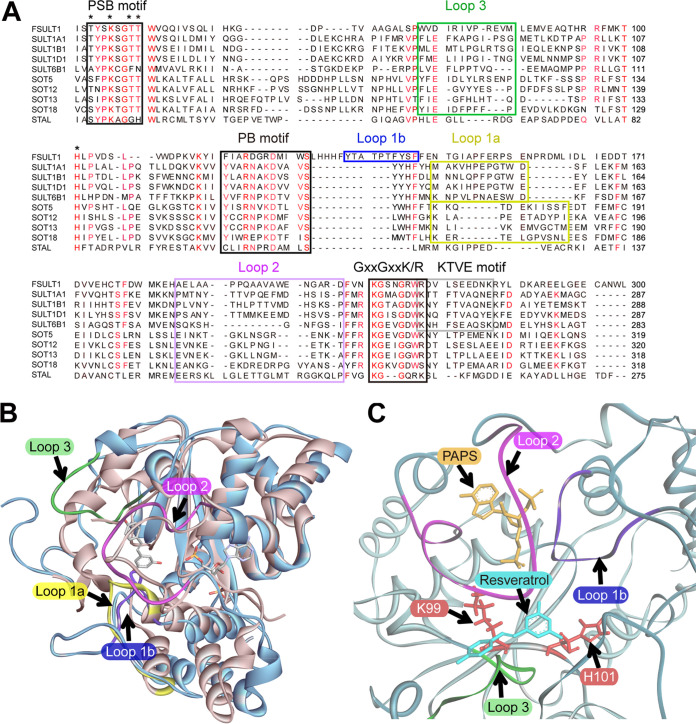
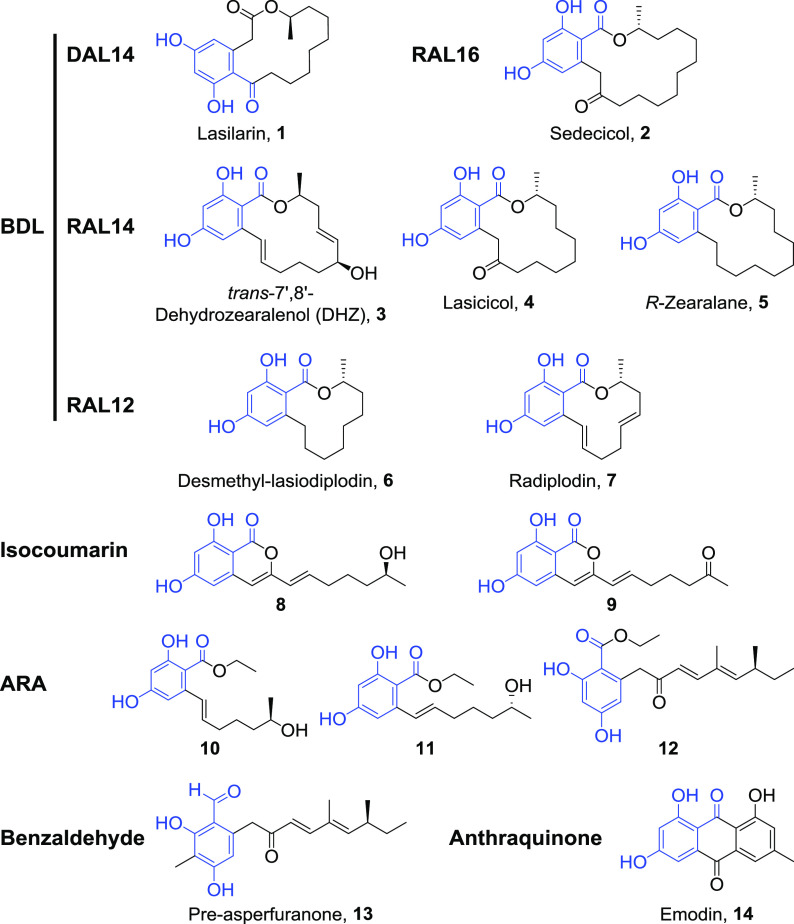
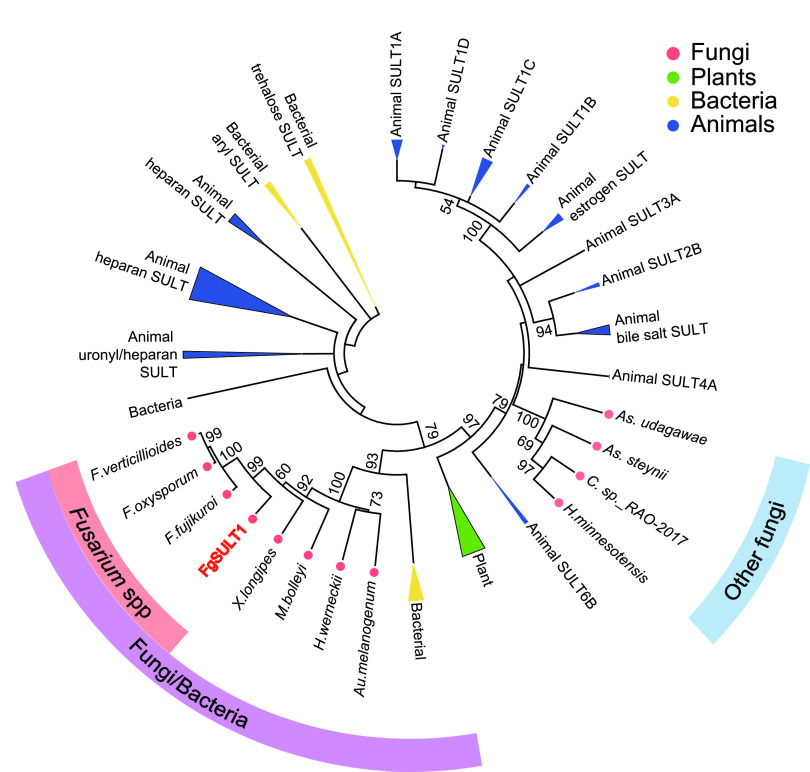
Total biosynthesis or whole-cell biocatalytic production of sulfated small molecules relies on the discovery and implementation of appropriate sulfotransferase enzymes. Although fungi are prominent biocatalysts and have been used to sulfate drug-like phenolics, no gene encoding a sulfotransferase enzyme has been functionally characterized from these organisms. Here, we identify a phenolic sulfotransferase, FgSULT1, by genome mining from the plant-pathogenic fungus PH-1. We expressed FgSULT1 in a chassis to modify a broad range of benzenediol lactones and their nonmacrocyclic congeners, together with an anthraquinone, with the resulting unnatural natural product (uNP) sulfates displaying increased solubility. FgSULT1 shares low similarity with known animal and plant sulfotransferases. Instead, it forms a sulfotransferase family with putative bacterial and fungal enzymes for phase II detoxification of xenobiotics and allelochemicals. Among fungi, putative FgSULT1 homologues are encoded in the genomes of spp. and a few other genera in nonsyntenic regions, some of which may be related to catabolic sulfur recycling. Computational structure modeling combined with site-directed mutagenesis revealed that FgSULT1 retains the key catalytic residues and the typical fold of characterized animal and plant sulfotransferases. Our work opens the way for the discovery of hitherto unknown fungal sulfotransferases and provides a synthetic biological and enzymatic platform that can be adapted to produce bioactive sulfates, together with sulfate ester standards and probes for masked mycotoxins, precarcinogenic toxins, and xenobiotics. Sulfation is an expedient strategy to increase the solubility, bioavailability, and bioactivity of nutraceuticals and clinically important drugs. However, chemical or biological synthesis of sulfoconjugates is challenging. Genome mining, heterologous expression, homology structural modeling, and site-directed mutagenesis identified FgSULT1 of PH-1 as a cytosolic sulfotransferase with the typical fold and active site architecture of characterized animal and plant sulfotransferases, despite low sequence similarity. FgSULT1 homologues are sparse in fungi but form a distinct clade with bacterial sulfotransferases. This study extends the functionally characterized sulfotransferase superfamily to the kingdom Fungi and demonstrates total biosynthetic and biocatalytic synthetic biological platforms to produce unnatural natural product (uNP) sulfoconjugates. Such uNP sulfates may be utilized for drug discovery in human and veterinary medicine and crop protection. Our synthetic biological methods may also be adapted to generate masked mycotoxin standards for food safety and environmental monitoring applications and to expose precarcinogenic xenobiotics.
小分子的全合成或全细胞生物催化生产依赖于合适的磺基转移酶的发现和应用。虽然真菌是突出的生物催化剂,并已被用于硫酸化类似药物的酚类化合物,但从这些生物体中尚未鉴定出编码磺基转移酶的基因。在这里,我们通过从植物病原菌 PH-1 中进行基因组挖掘,鉴定出一种酚类磺基转移酶 FgSULT1。我们在底盘中表达 FgSULT1,以修饰广泛的苯二醇内酯及其非大环同系物,以及蒽醌,所得非天然天然产物 (uNP) 硫酸盐的溶解度增加。FgSULT1 与已知的动物和植物磺基转移酶相似度低。相反,它与假定的细菌和真菌磺基转移酶一起形成磺基转移酶家族,用于外源性化学物质和化感物质的二期解毒。在真菌中,假定的 FgSULT1 同源物编码在 spp.和其他几个属的基因组中,位于非同源区域,其中一些可能与代谢性硫循环有关。计算结构建模结合定点突变揭示了 FgSULT1 保留了关键的催化残基和特征化的动物和植物磺基转移酶的典型折叠。我们的工作为发现迄今未知的真菌磺基转移酶开辟了道路,并提供了一个合成生物学和酶学平台,可用于生产生物活性硫酸盐,以及硫酸盐酯标准品和用于掩蔽霉菌毒素、前致癌毒素和外源性化学物质的探针。磺化是提高营养保健品和临床上重要药物的溶解度、生物利用度和生物活性的便捷策略。然而,磺化共轭物的化学或生物合成具有挑战性。基因组挖掘、异源表达、同源结构建模和定点突变鉴定了 PH-1 的 FgSULT1 是一种胞质磺基转移酶,具有特征化的动物和植物磺基转移酶的典型折叠和活性位点结构,尽管序列相似性低。真菌中的 FgSULT1 同源物很少,但与细菌磺基转移酶形成一个独特的分支。这项研究将功能表征的磺基转移酶超家族扩展到真菌王国,并展示了全生物合成和生物催化合成生物学平台来生产非天然天然产物 (uNP) 磺酸盐。这种 uNP 硫酸盐可能用于人类和兽医医学和作物保护的药物发现。我们的合成生物学方法也可以适应生成用于食品安全和环境监测应用的掩蔽霉菌毒素标准品,并暴露前致癌的外源性化学物质。