Zhang Jingyu, Zhang Kai, Jia Baixue, Qi Zhongqi, Mo Dapeng, Ma Ning, Gao Feng, Miao Zhongrong
Interventional Neuroradiology Center, Beijing Tiantan Hospital, Capital Medical University, Beijing, China.
Front Neurol. 2020 Nov 6;11:574926. doi: 10.3389/fneur.2020.574926. eCollection 2020.
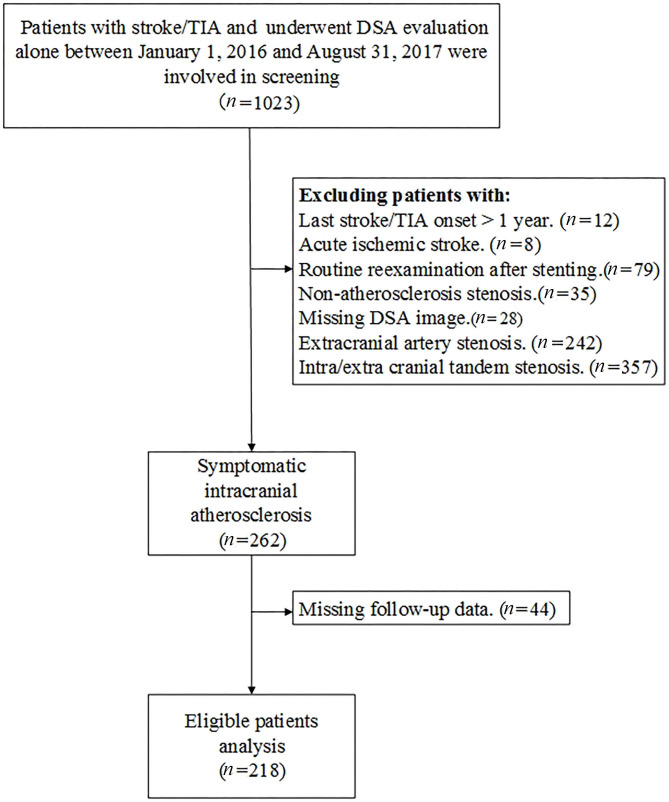
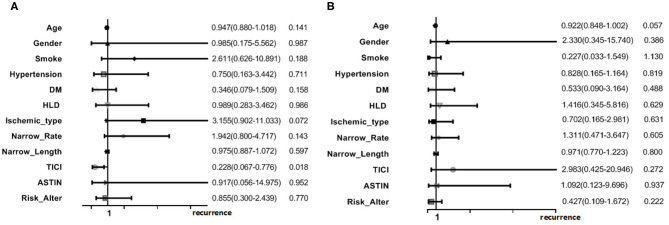
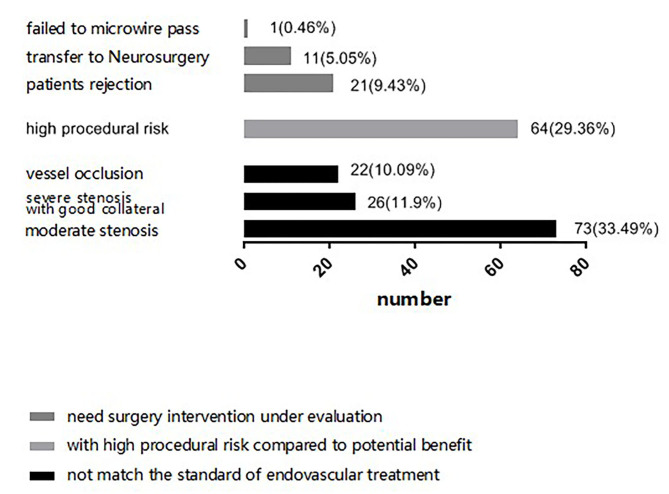
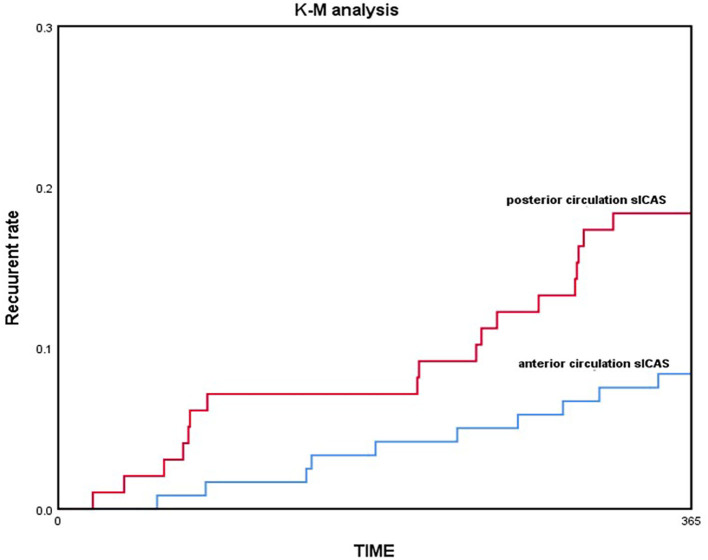
Intracranial atherosclerotic stenosis (ICAS) is an important cause of ischemic stroke. In Asians, intracranial atherosclerotic disease leads to 33-50% of ischemic events. At present, treatment with medication vs. endovascular therapy (EVT) for symptomatic ICAS (sICAS) patients is still debatable. The clinical prognosis of patients who are not completely free of stroke symptoms despite regular medication and are not eligible for EVT for various reasons, is not yet investigated. To report the long-term recurrence rate of stroke in a cohort of symptomatic ICAS patients who intended to undergo EVT upon admission but could not for various reasons after digital subtraction angiography (DSA) evaluation. This is a retrospective analysis of consecutive sICAS patients in a single center from January 1, 2016 to August 31, 2017 who underwent DSA assessment alone and were not eligible for further EVT. Demographic information, risk factors related to cerebrovascular disease, clinical comorbidities, medication, imaging data, and long-term outcomes were reported. A total of 218 patients were included in the study; 42 (19.2%) patients had recurrence of stroke/transient ischemic attack (TIA) at the 1-year follow up. Patients were divided into two groups according to lesions in anterior circulation ( = 120) or posterior circulation ( = 98). There was a higher stroke/TIA recurrence rate in the posterior circulation than anterior circulation group (25.5 vs. 14.2%, = 0.035). Given the advanced age, higher prevalence of coronary heart disease, larger stenosis length, and poorer collateral circulation, the posterior circulation group showed a higher risk of recurrent stroke/TIA and death than the anterior circulation group [HR = 3.092, 95% CI (1.335-7.164), = 0.0084], after adjusting for all confounding factors in the COX regression model. Kaplan-Meier analysis showed that sICAS recurrence and mortality risk in the posterior circulation group was consistently higher than that in the anterior circulation group (log-rank-test, = 0.033). Patients with posterior circulation sICAS have higher recurrence risk than those with anterior circulation managed with medication alone. Further, posterior circulation lesion is an independent risk factor for recurrence in sICAS patients.
颅内动脉粥样硬化性狭窄(ICAS)是缺血性卒中的重要病因。在亚洲人中,颅内动脉粥样硬化性疾病导致33%-50%的缺血性事件。目前,对于症状性ICAS(sICAS)患者,药物治疗与血管内治疗(EVT)相比仍存在争议。对于那些尽管规律服药但仍未完全摆脱卒中症状且因各种原因不符合EVT治疗条件的患者,其临床预后尚未得到研究。本研究旨在报告一组症状性ICAS患者的长期卒中复发率,这些患者入院时打算接受EVT,但在数字减影血管造影(DSA)评估后因各种原因未能进行。这是一项对2016年1月1日至2017年8月31日在单一中心连续收治的sICAS患者进行的回顾性分析,这些患者仅接受了DSA评估且不符合进一步EVT治疗条件。报告了患者的人口统计学信息、与脑血管疾病相关的危险因素、临床合并症、用药情况、影像学数据以及长期预后。本研究共纳入218例患者;在1年随访时,42例(19.2%)患者发生了卒中/短暂性脑缺血发作(TIA)复发。根据前循环(n = 120)或后循环(n = 98)病变将患者分为两组。后循环组的卒中/TIA复发率高于前循环组(25.5%对14.2%,P = 0.035)。考虑到年龄较大、冠心病患病率较高、狭窄长度较长以及侧支循环较差,在COX回归模型中校正所有混杂因素后,后循环组的复发性卒中/TIA和死亡风险高于前循环组[HR = 3.092,95%CI(1.335-7.164),P = 0.0084]。Kaplan-Meier分析显示,后循环组的sICAS复发和死亡风险始终高于前循环组(对数秩检验,P = 0.033)。后循环sICAS患者的复发风险高于仅接受药物治疗的前循环患者。此外,后循环病变是sICAS患者复发的独立危险因素。