Xing Yulin, Kong Xiangdong, Guo Xu, Liu Yan, Li Qiuyao, Zhang Yuzhe, Sheng Yelin, Yang Xupeng, Geng Zhigang, Zeng Jie
Hefei National Laboratory for Physical Sciences at the Microscale CAS Key Laboratory of Strongly-Coupled Quantum Matter Physics Key Laboratory of Surface and Interface Chemistry and Energy Catalysis of Anhui Higher Education Institutes Department of Chemical Physics University of Science and Technology of China Hefei Anhui 230026 P. R. China.
Adv Sci (Weinh). 2020 Oct 1;7(22):1902989. doi: 10.1002/advs.201902989. eCollection 2020 Nov.
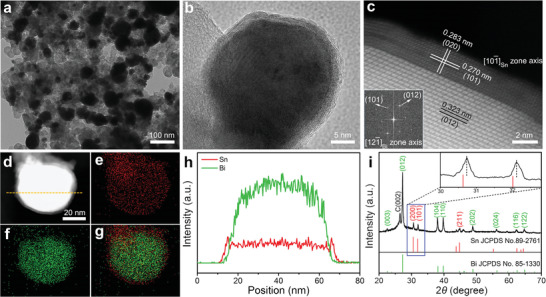
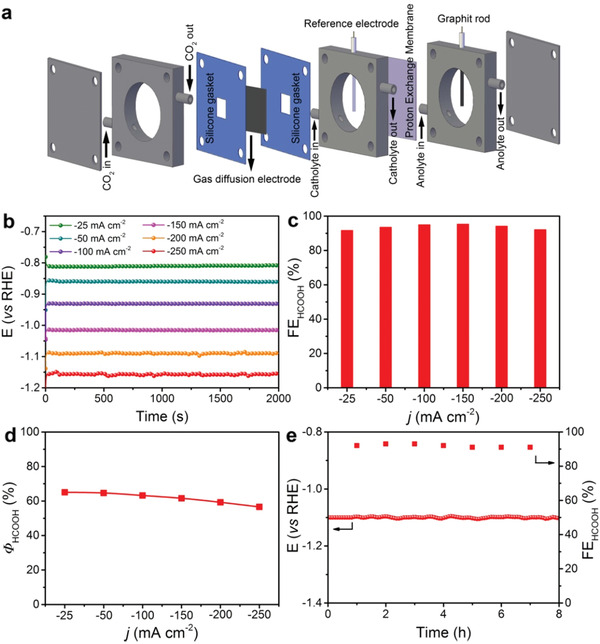
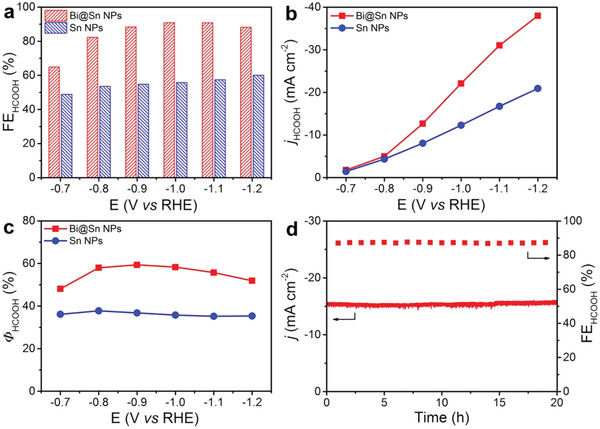
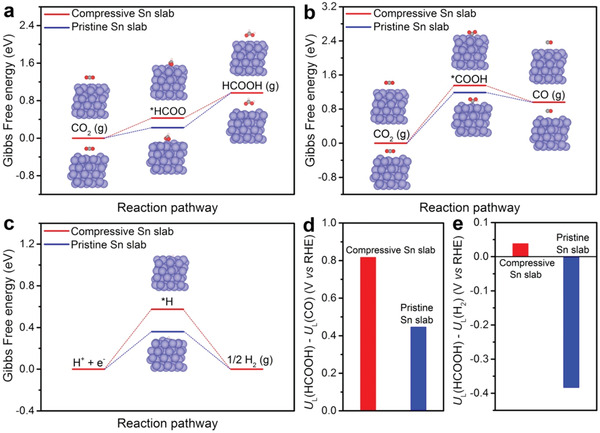
As a profitable product from CO electroreduction, HCOOH holds economic viability only when the selectivity is higher than 90% with current density () over -200.0 mA cm. Herein, Bi@Sn core-shell nanoparticles (Bi core and Sn shell, denoted as Bi@Sn NPs) are developed to boost the activity and selectivity of CO electroreduction into HCOOH. In an H-cell system with 0.5 m KHCO as electrolyte, Bi@Sn NPs exhibit a Faradaic efficiency for HCOOH (FE) of 91% with partial for HCOOH ( ) of -31.0 mA cm at -1.1 V versus reversible hydrogen electrode. The potential application of Bi@Sn NPs is testified via chronopotentiometric measurements in the flow-cell system with 2.0 m KHCO electrolyte. Under this circumstance, Bi@Sn NPs achieve an FE of 92% with an energy efficiency of 56% at steady-state of -250.0 mA cm. Theoretical studies indicate that the energy barrier of the potential-limiting step for the formation of HCOOH is decreased owing to the compressive strain in the Sn shell, resulting in the enhanced catalytic performance.
作为CO电还原的一种盈利性产物,只有当选择性高于90%且电流密度()超过-200.0 mA cm时,HCOOH才具有经济可行性。在此,开发了Bi@Sn核壳纳米颗粒(Bi核和Sn壳,记为Bi@Sn NPs)以提高CO电还原为HCOOH的活性和选择性。在以0.5 m KHCO为电解质的H型电池系统中,Bi@Sn NPs在相对于可逆氢电极-1.1 V时,对HCOOH的法拉第效率(FE)为91%,HCOOH的部分电流密度()为-31.0 mA cm。通过在以2.0 m KHCO为电解质的流动电池系统中进行计时电位测量,证实了Bi@Sn NPs的潜在应用。在这种情况下,Bi@Sn NPs在稳态电流密度为-250.0 mA cm时实现了92%的FE和56%的能量效率。理论研究表明,由于Sn壳中的压缩应变,形成HCOOH的电位限制步骤的能垒降低,从而提高了催化性能。