Department of Biochemistry, BioFrontiers Institute, University of Colorado Boulder, Boulder, CO, USA.
Howard Hughes Medical Institute, University of Colorado Boulder, Boulder, CO, USA.
Mol Oncol. 2020 Oct;14(10):2358-2374. doi: 10.1002/1878-0261.12786. Epub 2020 Sep 11.
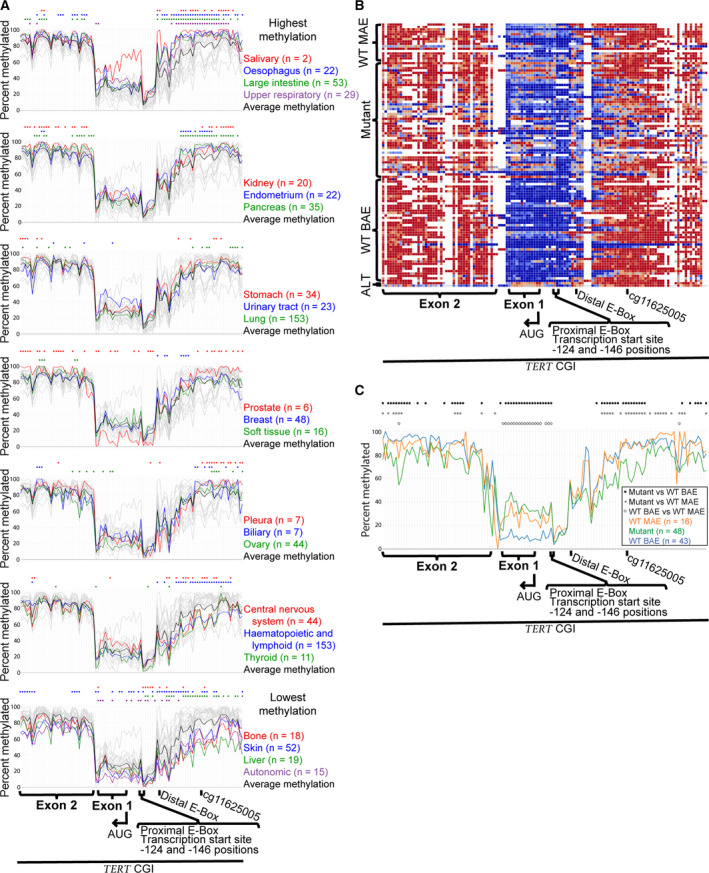
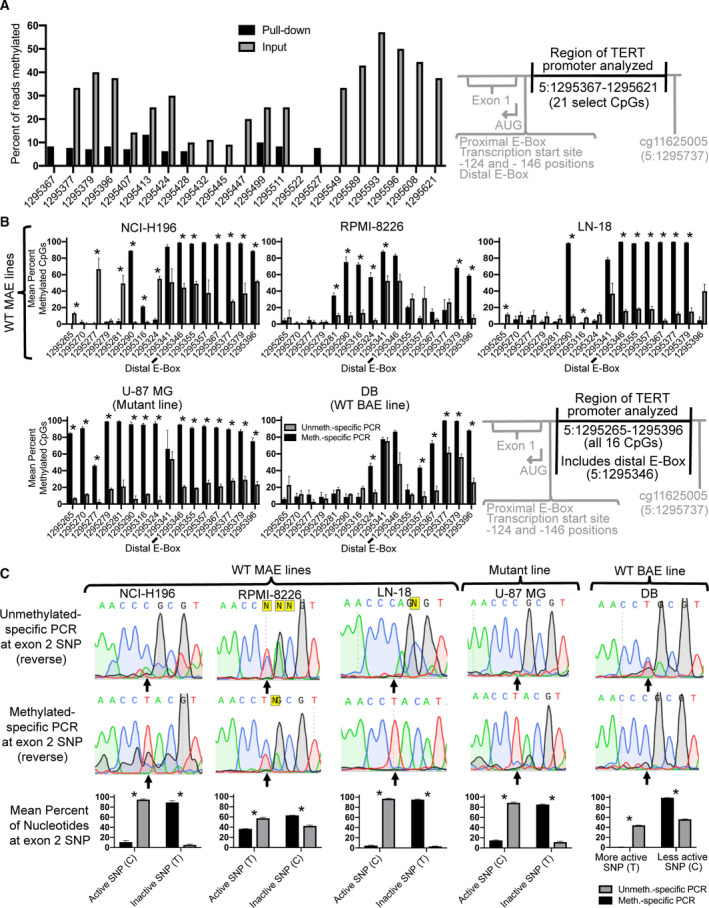
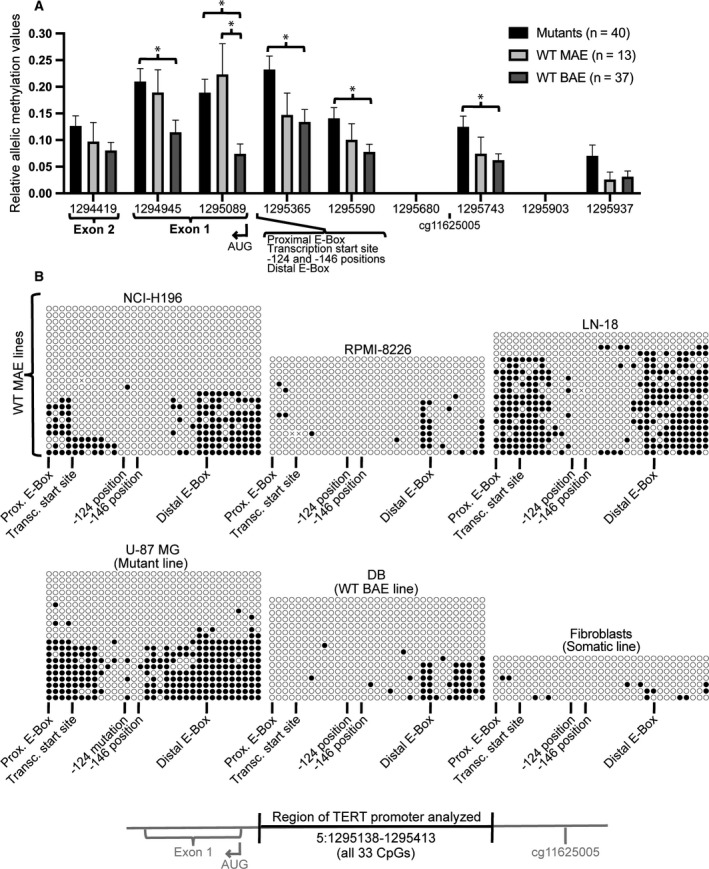
Telomerase reverse transcriptase (TERT) is pathologically expressed in the vast majority of human cancers, but the epigenetic regulation of its expression is only beginning to be understood. In particular, the active TERT gene in cancer cells has been characterized as having a hypermethylated CpG island, opposite to the general association of DNA methylation with gene repression. Here, we analyzed TERT promoter CpG methylation in 833 human cancer cell lines representing 23 different tissue types and found hypermethylation of the upstream portion of the CpG island and more conserved hypomethylation of a region including the proximal TERT promoter and exon 1. In cell lines with monoallelic expression of TERT, we found allelic methylation of the proximal TERT promoter. This included cell lines with the -124 or -146 activating promoter mutation as well as wild-type TERT cancer lines. In these cell line types, decreased proximal promoter methylation is associated with the active allele. Compared to cells with monoallelic expression of TERT, lines with biallelic expression of TERT had even lower methylation in the proximal TERT promoter. Thus, in cell lines from cancers of many different tissues, the TERT proximal promoter has canonical DNA methylation, with low methylation correlating with increased TERT expression.
端粒酶逆转录酶(TERT)在绝大多数人类癌症中病理性表达,但对其表达的表观遗传调控才刚刚开始被理解。特别是,癌细胞中活跃的 TERT 基因已被表征为具有超甲基化的 CpG 岛,与 DNA 甲基化与基因抑制的一般关联相反。在这里,我们分析了 833 个人类癌细胞系,代表 23 种不同的组织类型,发现 CpG 岛的上游部分存在高甲基化,而包括近端 TERT 启动子和外显子 1 在内的区域则保持更保守的低甲基化。在 TERT 单等位基因表达的细胞系中,我们发现近端 TERT 启动子存在等位基因甲基化。这包括具有-124 或-146 激活启动子突变的细胞系以及野生型 TERT 癌症细胞系。在这些细胞系类型中,近端启动子甲基化减少与活性等位基因相关。与 TERT 单等位基因表达的细胞相比,具有 TERT 双等位基因表达的细胞系中近端 TERT 启动子的甲基化程度更低。因此,在来自许多不同组织的癌症细胞系中,TERT 近端启动子具有典型的 DNA 甲基化,低甲基化与 TERT 表达增加相关。