Department of Anesthesiology and Critical Care Medicine, Peking University First Hospital, No. 8 Xishiku Street, Beijing, 100034, China.
Key Laboratory of Carcinogenesis and Translational Research (Ministry of Education/Beijing), Department of Anesthesiology, Peking University Cancer Hospital & Institute, Beijing, 100142, China.
BMC Anesthesiol. 2020 Nov 30;20(1):294. doi: 10.1186/s12871-020-01212-6.
Preoperative intravenous rehydration for patients with pheochromocytomas and paragangliomas (PPGLs) is widely used in many medical centers, but its usefulness has not been well evaluated. The objective of this study was to compare the perioperative hemodynamics and early outcome between patients who received preoperative intravenous rehydration and those without for resection of PPGLs.
In this retrospective propensity score-matched cohort study, the data of patients who underwent surgery for PPGLs were collected. Patients were divided into two groups depending on whether they received or did not receive intravenous rehydration preoperatively. The primary endpoint was intraoperative hypotension, described as the cumulative time of mean arterial pressure < 65 mmHg averaged by surgery duration.
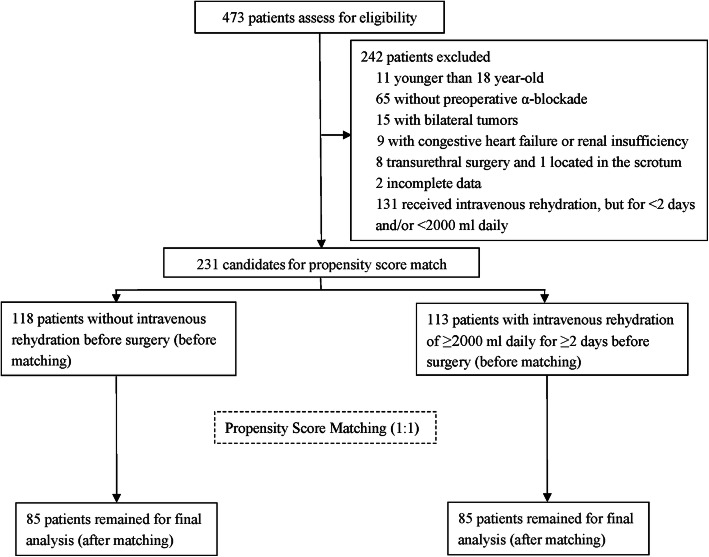
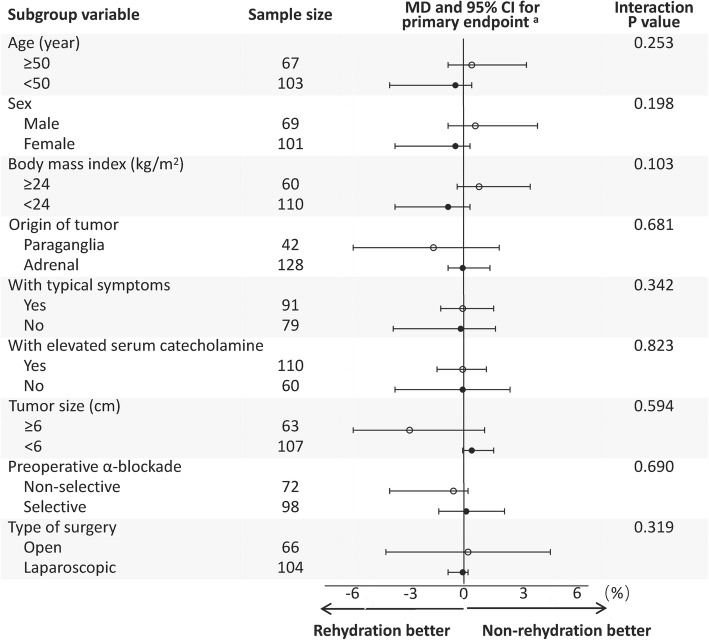
Among 231 enrolled patients, 113 patients received intravenous rehydration of ≥2000 ml daily for ≥2 days before surgery and 118 patients who did not have any intravenous rehydration before surgery. After propensity score matching, 85 patients remained in each group. The median cumulative time of mean arterial pressure < 65 mmHg averaged by surgery duration was not significantly different between rehydrated patients and non-rehydrated patients (median 3.0% [interquartile range 0.2-12.2] versus 3.8% [0.0-14.2], median difference 0.0, 95%CI - 1.2 to 0.8, p = 0.909). The total dose of catecholamines given intraoperatively, volume of intraoperative fluids, intraoperative tachycardia and hypertension, percentage of patients who suffered from postoperative hypotension, postoperative diuretics use, and postoperative early outcome between the two groups were not significantly different either.
For patients with PPGLs, preoperative intravenous rehydration failed to optimize perioperative hemodynamics or improve early outcome.
在许多医疗中心,术前静脉补液被广泛用于治疗嗜铬细胞瘤和副神经节瘤(PPGLs)患者,但它的有效性尚未得到很好的评估。本研究的目的是比较接受和不接受术前静脉补液的 PPGLs 切除患者的围手术期血液动力学和早期结果。
在这项回顾性倾向评分匹配队列研究中,收集了接受 PPGLs 手术治疗的患者数据。根据患者是否接受术前静脉补液,将其分为两组。主要终点是术中低血压,定义为平均动脉压<65mmHg 的累计时间,平均手术时间。
在纳入的 231 例患者中,113 例患者在术前至少 2 天每天接受≥2000ml 的静脉补液,118 例患者术前未接受任何静脉补液。经倾向评分匹配后,每组各有 85 例患者。术中平均动脉压<65mmHg 的累计时间,补液组与非补液组无显著差异(中位数 3.0%[四分位距 0.2-12.2]与 3.8%[0.0-14.2],中位数差值 0.0,95%CI-1.2 至 0.8,p=0.909)。术中给予的儿茶酚胺总量、术中液体量、术中心动过速和高血压、术后低血压患者比例、术后利尿剂使用以及两组患者术后早期结果也无显著差异。
对于 PPGLs 患者,术前静脉补液并不能优化围手术期血液动力学或改善早期结果。