
丙泊酚、芬太尼和咪达唑仑对中重度创伤性脑损伤的脑血管反应:对人类和动物文献的范围界定性系统评价
Cerebrovascular Response to Propofol, Fentanyl, and Midazolam in Moderate/Severe Traumatic Brain Injury: A Scoping Systematic Review of the Human and Animal Literature.
作者信息
Froese Logan, Dian Joshua, Batson Carleen, Gomez Alwyn, Unger Bertram, Zeiler Frederick A
机构信息
Biomedical Engineering, Faculty of Engineering, University of Manitoba, Winnipeg, Manitoba, Canada.
Section of Neurosurgery, Department of Surgery, Department of Medicine, Rady Faculty of Health Sciences, University of Manitoba, Winnipeg, Manitoba, Canada.
出版信息
Neurotrauma Rep. 2020 Oct 13;1(1):100-112. doi: 10.1089/neur.2020.0040. eCollection 2020.
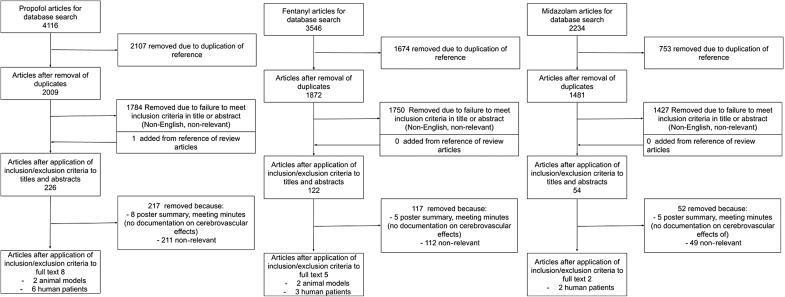
Intravenous propofol, fentanyl, and midazolam are utilized commonly in critical care for metabolic suppression and anesthesia. The impact of propofol, fentanyl, and midazolam on cerebrovasculature and cerebral blood flow (CBF) is unclear in traumatic brain injury (TBI) and may carry important implications, as care is shifting to focus on cerebrovascular reactivity monitoring/directed therapies. The aim of this study was to perform a scoping review of the literature on the cerebrovascular/CBF effects of propofol, fentanyl, and midazolam in human patients with moderate/severe TBI and animal models with TBI. A search of MEDLINE, BIOSIS, EMBASE, Global Health, SCOPUS, and the Cochrane Library from inception to May 2020 was performed. All articles were included pertaining to the administration of propofol, fentanyl, and midazolam, in which the impact on CBF/cerebral vasculature was recorded. We identified 14 studies: 8 that evaluated propofol, 5 that evaluated fentanyl, and 2 that evaluated midazolam. All studies suffered from significant limitations, including: small sample size, and heterogeneous design and measurement techniques. In general, there was no significant change seen in CBF/cerebrovascular response to administration of propofol, fentanyl, or midazolam during experiments where PCO and mean arterial pressure (MAP) were controlled. This review highlights the current knowledge gap surrounding the impact of commonly utilized sedative drugs in TBI care. This work supports the need for dedicated studies, both experimental and human-based, evaluating the impact of these drugs on CBF and cerebrovascular reactivity/response in TBI.
静脉注射丙泊酚、芬太尼和咪达唑仑常用于重症监护中以实现代谢抑制和麻醉。在创伤性脑损伤(TBI)中,丙泊酚、芬太尼和咪达唑仑对脑血管和脑血流量(CBF)的影响尚不清楚,这可能具有重要意义,因为目前的治疗正转向关注脑血管反应性监测/定向治疗。本研究的目的是对关于丙泊酚、芬太尼和咪达唑仑对中度/重度TBI人类患者和TBI动物模型的脑血管/CBF影响的文献进行范围综述。检索了MEDLINE、BIOSIS、EMBASE、Global Health、SCOPUS和Cochrane图书馆,检索时间从数据库建立至2020年5月。纳入了所有与丙泊酚、芬太尼和咪达唑仑给药相关且记录了对CBF/脑血管影响的文章。我们识别出14项研究:8项评估丙泊酚,5项评估芬太尼,2项评估咪达唑仑。所有研究都存在显著局限性,包括:样本量小,以及设计和测量技术的异质性。总体而言,在控制了PCO和平均动脉压(MAP)的实验中,给予丙泊酚、芬太尼或咪达唑仑后,CBF/脑血管反应未见显著变化。本综述突出了目前在TBI治疗中常用镇静药物影响方面的知识空白。这项工作支持开展专门的研究,包括实验研究和基于人体的研究,以评估这些药物对TBI中CBF和脑血管反应性/反应的影响。
 Zotero 插件