Department of Chemical Engineering, Indian Institute of Science, Bengaluru, India.
Centre for Biosystems Science and Engineering, Indian Institute of Science, Bengaluru, India.
PLoS Comput Biol. 2020 Nov 30;16(11):e1008434. doi: 10.1371/journal.pcbi.1008434. eCollection 2020 Nov.
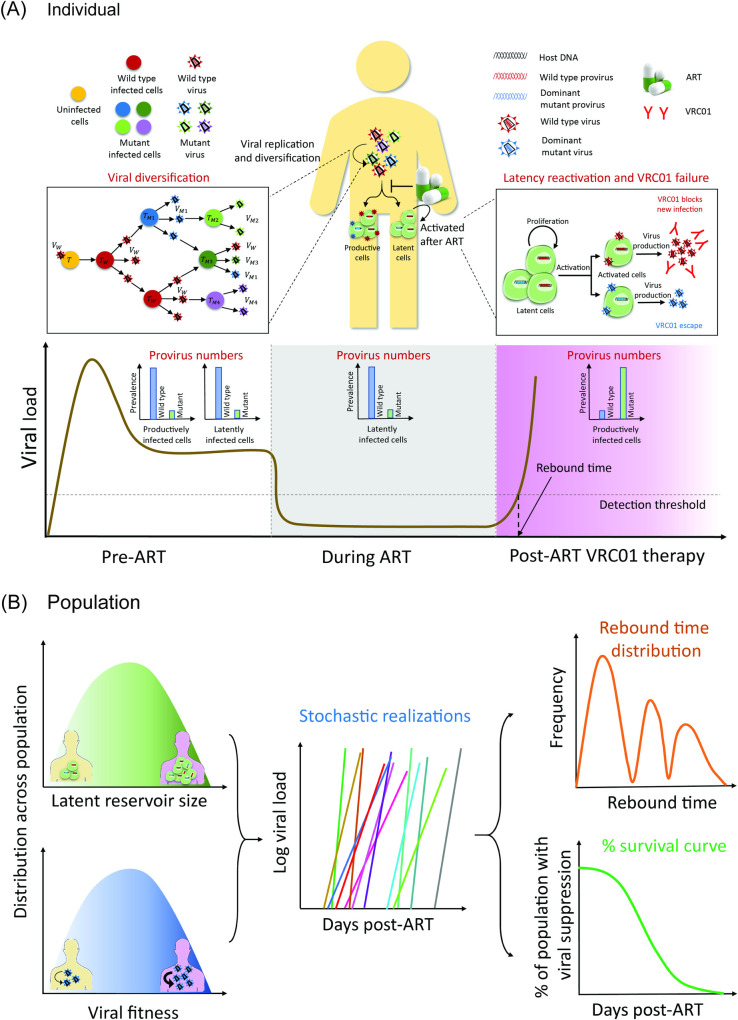
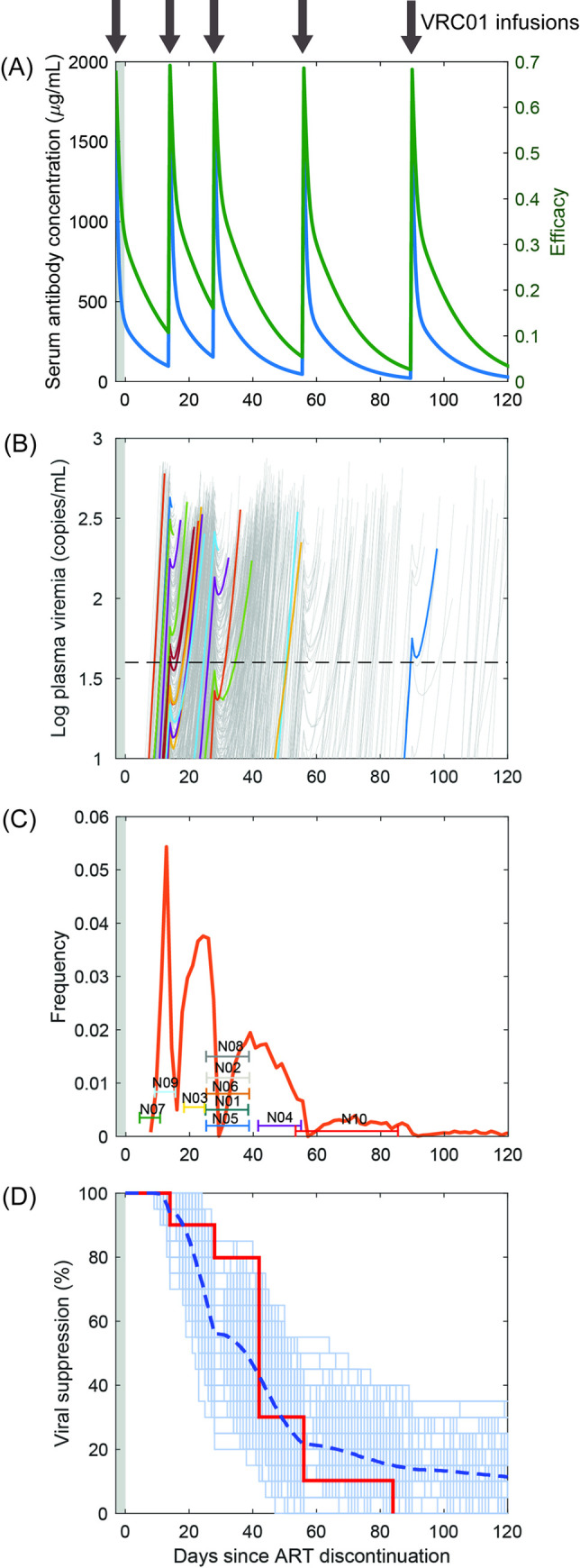
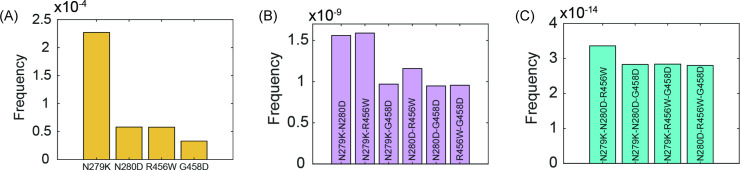
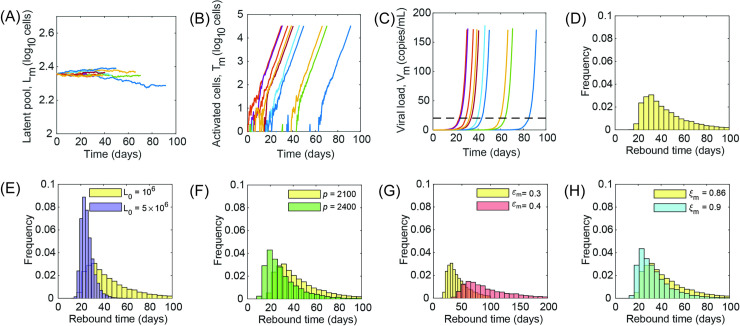
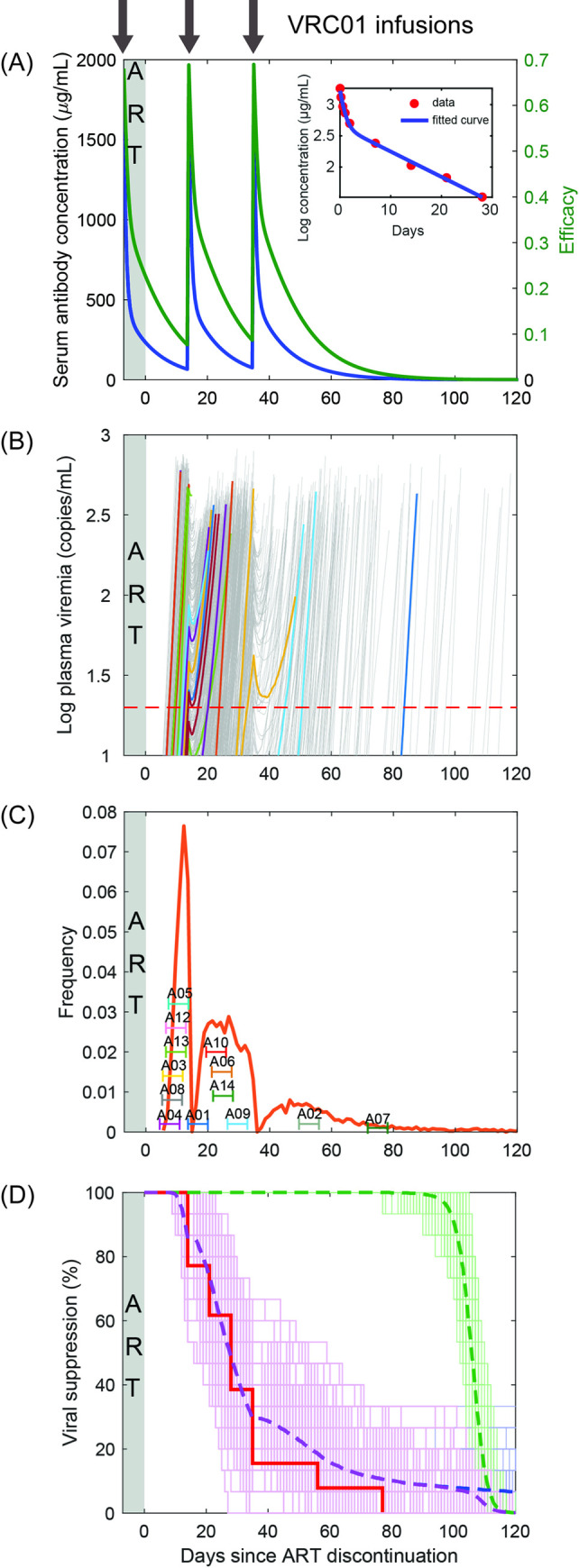
Passive immunization with broadly neutralizing antibodies (bNAbs) of HIV-1 appears a promising strategy for eliciting long-term HIV-1 remission. When administered concomitantly with the cessation of antiretroviral therapy (ART) to patients with established viremic control, bNAb therapy is expected to prolong remission. Surprisingly, in clinical trials on chronic HIV-1 patients, the bNAb VRC01 failed to prolong remission substantially. Identifying the cause of this failure is important for improving VRC01-based therapies and unraveling potential vulnerabilities of other bNAbs. In the trials, viremia resurged rapidly in most patients despite suppressive VRC01 concentrations in circulation, suggesting that VRC01 resistance was the likely cause of failure. ART swiftly halts viral replication, precluding the development of resistance during ART. If resistance were to emerge post ART, virological breakthrough would have taken longer than without VRC01 therapy. We hypothesized therefore that VRC01-resistant strains must have been formed before ART initiation, survived ART in latently infected cells, and been activated during VRC01 therapy, causing treatment failure. Current assays preclude testing this hypothesis experimentally. We developed a mathematical model based on the hypothesis and challenged it with available clinical data. The model integrated within-host HIV-1 evolution, stochastic latency reactivation, and viral dynamics with multiple-dose VRC01 pharmacokinetics. The model predicted that single but not higher VRC01-resistant mutants would pre-exist in the latent reservoir. We constructed a virtual patient population that parsimoniously recapitulated inter-patient variations. Model predictions with this population quantitatively captured data of VRC01 failure from clinical trials, presenting strong evidence supporting the hypothesis. We attributed VRC01 failure to single-mutant VRC01-resistant proviruses in the latent reservoir triggering viral recrudescence, particularly when VRC01 was at trough levels. Pre-existing resistant proviruses in the latent reservoir may similarly compromise other bNAbs. Our study provides a framework for designing bNAb-based therapeutic protocols that would avert such failure and maximize HIV-1 remission.
被动免疫接种 HIV-1 的广谱中和抗体(bNAb)似乎是一种很有前途的策略,可以诱导 HIV-1 的长期缓解。当与已建立的病毒血症控制患者的抗逆转录病毒治疗(ART)同时停止时,bNAb 治疗有望延长缓解期。令人惊讶的是,在慢性 HIV-1 患者的临床试验中,bNAb VRC01 并没有显著延长缓解期。确定这种失败的原因对于改进基于 VRC01 的治疗方法和揭示其他 bNAb 的潜在弱点非常重要。在这些试验中,尽管循环中的 VRC01 浓度具有抑制作用,但大多数患者的病毒血症迅速反弹,这表明 VRC01 耐药性可能是失败的原因。ART 迅速阻止病毒复制,在 ART 期间阻止耐药性的发展。如果在 ART 后出现耐药性,病毒学突破将需要比没有 VRC01 治疗更长的时间。因此,我们假设在 ART 开始之前,必须已经形成了 VRC01 耐药株,在潜伏感染细胞中存活下来,并在 VRC01 治疗期间被激活,从而导致治疗失败。目前的检测方法排除了对该假设进行实验测试的可能性。我们根据该假设建立了一个数学模型,并利用可用的临床数据对其进行了检验。该模型将 HIV-1 在体内的进化、随机潜伏再激活和病毒动力学与多次剂量 VRC01 药代动力学相结合。该模型预测,只有单个但不是更高的 VRC01 耐药突变体将预先存在于潜伏库中。我们构建了一个虚拟患者群体,该群体能够简洁地再现患者间的变异。该群体的模型预测定量捕捉了临床试验中 VRC01 失败的数据,为该假设提供了强有力的证据支持。我们将 VRC01 的失败归因于潜伏库中单个突变体的 VRC01 耐药性前病毒触发病毒复发,尤其是当 VRC01 处于谷值水平时。潜伏库中预先存在的耐药性前病毒也可能使其他 bNAb 受到影响。我们的研究为设计基于 bNAb 的治疗方案提供了一个框架,可以避免这种失败并最大限度地延长 HIV-1 的缓解期。