Mayo Clinic, Department of Psychiatry and Psychology, Jacksonville, Florida, United States of America.
Windward Islands Research and Education Foundation, St George's University, St George's, Grenada, West Indies.
PLoS Negl Trop Dis. 2020 Nov 30;14(11):e0008874. doi: 10.1371/journal.pntd.0008874. eCollection 2020 Nov.
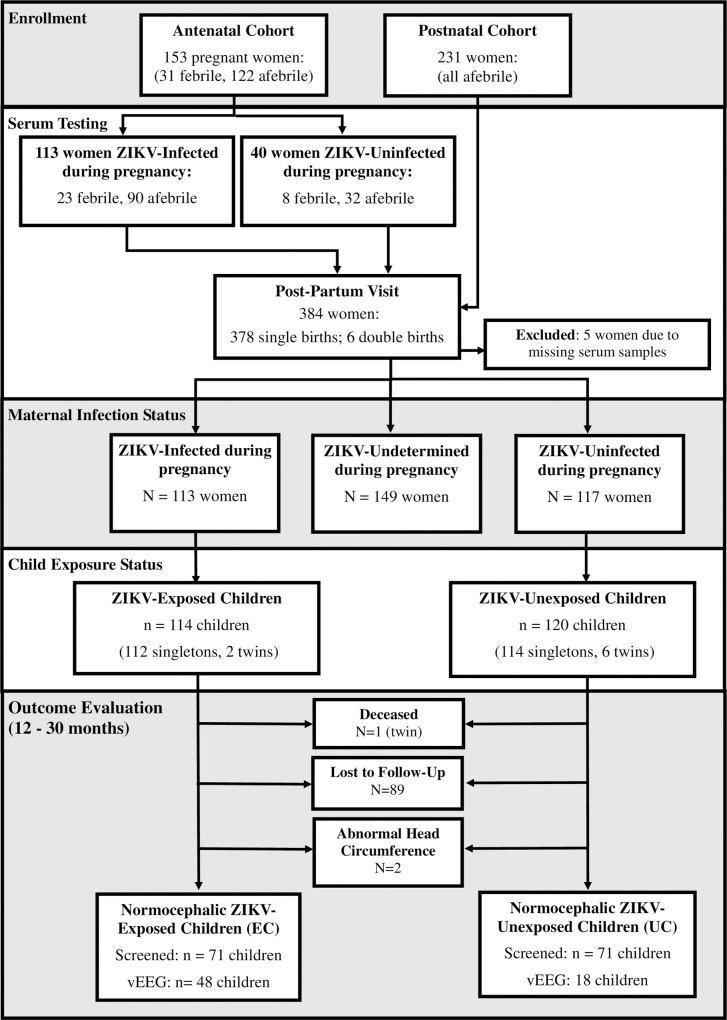
Children with Congenital Zika Syndrome and microcephaly are at high risk for epilepsy; however, the risk is unclear in normocephalic children with prenatal Zika virus (ZIKV) exposure [Exposed Children (EC)]. In this prospective cohort study, we performed epilepsy screening in normocephalic EC alongside a parallel group of normocephalic unexposed children [Unexposed Children (UC)]. We compared the incidence rate of epilepsy among EC and UC at one year of life to global incidence rates. Pregnant women were recruited from public health centers during the ZIKV outbreak in Grenada, West Indies and assessed for prior ZIKV infection using a plasmonic-gold platform that measures IgG antibodies in serum. Normocephalic children born to mothers with positive ZIKV results during pregnancy were classified as EC and those born to mothers with negative ZIKV results during and after pregnancy were classified as UC. Epilepsy screening procedures included a pediatric epilepsy screening questionnaire and video electroencephalography (vEEG). vEEG was collected using a multi-channel microEEG® system for a minimum of 20 minutes along with video recording of participant behavior time-locked to the EEG. vEEGs were interpreted independently by two pediatric epileptologists, who were blinded to ZIKV status, via telemedicine platform. Positive screening cases were referred to a local pediatrician for an epilepsy diagnostic evaluation. Epilepsy screens were positive in 2/71 EC (IR: 0.028; 95% CI: 0.003-0.098) and 0/71 UC. In both epilepsy-positive cases, questionnaire responses and interictal vEEGs were consistent with focal, rather than generalized, seizures. Both children met criteria for a clinical diagnosis of epilepsy and good seizure control was achieved with carbamazepine. Our results indicate that epilepsy rates are modestly elevated in EC. Given our small sample size, results should be considered preliminary. They support the use of epilepsy screening procedures in larger epidemiological studies of children with congenital ZIKV exposure, even in the absence of microcephaly, and provide guidance for conducting epilepsy surveillance in resource limited settings.
患有先天性寨卡综合征和小头畸形的儿童患癫痫的风险很高;然而,在产前感染寨卡病毒(ZIKV)的正常头围儿童中(暴露儿童,EC),其风险尚不清楚。在这项前瞻性队列研究中,我们对正常头围的 EC 进行了癫痫筛查,并与一组正常头围的未暴露儿童(未暴露儿童,UC)进行了平行比较。我们比较了 EC 和 UC 在一岁时的癫痫发病率与全球发病率。孕妇在西印度群岛格林纳达寨卡病毒爆发期间从公共卫生中心招募,并使用等离子体金平台评估既往 ZIKV 感染情况,该平台可测量血清中的 IgG 抗体。妊娠期间 ZIKV 检测结果阳性的母亲所生的正常头围儿童被归类为 EC,而妊娠期间和之后 ZIKV 检测结果阴性的母亲所生的正常头围儿童被归类为 UC。癫痫筛查程序包括儿科癫痫筛查问卷和视频脑电图(vEEG)。 vEEG 使用多通道 microEEG®系统采集,至少 20 分钟,同时记录参与者行为的视频,与 EEG 时间锁定。 vEEG 由两位儿科癫痫专家通过远程医疗平台独立解读,他们对 ZIKV 状态一无所知。阳性筛查病例转介给当地儿科医生进行癫痫诊断评估。在 71 名 EC 中有 2 名(发病率:0.028;95%CI:0.003-0.098)和 71 名 UC 中有 0 名(发病率:0.000;95%CI:0.000-0.139)的癫痫筛查阳性。在这两个癫痫阳性病例中,问卷回答和发作间期 vEEG 均与局灶性而非全身性癫痫发作一致。这两个孩子都符合癫痫临床诊断标准,卡马西平治疗效果良好。我们的结果表明,EC 中的癫痫发病率略有升高。鉴于我们的样本量较小,结果应被认为是初步的。这些结果支持在更大规模的先天性 ZIKV 暴露儿童中进行癫痫筛查程序,即使在没有小头畸形的情况下,也支持在资源有限的环境中进行癫痫监测。