
具有偏析外来间隙原子的纳米晶体心立方铁的变形行为:分子动力学研究
Deformation Behavior of Nanocrystalline Body-Centered Cubic Iron with Segregated, Foreign Interstitial: A Molecular Dynamics Study.
作者信息
AlMotasem Ahmed Tamer, Posselt Matthias, Polcar Tomas
机构信息
Department of Mechanical Engineering, Faculty of Engineering and Physical Sciences, University of Southampton, Southampton SO17 1BJ, UK.
Department of Physics, Faculty of science, Assiut University, Assiut 7156, Egypt.
出版信息
Materials (Basel). 2020 Nov 25;13(23):5351. doi: 10.3390/ma13235351.
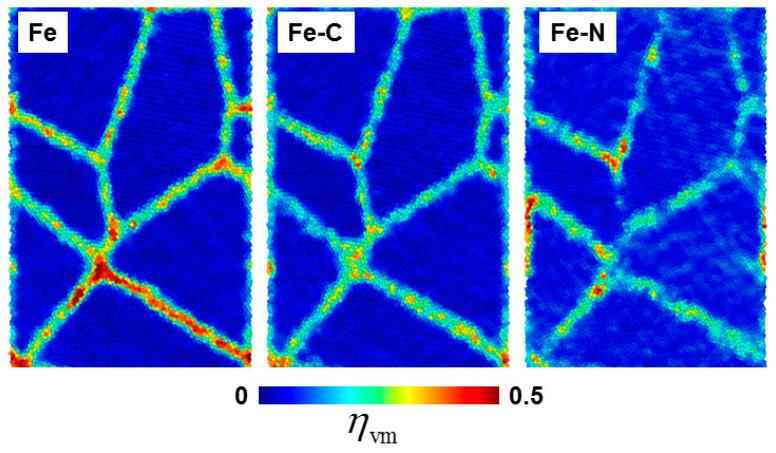
In the present work, modified embedded atom potential and large-scale molecular dynamics' simulations were used to explore the effect of grain boundary (GB) segregated foreign interstitials on the deformation behavior of nanocrystalline (nc) iron. As a case study, carbon and nitrogen (about 2.5 at.%) were added to (nc) iron. The tensile test results showed that, at the onset of plasticity, grain boundary sliding mediated was dominated, whereas both dislocations and twinning were prevailing deformation mechanisms at high strain. Adding C/N into GBs reduces the free excess volume and consequently increases resistance to GB sliding. In agreement with experiments, the flow stress increased due to the presence of carbon or nitrogen and carbon had the stronger impact. Additionally, the simulation results revealed that GB reduction and suppressing GBs' dislocation were the primary cause for GB strengthening. Moreover, we also found that the stress required for both intragranular dislocation and twinning nucleation were strongly dependent on the solute type.
在本研究中,采用修正的嵌入原子势和大规模分子动力学模拟来探究晶界(GB)偏聚的外来间隙原子对纳米晶(nc)铁变形行为的影响。作为案例研究,向(nc)铁中添加了碳和氮(约2.5原子百分比)。拉伸试验结果表明,在塑性开始时,以晶界滑动介导为主,而在高应变时,位错和孪晶都是主要的变形机制。向晶界添加C/N会减少自由过剩体积,从而增加对晶界滑动的阻力。与实验结果一致,由于碳或氮的存在,流动应力增加,且碳的影响更强。此外,模拟结果表明,晶界减少和抑制晶界位错是晶界强化的主要原因。而且,我们还发现,晶内位错和孪晶形核所需的应力强烈依赖于溶质类型。




 Zotero 插件