State Key Laboratory of Infectious Disease Prevention and Control, National Institute for Communicable Disease Control and Prevention, Chinese Center for Disease Control and Prevention, Beijing, 102206, China.
Shanghai Public Health Clinical Center, Fudan University, Shanghai, 201508, China.
Virol Sin. 2021 Jun;36(3):402-411. doi: 10.1007/s12250-020-00325-z. Epub 2020 Dec 1.
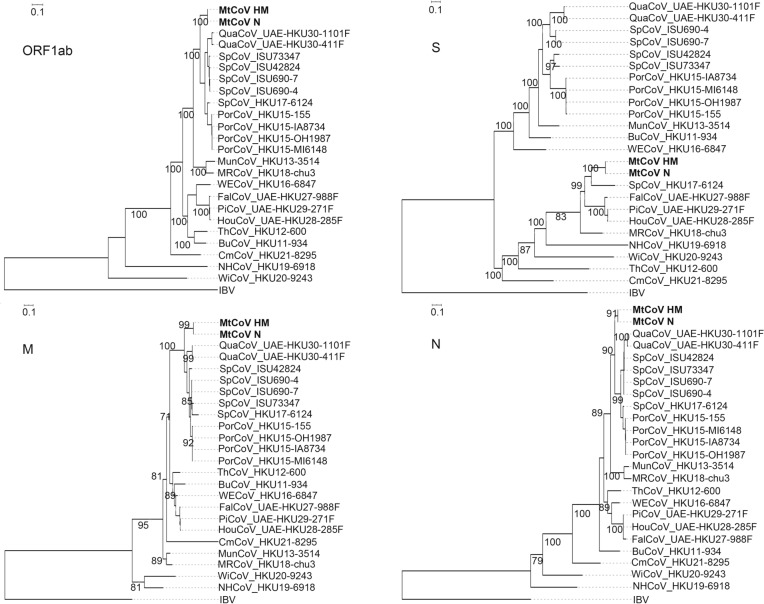
Outbreaks of severe virus infections with the potential to cause global pandemics are increasingly concerning. One type of those commonly emerging and re-emerging pathogens are coronaviruses (SARS-CoV, MERS-CoV and SARS-CoV-2). Wild animals are hosts of different coronaviruses with the potential risk of cross-species transmission. However, little is known about the reservoir and host of coronaviruses in wild animals in Qinghai Province, where has the greatest biodiversity among the world's high-altitude regions. Here, from the next-generation sequencing data, we obtained a known beta-coronavirus (beta-CoV) genome and a novel delta-coronavirus (delta-CoV) genome from faecal samples of 29 marmots, 50 rats and 25 birds in Yushu Tibetan Autonomous Prefecture, Qinghai Province, China in July 2019. According to the phylogenetic analysis, the beta-CoV shared high nucleotide identity with Coronavirus HKU24. Although the novel delta-CoV (MtCoV) was closely related to Sparrow deltacoronavirus ISU42824, the protein spike of the novel delta-CoV showed highest amino acid identity to Sparrow coronavirus HKU17 (73.1%). Interestingly, our results identified a novel host (Montifringilla taczanowskii) for the novel delta-CoV and the potential cross-species transmission. The most recent common ancestor (tMRCA) of MtCoVs along with other closest members of the species of Coronavirus HKU15 was estimated to be 289 years ago. Thus, this study increases our understanding of the genetic diversity of beta-CoVs and delta-CoVs, and also provides a new perspective of the coronavirus hosts.
严重病毒感染的爆发有可能导致全球大流行,越来越令人担忧。其中一类常见的新发和再发病原体是冠状病毒(SARS-CoV、MERS-CoV 和 SARS-CoV-2)。野生动物是不同冠状病毒的宿主,具有跨物种传播的潜在风险。然而,对于青藏高原地区生物多样性最丰富的青海省野生动物中冠状病毒的储存宿主和宿主知之甚少。在这里,我们从下一代测序数据中,从 2019 年 7 月在中国青海省玉树藏族自治州采集的 29 只旱獭、50 只老鼠和 25 只鸟类的粪便样本中获得了一种已知的β冠状病毒(β-CoV)基因组和一种新型的δ冠状病毒(δ-CoV)基因组。根据系统发育分析,β-CoV 与冠状病毒 HKU24 具有高度核苷酸同一性。虽然新型的δ-CoV(MtCoV)与麻雀δ冠状病毒 ISU42824 密切相关,但新型的δ-CoV 的蛋白刺突与麻雀冠状病毒 HKU17 具有最高的氨基酸同一性(73.1%)。有趣的是,我们的研究结果确定了新型的δ-CoV 的一个新宿主(松雀鹰)和潜在的跨物种传播。与其他冠状病毒 HKU15 最接近的成员一起,MtCoVs 的最近共同祖先(tMRCA)估计在 289 年前。因此,这项研究增加了我们对β-CoV 和δ-CoV 遗传多样性的认识,并为冠状病毒宿主提供了新的视角。