Graduate School of Life and Environmental Sciences, University of Tsukuba, Tsukuba, Japan.
Division of Evolutionary Developmental Biology, National Institute for Basic Biology, Okazaki, Japan.
Sci Rep. 2020 Dec 1;10(1):20907. doi: 10.1038/s41598-020-77683-x.
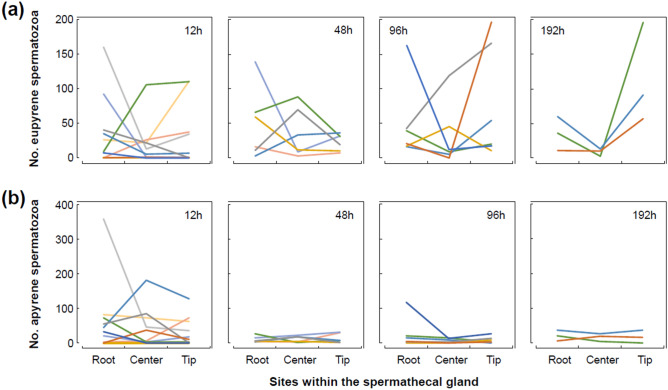
Most male lepidopterans produce fertile eupyrene sperm and non-fertile apyrene sperm, both of which are transferred to the female in a spermatophore during mating. Apyrene sperm outnumbers eupyrene sperm and both sperm types migrate from the bursa copulatrix to the spermatheca after mating. While eupyrene sperm are maintained in the spermatheca until oviposition, the number of apyrene sperm decreases with time. It is unclear whether apyrene sperm disappear from all sperm storage organs in females because both sperm types are often observed in the spermathecal gland. To investigate this, the numbers of both sperm types were estimated in the spermatheca and spermathecal gland of female Byasa alcinous (a monandrous butterfly) 6, 12, 48, 96, and 192 h after mating terminated. Apyrene sperm arrived in the spermatheca earlier than eupyrene sperm; however, some eupyrene and apyrene sperm migrated to the spermathecal gland from the spermatheca at almost the same time. The number of apyrene sperm reached a peak 12 h after the termination of mating and then decreased with time in both the spermatheca and spermathecal gland. Our results suggest that the role of apyrene sperm might be completed early after arriving in the spermatheca of B. alcinous.
大多数雄性鳞翅目昆虫产生可育的有精囊精子和非可育的无精囊精子,这两种精子都在交配时通过精囊转移到雌性体内。无精囊精子的数量多于有精囊精子,两种精子类型在交配后都从交合囊迁移到受精囊。虽然有精囊精子在受精囊中保存到产卵时,但随着时间的推移,无精囊精子的数量会减少。目前尚不清楚无精囊精子是否会从雌性的所有精子储存器官中消失,因为这两种精子类型通常都在受精囊腺中观察到。为了研究这一点,在交配结束后 6、12、48、96 和 192 小时,测定了单配性蝴蝶蓝凤蝶雌性个体的受精囊中以及受精囊腺中两种精子类型的数量。无精囊精子比有精囊精子更早到达受精囊;然而,一些有精囊和无精囊精子几乎同时从受精囊迁移到受精囊腺。无精囊精子的数量在交配结束后 12 小时达到峰值,然后在受精囊和受精囊腺中随着时间的推移而减少。我们的结果表明,无精囊精子在到达蓝凤蝶的受精囊后可能很快就完成了其作用。