School of Medicine and Public Health, Faculty of Health and Medicine, University of Newcastle, 1 University Drive, Callaghan, NSW, 2308, Australia.
Hunter New England Population Health, Hunter New England Local Health District, Wallsend, NSW, 2287, Australia.
BMC Public Health. 2020 Dec 2;20(1):1849. doi: 10.1186/s12889-020-09950-5.
Optimisation processes have the potential to rapidly improve the impact of health interventions. Optimisation can be defined as a deliberate, iterative and data-driven process to improve a health intervention and/or its implementation to meet stakeholder-defined public health impacts within resource constraints. This study aimed to identify frameworks used to optimise the impact of health interventions and/or their implementation, and characterise the key concepts, steps or processes of identified frameworks.
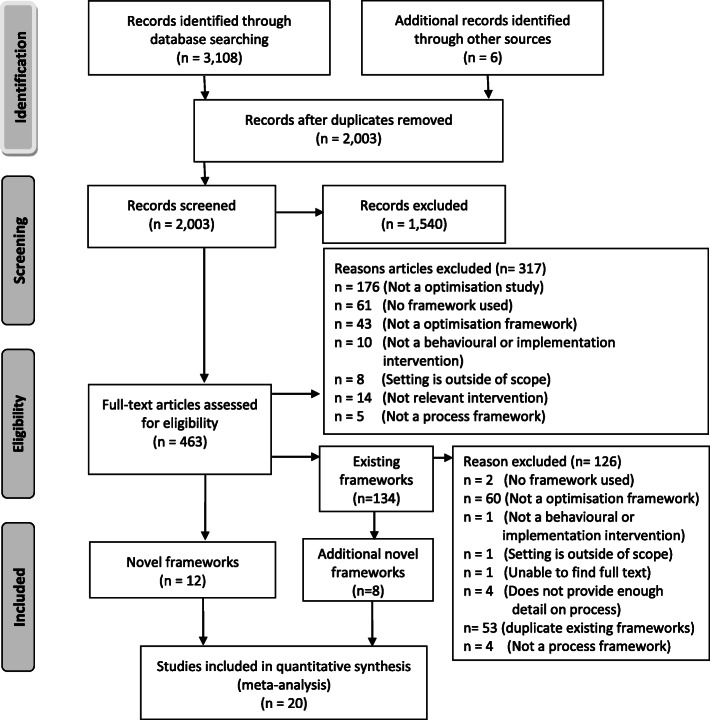
A scoping review of MEDLINE, CINAL, PsycINFO, and ProQuest Nursing & Allied Health Source databases was undertaken. Two reviewers independently coded the key concepts, steps or processes involved in each frameworks, and identified if it was a framework aimed to optimise interventions or their implementation. Two review authors then identified the common steps across included frameworks.
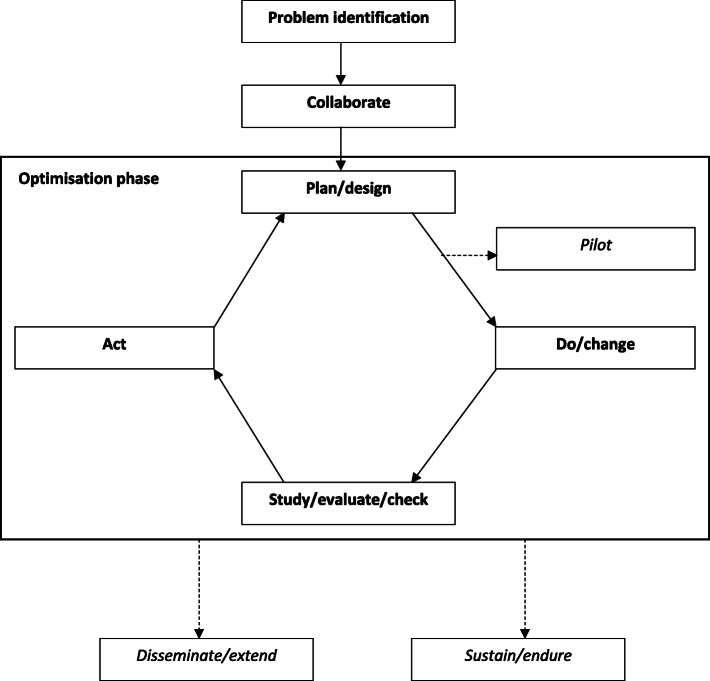
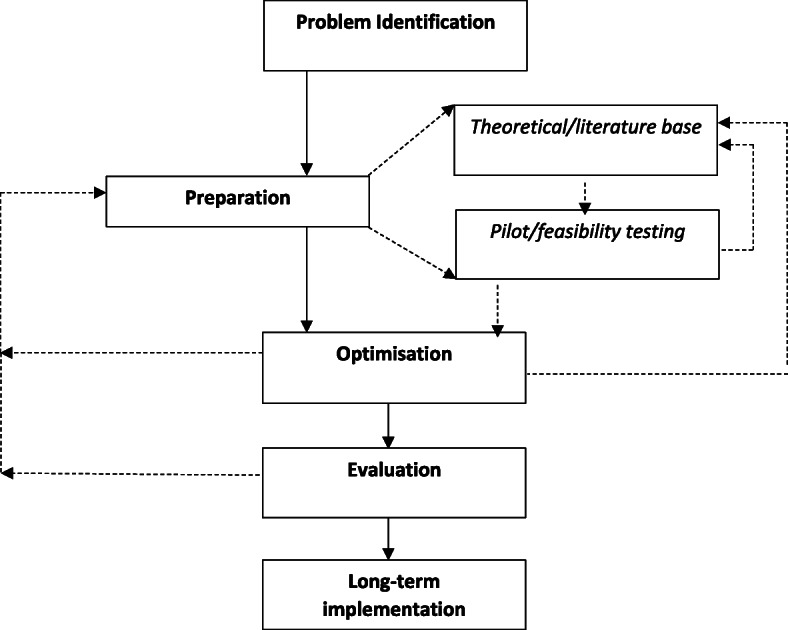
Twenty optimisation frameworks were identified. Eight frameworks were for optimising interventions, 11 for optimising implementation and one covered both intervention and implementation optimisation. The mean number of steps within the frameworks was six (range 3-9). Almost half (n = 8) could be classified as both linear and cyclic frameworks, indicating that some steps may occur multiple times in a single framework. Two meta-frameworks are proposed, one for intervention optimisation and one for implementation strategy optimisation. Steps for intervention optimisation are: Problem identification; Preparation; Theoretical/Literature base; Pilot/Feasibility testing; Optimisation; Evaluation; and Long-term implementation. Steps for implementation strategy optimisation are: Problem identification; Collaborate; Plan/design; Pilot; Do/change; Study/evaluate/check; Act; Sustain/endure; and Disseminate/extend.
This review provides a useful summary of the common steps followed to optimise a public health intervention or its implementation according to established frameworks. Further opportunities to study and/or validate such frameworks and their impact on improving outcomes exist.
优化流程具有快速提高健康干预措施效果的潜力。优化可定义为一种深思熟虑、迭代和数据驱动的过程,旨在改进健康干预措施及其实施,以在资源限制内满足利益相关者定义的公共卫生影响。本研究旨在确定用于优化健康干预措施及其实施效果的框架,并描述所确定框架的关键概念、步骤或流程。
对 MEDLINE、CINAL、PsycINFO 和 ProQuest 护理与联合健康资源数据库进行了范围综述。两名审查员独立对每个框架中涉及的关键概念、步骤或流程进行编码,并确定其是否旨在优化干预措施或其实施。然后,两名综述作者确定了纳入框架的共同步骤。
确定了 20 个优化框架。8 个框架用于优化干预措施,11 个用于优化实施,1 个涵盖了干预和实施的优化。框架内的平均步骤数为 6 个(范围为 3-9)。近一半(n=8)可归类为线性和循环框架,这表明某些步骤可能在单个框架中多次发生。提出了两个元框架,一个用于干预优化,一个用于实施策略优化。干预优化的步骤包括:问题识别;准备;理论/文献基础;试点/可行性测试;优化;评估;和长期实施。实施策略优化的步骤包括:问题识别;协作;计划/设计;试点;实施/改变;研究/评估/检查;行动;维持/持久;传播/扩展。
根据既定框架,本综述提供了优化公共卫生干预措施或其实施的常用步骤的有用总结。进一步有机会研究和/或验证这些框架及其对改善结果的影响。