Schwenkgrub Joanna, Harrell Evan R, Bathellier Brice, Bouvier Julien
Université Paris-Saclay, CNRS, Institut des Neurosciences Paris-Saclay, 91190 Gif-sur-Yvette, France.
Institut Pasteur, INSERM, Institut de l'Audition, 63 rue de Charenton, F-75012 Paris, France.
Sci Adv. 2020 Dec 4;6(49). doi: 10.1126/sciadv.abc6309. Print 2020 Dec.
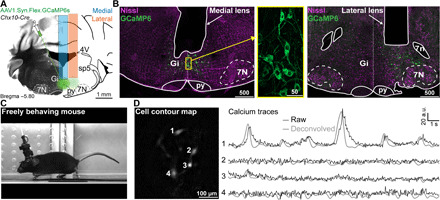
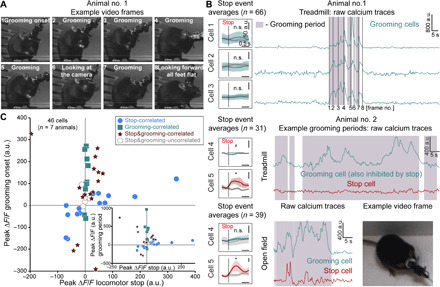
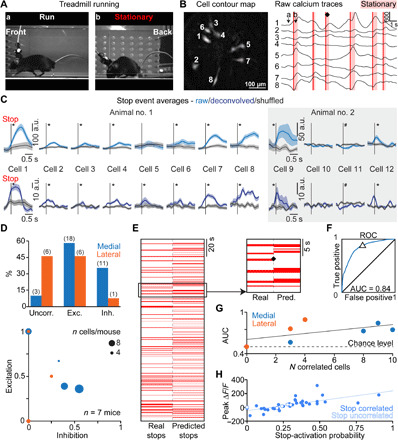
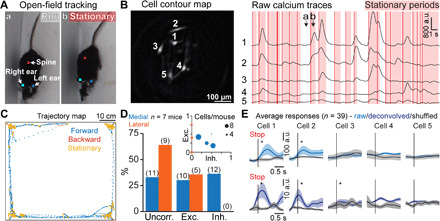
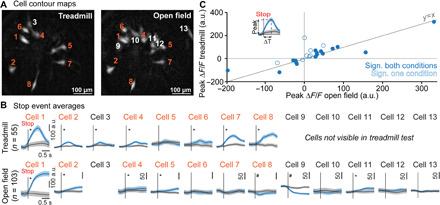
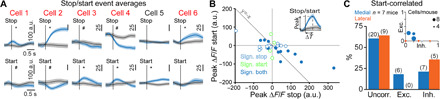
V2a neurons are a genetically defined cell class that forms a major excitatory descending pathway from the brainstem reticular formation to the spinal cord. Their activation has been linked to the termination of locomotor activity based on broad optogenetic manipulations. However, because of the difficulties involved in accessing brainstem structures for in vivo cell type-specific recordings, V2a neuron function has never been directly observed during natural behaviors. Here, we imaged the activity of V2a neurons using micro-endoscopy in freely moving mice. We find that as many as half of the V2a neurons are excited at locomotion arrest and with low reliability. Other V2a neurons are inhibited at locomotor arrests and/or activated during other behaviors such as locomotion initiation or stationary grooming. Our results establish that V2a neurons not only drive stops as suggested by bulk optogenetics but also are stratified into subpopulations that likely contribute to diverse motor patterns.
V2a神经元是一类由基因定义的细胞类型,它构成了从脑干网状结构到脊髓的主要兴奋性下行通路。基于广泛的光遗传学操作,它们的激活与运动活动的终止有关。然而,由于在体内进行细胞类型特异性记录时难以进入脑干结构,V2a神经元的功能从未在自然行为中被直接观察到。在这里,我们使用微型内窥镜对自由活动小鼠的V2a神经元活动进行成像。我们发现,多达一半的V2a神经元在运动停止时被兴奋,且可靠性较低。其他V2a神经元在运动停止时被抑制和/或在其他行为(如运动开始或静止梳理)期间被激活。我们的结果表明,V2a神经元不仅如整体光遗传学所暗示的那样驱动停止,而且还被分层为亚群,这些亚群可能有助于形成多样的运动模式。