Barros Vanessa A, Chandnani Rahul, de Sousa Sylvia M, Maciel Laiane S, Tokizawa Mutsutomo, Guimaraes Claudia T, Magalhaes Jurandir V, Kochian Leon V
Embrapa Maize and Sorghum, Sete Lagoas, Brazil.
Departamento de Biologia Geral, Universidade Federal de Minas Gerais, Belo Horizonte, Brazil.
Front Plant Sci. 2020 Nov 12;11:565339. doi: 10.3389/fpls.2020.565339. eCollection 2020.
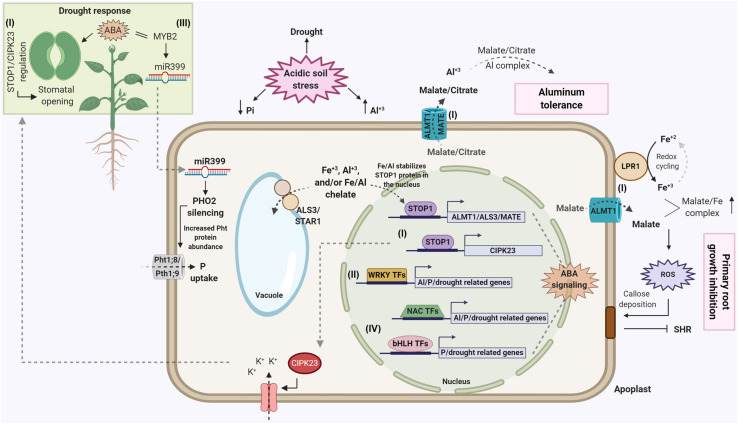
Crop tolerance to multiple abiotic stresses has long been pursued as a Holy Grail in plant breeding efforts that target crop adaptation to tropical soils. On tropical, acidic soils, aluminum (Al) toxicity, low phosphorus (P) availability and drought stress are the major limitations to yield stability. Molecular breeding based on a small suite of pleiotropic genes, particularly those with moderate to major phenotypic effects, could help circumvent the need for complex breeding designs and large population sizes aimed at selecting transgressive progeny accumulating favorable alleles controlling polygenic traits. The underlying question is twofold: do common tolerance mechanisms to Al toxicity, P deficiency and drought exist? And if they do, will they be useful in a plant breeding program that targets stress-prone environments. The selective environments in tropical regions are such that multiple, co-existing regulatory networks may drive the fixation of either distinctly different or a smaller number of pleiotropic abiotic stress tolerance genes. Recent studies suggest that genes contributing to crop adaptation to acidic soils, such as the major Arabidopsis Al tolerance protein, AtALMT1, which encodes an aluminum-activated root malate transporter, may influence both Al tolerance and P acquisition via changes in root system morphology and architecture. However, -acting elements such as transcription factors (TFs) may be the best option for pleiotropic control of multiple abiotic stress genes, due to their small and often multiple binding sequences in the genome. One such example is the C2H2-type zinc finger, AtSTOP1, which is a transcriptional regulator of a number of Arabidopsis Al tolerance genes, including and , and has been shown to activate , not only in response to Al but also low soil P. The large WRKY family of transcription factors are also known to affect a broad spectrum of phenotypes, some of which are related to acidic soil abiotic stress responses. Hence, we focus here on signaling proteins such as TFs and protein kinases to identify, from the literature, evidence for unifying regulatory networks controlling Al tolerance, P efficiency and, also possibly drought tolerance. Particular emphasis will be given to modification of root system morphology and architecture, which could be an important physiological "hub" leading to crop adaptation to multiple soil-based abiotic stress factors.
长期以来,培育对多种非生物胁迫具有耐受性的作物一直是植物育种工作的圣杯,这些工作旨在使作物适应热带土壤。在热带酸性土壤中,铝(Al)毒性、低磷(P)有效性和干旱胁迫是产量稳定性的主要限制因素。基于一小套多效性基因的分子育种,特别是那些具有中度至主要表型效应的基因,有助于避免采用复杂的育种设计和大群体规模来选择积累控制多基因性状的有利等位基因的超亲后代。潜在的问题有两个方面:是否存在对铝毒性、磷缺乏和干旱的共同耐受机制?如果存在,它们在针对易受胁迫环境的植物育种计划中是否有用?热带地区的选择环境使得多个共存的调控网络可能推动截然不同或数量较少的多效性非生物胁迫耐受基因的固定。最近的研究表明,有助于作物适应酸性土壤的基因,如拟南芥主要的铝耐受蛋白AtALMT1,它编码一种铝激活的根苹果酸转运蛋白,可能通过根系形态和结构的变化影响铝耐受性和磷吸收。然而,转录因子(TFs)等作用元件可能是多效性控制多个非生物胁迫基因的最佳选择,因为它们在基因组中的结合序列小且往往有多个。一个这样的例子是C2H2型锌指蛋白AtSTOP1,它是许多拟南芥铝耐受基因的转录调节因子,包括 和 ,并且已被证明不仅响应铝,而且在低土壤磷条件下也能激活 。转录因子的WRKY大家族也已知会影响广泛的表型,其中一些与酸性土壤非生物胁迫反应有关。因此,我们在此关注信号蛋白,如转录因子和蛋白激酶,以便从文献中找出控制铝耐受性、磷效率以及可能还有干旱耐受性的统一调控网络的证据。将特别强调根系形态和结构的改变,这可能是导致作物适应多种基于土壤的非生物胁迫因素的重要生理“枢纽”。