Rocha Cátia, Lago Paula, Fernandes Samuel, Correia Luís, Portela Francisco, Vieira Ana Isabel, Patita Marta, Arroja Bruno, Ministro Paula, Alves Catarina, Dias Cláudia Camila, Magro Fernando
Department of Biomedicine, Unit of Pharmacology and Therapeutics, Faculty of Medicine, University of Porto, Porto, Portugal.
Department of Gastroenterology, Centro Hospitalar do Porto, Porto, Portugal.
Therap Adv Gastroenterol. 2020 Nov 18;13:1756284820965790. doi: 10.1177/1756284820965790. eCollection 2020.
Therapeutic drug monitoring (TDM) of infliximab (IFX) and anti-infliximab antibodies (ATIs) is essential for treatment optimisation in inflammatory bowel disease (IBD) patients. The aim of this study was to estimate and compare the agreement and accuracy between a new rapid test and three established enzyme-linked immunosorbent assays (ELISAs) to quantify ATIs levels, and to evaluate the impact of exogenous IFX on the performance of these assays.
We analysed 200 serum samples from 57 IBD outpatients in IFX induction or maintenance therapy at six IBD centres in Portugal. ATI levels were quantified using the rapid test Quantum Blue® (QB) Anti-Infliximab (Bühlmann) and three established ELISAs: In-House, Theradiag (Lisa Tracker Anti-Infliximab), and Immundiagnostik (IDKmonitor Infliximab). ATIs were quantified in patients' serum samples and spiked samples with exogenous IFX, based on analytical and clinical cutoffs. Qualitative agreement and accuracy were estimated by Cohen's kappa () with 95% confidence intervals.
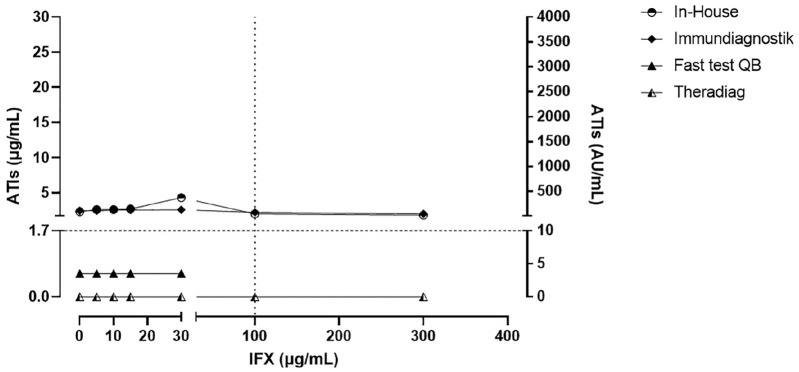
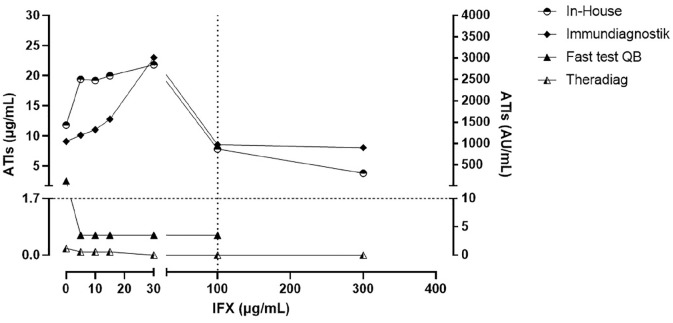
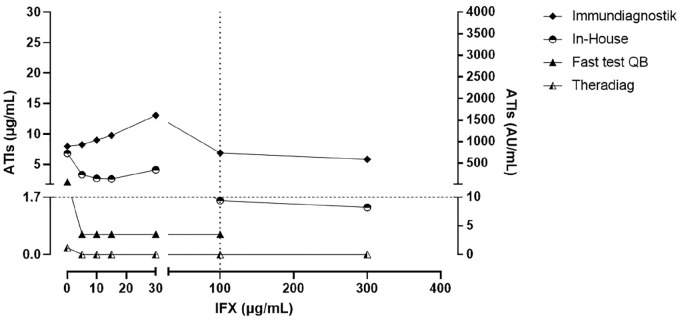
ATIs quantification with clinical cutoffs showed a slight agreement between QB rapid test and In-House [ = 0.163 (0.051-0.276)] and Immundiagnostik [ = 0.085 (0.000-0.177)]. Regarding IFX/ATIs status, the QB rapid test showed a substantial agreement with Theradiag [ = 0.808 (0.729-0.888)] and a fair agreement with In-House [ = 0.343 (0.254-0.431)] and Immundiagnostik [ = 0.217 (0.138-0.297)]. The QB rapid test could not detect ATI-positive levels in samples with exogenous IFX at 5-300 µg/ml. Interference on ATIs detection was observed at exogenous IFX ⩾30 µg/ml for In-house and Immundiagnostik assays.
QB rapid test is only suitable to detect ATI-positive levels in the absence of IFX.
对英夫利昔单抗(IFX)和抗英夫利昔单抗抗体(ATI)进行治疗药物监测(TDM)对于优化炎症性肠病(IBD)患者的治疗至关重要。本研究的目的是评估并比较一种新型快速检测法与三种已确立的酶联免疫吸附测定法(ELISA)在定量ATI水平方面的一致性和准确性,并评估外源性IFX对这些检测方法性能的影响。
我们分析了来自葡萄牙六个IBD中心的57名接受IFX诱导或维持治疗的IBD门诊患者的200份血清样本。使用快速检测法Quantum Blue®(QB)抗英夫利昔单抗(Bühlmann)和三种已确立的ELISA法对ATI水平进行定量:内部检测法、Theradiag公司的(Lisa Tracker抗英夫利昔单抗)以及Immundiagnostik公司的(IDKmonitor英夫利昔单抗)。根据分析和临床临界值,对患者血清样本以及添加外源性IFX的加标样本中的ATI进行定量。通过Cohen's kappa(κ)系数及其95%置信区间来评估定性一致性和准确性。
采用临床临界值对ATI进行定量时,QB快速检测法与内部检测法[κ = 0.163(0.051 - 0.276)]以及Immundiagnostik公司的检测法[κ = 0.085(0.000 - 0.177)]之间显示出轻微一致性。关于IFX/ATI状态,QB快速检测法与Theradiag公司的检测法显示出高度一致性[κ = 0.808(0.729 - 0.888)],与内部检测法显示出一般一致性[κ = 0.343(0.254 - 0.431)],与Immundiagnostik公司的检测法显示出一般一致性[κ = 0.217(0.138 - 0.297)]。QB快速检测法无法检测出添加了5 - 300μg/ml外源性IFX的样本中的ATI阳性水平。对于内部检测法和Immundiagnostik公司的检测法,在外源性IFX≥30μg/ml时观察到对ATI检测存在干扰。
QB快速检测法仅适用于在不存在IFX的情况下检测ATI阳性水平。