Zheng Kelvin Y C, Guo Chuan-Guo, Wong Irene O L, Chen Lijia, Chung Ho Yin, Cheung Ka Shing, Leung Wai K
Department of Medicine, Li Ka Shing Faculty of Medicine, University of Hong Kong, Hong Kong, China.
School of Public Health, Li Ka Shing Faculty of Medicine, University of Hong Kong, Hong Kong, China.
Therap Adv Gastroenterol. 2020 Nov 18;13:1756284820967275. doi: 10.1177/1756284820967275. eCollection 2020.
Thiopurines are believed to increase cancer risks, but data from Asian patients are sparse. We determined the risks of malignancies in thiopurine users with inflammatory bowel disease (IBD) or other indications from Hong Kong.
All patients who had received thiopurines between 2005 and 2009 in Hong Kong were identified from local electronic healthcare database. Patients were followed from the start date of thiopurines until death or end of study in 2017. We excluded patients with baseline malignancy. Standardized incidence ratios (SIR) and the corresponding 95% confidence intervals (CI) of all malignancies were computed against matched local general population from the cancer registry. Patients in the same diagnosis category but not exposed to thiopurines were included as controls.
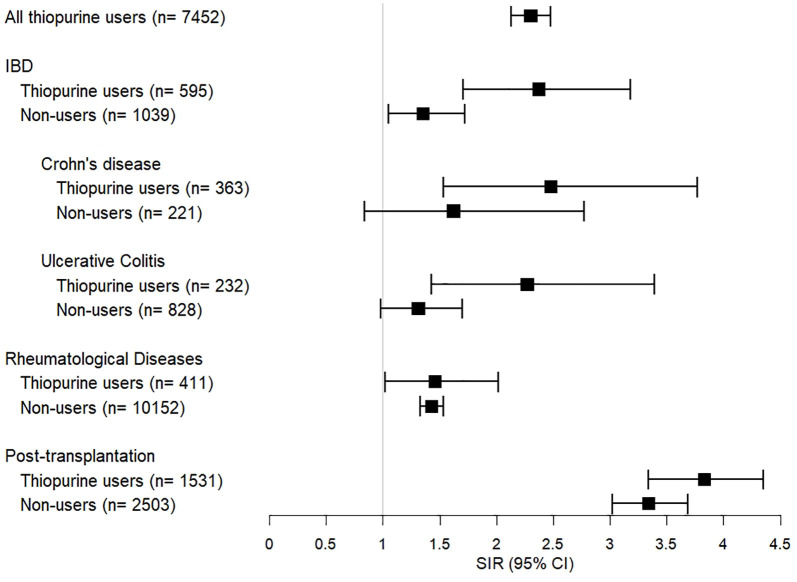
There were 7452 thiopurines users (median age 47.0 years), including 595 IBD patients, with a median follow-up of 11.2 years. Of them, 684 (9.2%) developed malignancies with an overall SIR of 2.30 (95% CI 2.13-2.48). The SIR in IBD patients who used thiopurines was 2.37 (95% CI 1.71-3.18) as compared with non-users (SIR 1.35, 95% CI 1.05-1.72). Highest risk of malignancies was observed in post-transplant patients (SIR 3.83, 95% CI 3.34-4.35), and lower risks were seen in patients with rheumatological diseases (SIR 1.46, 95% CI 1.02-2.02).
IBD patients in Hong Kong who used thiopurines had 2.37-fold increase in risk of malignancies than the general population, which was higher than non-users and different from thiopurine users for other indications.
硫唑嘌呤被认为会增加癌症风险,但来自亚洲患者的数据较少。我们确定了香港使用硫唑嘌呤治疗炎症性肠病(IBD)或其他病症的患者发生恶性肿瘤的风险。
从本地电子医疗数据库中识别出2005年至2009年期间在香港接受硫唑嘌呤治疗的所有患者。从开始使用硫唑嘌呤之日起对患者进行随访,直至2017年死亡或研究结束。我们排除了基线时患有恶性肿瘤的患者。根据癌症登记处匹配的本地普通人群计算所有恶性肿瘤的标准化发病比(SIR)及相应的95%置信区间(CI)。将相同诊断类别但未接触硫唑嘌呤的患者作为对照。
共有7452名硫唑嘌呤使用者(中位年龄47.0岁),其中包括595名IBD患者,中位随访时间为11.2年。其中,684人(9.2%)发生了恶性肿瘤,总体SIR为2.30(95%CI 2.13 - 2.48)。使用硫唑嘌呤的IBD患者的SIR为2.37(95%CI 1.71 - 3.18),而非使用者的SIR为1.35(95%CI 1.05 - 1.72)。移植后患者发生恶性肿瘤的风险最高(SIR 3.83,95%CI 3.34 - 4.35),而风湿病患者的风险较低(SIR 1.46,95%CI 1.02 - 2.02)。
香港使用硫唑嘌呤的IBD患者发生恶性肿瘤的风险比普通人群高2.37倍,高于未使用者,且与其他适应症的硫唑嘌呤使用者不同。