Zheng Wei, Zhou Yan-Ling, Wang Cheng-Yu, Lan Xiao-Feng, Zhang Bin, Zhou Su-Miao, Yan Su, Yang Ming-Zhe, Nie Sha, Ning Yu-Ping
The Affiliated Brain Hospital of Guangzhou Medical University (Guangzhou Huiai Hospital), Guangzhou, China.
The Affiliated Brain Hospital of Guangzhou Medical University (Guangzhou Huiai Hospital), Guangzhou, 510182, China; The First School of Clinical Medicine, Southern Medical University, Guangzhou, Guangdong, China.
Ther Adv Psychopharmacol. 2020 Nov 25;10:2045125320973794. doi: 10.1177/2045125320973794. eCollection 2020.
This study is the first to examine the association between plasma levels of brain-derived neurotrophic factor (BDNF) and the antisuicidal effects of repeated ketamine infusions in depressed patients with suicidal ideation.
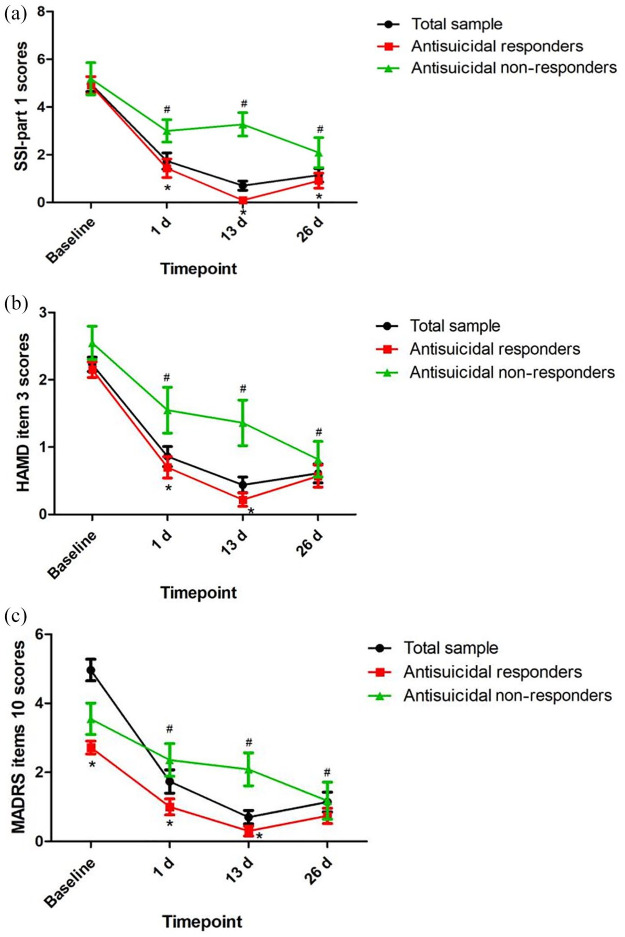
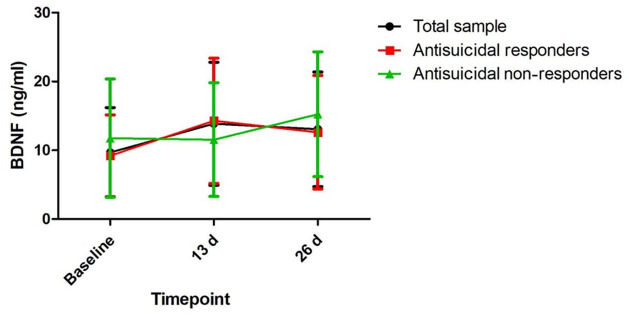
Fifty-seven depressed patients with suicidal ideation received six ketamine infusions (0.5 mg/kg) during a 12 days period. Suicidality was measured with the Scale for Suicidal Ideations (SSI-part 1), item 10 of the Montgomery-Åsberg Depression Rating Scale (MADRS), and item 3 of the Hamilton Depression Rating Scale (HAMD) at baseline, 1 day after the first infusion (1 day), 1 day after the sixth infusion (13 days), and at 2 weeks after the last infusion (26 days). Plasma levels of BDNF were measured by enzyme-linked immunosorbent assay at baseline, 13 days, and 26 days.
Overall, 46 (80.7%) depressed patients with suicidal ideation had an antisuicidal response at 13 days. Despite a significant reduction in suicidal symptoms over time, no changes in plasma levels of BDNF were found after ketamine treatment when compared with baseline. Correlation analysis showed that no significant association was observed between the plasma levels of BDNF and the changes in the severity of suicidal symptoms as measured by SSI-part 1, item 10 of the MADRS, or item 3 of the HAMD at 1 day, 13 days, and 26 days (all < 0.05).
Our results indicated that plasma levels of BDNF may not serve as a biomarker for determining the antisuicidal effects of six ketamine infusions in depressed patients with suicidal ideation.
本研究首次探讨了脑源性神经营养因子(BDNF)血浆水平与重复静脉注射氯胺酮对有自杀观念的抑郁症患者抗自杀作用之间的关联。
57例有自杀观念的抑郁症患者在12天内接受6次氯胺酮静脉注射(0.5mg/kg)。在基线、首次注射后1天(1天)、第六次注射后1天(13天)和最后一次注射后2周(26天),使用自杀观念量表(SSI第1部分)、蒙哥马利-阿斯伯格抑郁评定量表(MADRS)第10项和汉密尔顿抑郁评定量表(HAMD)第3项测量自杀倾向。在基线、13天和26天通过酶联免疫吸附测定法测量BDNF的血浆水平。
总体而言,46例(80.7%)有自杀观念的抑郁症患者在13天时出现抗自杀反应。尽管自杀症状随时间显著减轻,但与基线相比,氯胺酮治疗后BDNF的血浆水平没有变化。相关性分析表明,在1天、13天和26天时,BDNF的血浆水平与SSI第1部分、MADRS第10项或HAMD第3项测量的自杀症状严重程度变化之间没有显著关联(均P<0.05)。
我们的结果表明,BDNF的血浆水平可能无法作为判断6次氯胺酮静脉注射对有自杀观念的抑郁症患者抗自杀作用的生物标志物。