
模拟入侵对中国盐城沿海自然湿地景观演替的影响。
Modelling the effects of invasion on the landscape succession of Yancheng coastal natural wetlands, China.
作者信息
Dai Lingjun, Liu Hongyu, Wang Gang, Wang Cheng, Guo Ziru, Zhou Yi, Li Yufeng
机构信息
School of Geography, Nanjing Normal University, Nanjing, China.
Key Laboratory of Virtual Geographic Environment (Nanjing Normal University), Ministry of Education, Nanjing, China.
出版信息
PeerJ. 2020 Nov 24;8:e10400. doi: 10.7717/peerj.10400. eCollection 2020.
BACKGROUND
The Yancheng coastal natural wetlands (YCNR) are well-preserved silty tidal flat wetlands in China. Due to the severe invasion of , the native ecosystem has undergone great changes. The successful invasion of reduced the biodiversity of the YCNR, changed the structure and function of the local ecosystem, and eventually led to the degradation of the ecosystem and the loss of ecosystem function and service. Fully understanding the impact of an alien species invasion on YCNR succession is an important prerequisite for protecting and restoring the wetlands.
METHODS
In this study, remote sensing, GIS technology, and a cellular-automaton Markov model were used to simulate the natural succession process of native ecosystems without being affected by alien species. By comparing the landscape of the YCNR with the model simulation results, we gained a better understanding of how alien species affect native landscape-scale ecosystems.
RESULTS
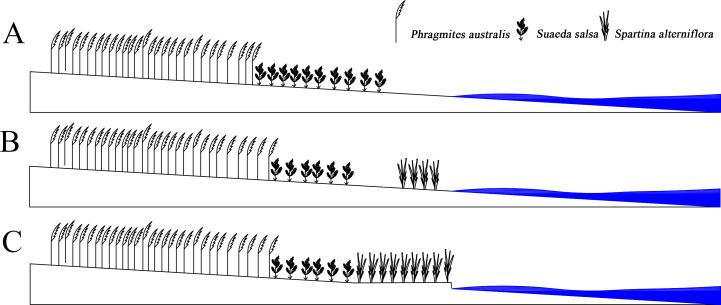
During the natural succession of the coastal native wetland ecosystem in the YCNR, the pioneer species occupied the mudflats and expanded seaward. The whole area expanded and moved seaward with an average annual movement of 58.23 m. Phragmites australis seemed to dominate the competition with communities, and the area gradually expanded with an average annual movement of 39.89 m. The invasion of changed the native ecosystem's spatial succession process, causing the ecosystem to be stressed by ecosystems on the side of the sea () and that of land (). The area of the seaward-expanding ecosystem has been declining. Under a reasonable protected area policy, human activities have enhanced the succession rate of the P. australis ecosystem and have had a small impact on the ecological spatial succession of and .
背景
盐城沿海自然湿地(YCNR)是中国保存完好的粉砂质潮滩湿地。由于[外来物种名称]的严重入侵,当地原生生态系统发生了巨大变化。[外来物种名称]的成功入侵降低了YCNR的生物多样性,改变了当地生态系统的结构和功能,最终导致生态系统退化以及生态系统功能和服务丧失。充分了解外来物种入侵对YCNR演替的影响是保护和恢复湿地的重要前提。
方法
在本研究中,利用遥感、地理信息系统(GIS)技术和元胞自动机马尔可夫模型来模拟未受外来物种影响的原生生态系统的自然演替过程。通过将YCNR的景观与模型模拟结果进行比较,我们更好地了解了外来物种如何影响原生景观尺度的生态系统。
结果
在YCNR沿海原生湿地生态系统的自然演替过程中,先锋物种[先锋物种名称]占据了泥滩并向海扩展。整个区域向海扩展并移动,平均每年移动58.23米。芦苇似乎在与[竞争物种名称]群落的竞争中占据主导地位,其面积逐渐扩大,平均每年移动39.89米。[外来物种名称]的入侵改变了原生生态系统的空间演替过程,导致[外来物种名称]生态系统受到来自海洋一侧([海洋相关生态系统名称])和陆地一侧([陆地相关生态系统名称])生态系统的压力。向海扩展的[外来物种名称]生态系统面积一直在下降。在合理的保护区政策下,人类活动提高了芦苇生态系统的演替速率,并且对[外来物种名称]和[另一外来物种名称]的生态空间演替影响较小。


 Zotero 插件