Esteva-Socias Margalida, Enver-Sumaya Mónica, Gómez-Bellvert Cristina, Guillot Mónica, Azkárate Aitor, Marsé Raquel, Sastre Úrsula, Blasco Ana, Calabuig-Fariñas Silvia, Asensio Víctor José, Terrasa Josefa, Obrador-Hevia Antònia
Centro de Investigación Biomédica en Red in Respiratory Diseases (CIBERES), Plataforma Biobanco Pulmonar CIBERES, Hospital Universitari Son Espases, Palma, Spain.
Grupo de Inflamación, reparación y cáncer en enfermedades respiratorias, Institut d'Investigació Sanitària de les Illes Balears (IdISBa), Hospital Universitari Son Espases, Palma, Spain.
Front Med (Lausanne). 2020 Nov 13;7:594900. doi: 10.3389/fmed.2020.594900. eCollection 2020.
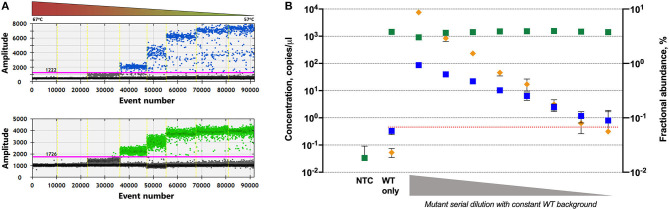
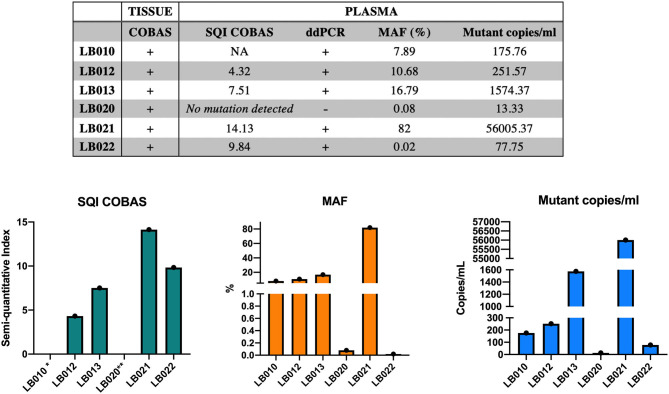
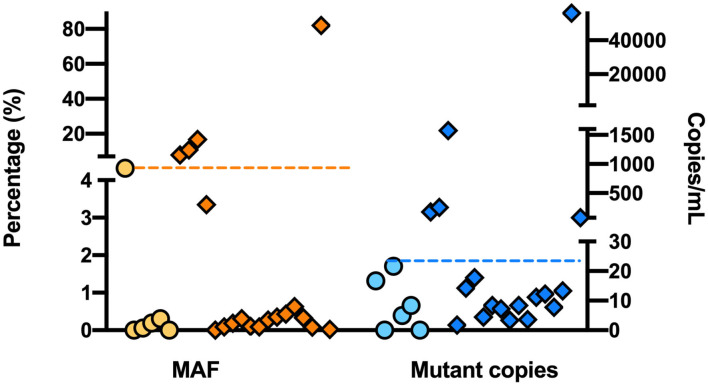
The main objectives of the study were (1) to set-up a droplet digital PCR (ddPCR) assay for the non-invasive detection of G719S EGFR mutation in NSCLC patients; (2) to determine the limits of detection of the ddPCR assay for G719S mutation and (3) to compare COBAS® and ddPCR System for G719S quantification in plasma. Blood samples were collected from 22 patients diagnosed with advanced NSCLC. Then, plasma ctDNA was extracted with the Qiagen Circulating Nucleic Acids kit and quantified by QuantiFluor® dsDNA System. The mutational study of EGFR was carried out by digital droplet PCR (ddPCR) with the QX200 Droplet Digital PCR System with specific probes and primers. We observed the lowest percentage of G719S mutant allele could be detected in a wildtype background was 0.058%. In the specificity analysis, low levels of G719S mutation were detected in healthy volunteers with a peak of 21.65 mutant copies per milliliter of plasma and 6.35 MAFs. In those patients whose tissue biopsy was positive for G719S mutation, mutant alleles could also be detected in plasma using both ddPCR and COBAS® System. Finally, when mutational status was studied using both genotyping techniques, higher mutant copies/ml and higher mutant allele fraction (MAF) correlated with higher Semiquantitative Index obtained by COBAS®. Although tissue biopsies cannot be replaced due to the large amount of information they provide regarding tumor type and structure, liquid biopsy and ddPCR represents a new promising strategy for genetic analysis of tumors from plasma samples. In the present study, G719S mutation was detected in a highly sensitive manner, allowing its monitorization with a non-invasive technique.
(1)建立一种用于非侵入性检测非小细胞肺癌(NSCLC)患者G719S表皮生长因子受体(EGFR)突变的液滴数字PCR(ddPCR)检测方法;(2)确定ddPCR检测方法对G719S突变的检测限;(3)比较COBAS®和ddPCR系统对血浆中G719S的定量分析。从22例诊断为晚期NSCLC的患者中采集血样。然后,使用Qiagen循环核酸试剂盒提取血浆循环肿瘤DNA(ctDNA),并通过QuantiFluor®双链DNA(dsDNA)系统进行定量。采用QX200液滴数字PCR系统,使用特异性探针和引物,通过数字液滴PCR(ddPCR)对EGFR进行突变研究。我们观察到,在野生型背景中能够检测到的G719S突变等位基因的最低百分比为0.058%。在特异性分析中,在健康志愿者中检测到低水平的G719S突变,血浆中每毫升峰值为21.65个突变拷贝,突变等位基因频率(MAF)为6.35。在那些组织活检G719S突变呈阳性的患者中,使用ddPCR和COBAS®系统均可在血浆中检测到突变等位基因。最后,当使用两种基因分型技术研究突变状态时,较高的每毫升突变拷贝数和较高的突变等位基因分数(MAF)与COBAS®获得的较高半定量指数相关。尽管由于组织活检能提供大量关于肿瘤类型和结构的信息而无法被取代,但液体活检和ddPCR代表了一种从血浆样本中对肿瘤进行基因分析的新的有前景的策略。在本研究中,以高灵敏度检测到G719S突变,从而能够通过非侵入性技术对其进行监测。