Department of Epidemiology and Cancer Control, St. Jude Children's Research Hospital, Memphis, Tennessee.
Department of Oncology, St. Jude Children's Research Hospital, Memphis, Tennessee.
Cancer Res. 2021 May 1;81(9):2556-2565. doi: 10.1158/0008-5472.CAN-20-2675. Epub 2020 Dec 7.
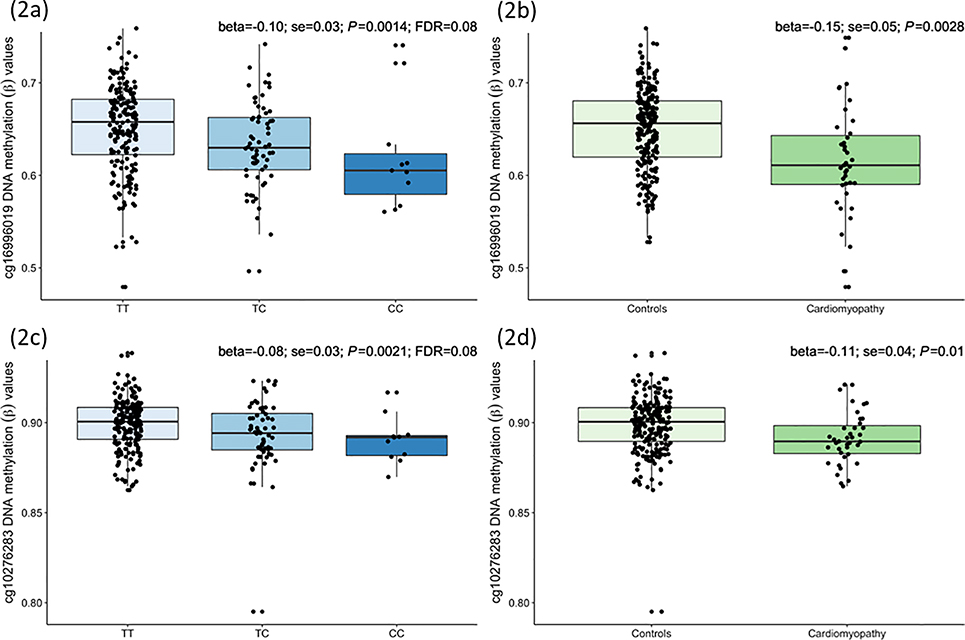
Cardiomyopathy occurs at significantly higher rates in survivors of childhood cancer than the general population, but few studies have evaluated racial or ethnic disparities, and none have assessed potential genetic factors contributing to this outcome. In this study, childhood cancer survivors of African ancestry exposed to cardiotoxic therapies (anthracyclines and/or heart radiotherapy; = 246) were compared with cardiotoxic-exposed survivors of European ancestry ( = 1,645) in the St. Jude Lifetime Cohort. Genetic variants were examined using whole-genome sequencing data among survivors of African ancestry, first based on ejection fraction (EF) as a continuous outcome, followed by clinical history of cardiomyopathy. Survivors of African ancestry showed 1.53- and 2.47-fold risks of CTCAE grade 2-4 and grade 3-4 cardiomyopathy than survivors of European ancestry. A novel locus at 1p13.2 showed significant association with EF (rs6689879C: EF reduction = 4.2%; = 2.8 × 10) in 246 survivors of African ancestry, which was successfully replicated in 1,645 survivors of European ancestry but with attenuated magnitude (EF reduction = 0.4%; = 0.042). In survivors of African ancestry, rs6689879C showed a 5.43-fold risk of cardiomyopathy and 1.31-fold risk in those of European ancestry. Among survivors of African ancestry with rs6689879C and CTCAE grade 2-4 cardiomyopathy, the promoter region was hypomethylated. Similar results were observed in survivors of European ancestry, albeit with reduced magnitudes of hypomethylation among those with rs6689879C and CTCAE grade 2-4 cardiomyopathy. was upregulated in human-induced pluripotent stem cell-derived cardiomyocytes from patients with doxorubicin-induced cardiomyopathy. These findings have potential implications for long-term cardiac surveillance and up-front cancer care for patients of African ancestry. SIGNIFICANCE: Childhood cancer survivors of African ancestry are at higher risk of cardiomyopathy than those of European ancestry, and a novel locus at 1p13.2 is associated with therapy-related cardiomyopathy specifically in African-American survivors..
与一般人群相比,儿童癌症幸存者患心肌病的比率明显更高,但很少有研究评估种族或族裔差异,也没有研究评估导致这种结果的潜在遗传因素。在这项研究中,接受过心脏毒性治疗(蒽环类药物和/或心脏放射治疗)的非洲裔儿童癌症幸存者(=246)与接受过心脏毒性治疗的欧洲裔儿童癌症幸存者(=1645)进行了比较。在非洲裔幸存者中,使用全基因组测序数据检查了遗传变异,首先基于射血分数(EF)作为连续结果,然后根据心肌病的临床病史。与欧洲裔幸存者相比,非洲裔幸存者患 CTCAE 2-4 级和 3-4 级心肌病的风险分别高出 1.53 倍和 2.47 倍。在 246 名非洲裔幸存者中,位于 1p13.2 的一个新基因座与 EF 显著相关(rs6689879C:EF 降低=4.2%;=2.8×10),在 1645 名欧洲裔幸存者中成功复制,但幅度减弱(EF 降低=0.4%;=0.042)。在非洲裔幸存者中,rs6689879C 导致心肌病的风险增加 5.43 倍,而欧洲裔幸存者的风险增加 1.31 倍。在携带 rs6689879C 和 CTCAE 2-4 级心肌病的非洲裔幸存者中, 启动子区域呈低甲基化状态。在携带 rs6689879C 和 CTCAE 2-4 级心肌病的欧洲裔幸存者中也观察到了类似的结果,尽管在携带 rs6689879*C 的幸存者中,低甲基化的幅度有所降低。在阿霉素诱导的心肌病患者来源的诱导多能干细胞衍生的心肌细胞中, 上调。这些发现对非洲裔患者的长期心脏监测和癌症治疗具有潜在意义。意义:与欧洲裔幸存者相比,非洲裔儿童癌症幸存者患心肌病的风险更高,位于 1p13.2 的一个新基因座与非洲裔美国幸存者特有的治疗相关心肌病相关。