Centre National de la Recherche Scientifique, Institut de Neurosciences de la Timone, Aix-Marseille Université, UMR 7289, Marseille, France.
Allgemeine und Experimentelle Psychologie, Ludwig-Maximilians-Universität München, Munich, Germany.
Sci Rep. 2020 Dec 7;10(1):21332. doi: 10.1038/s41598-020-78163-y.
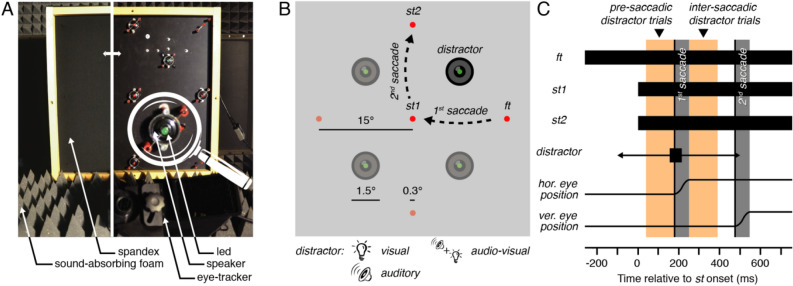
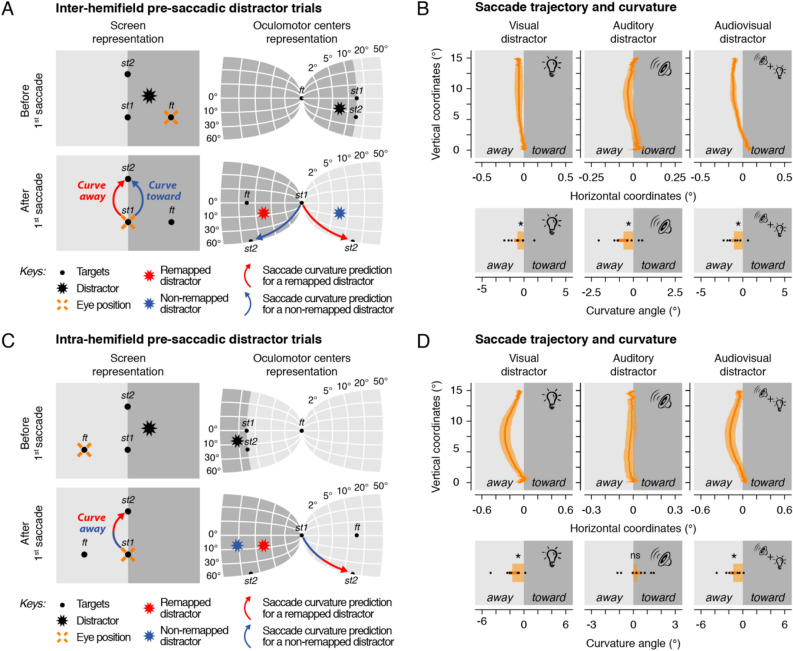
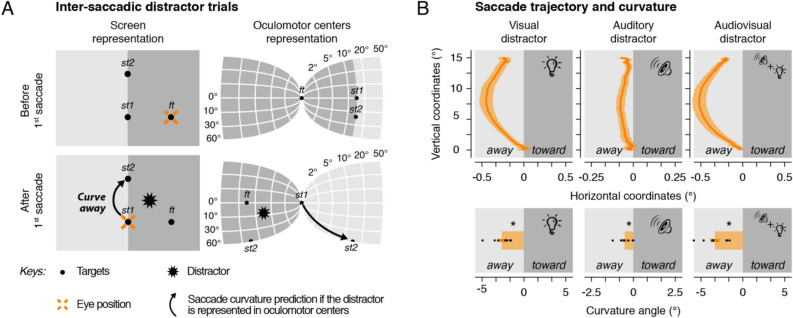
To achieve visual space constancy, our brain remaps eye-centered projections of visual objects across saccades. Here, we measured saccade trajectory curvature following the presentation of visual, auditory, and audiovisual distractors in a double-step saccade task to investigate if this stability mechanism also accounts for localized sounds. We found that saccade trajectories systematically curved away from the position at which either a light or a sound was presented, suggesting that both modalities are represented in eye-centered oculomotor centers. Importantly, the same effect was observed when the distractor preceded the execution of the first saccade. These results suggest that oculomotor centers keep track of visual, auditory and audiovisual objects by remapping their eye-centered representations across saccades. Furthermore, they argue for the existence of a supra-modal map which keeps track of multi-sensory object locations across our movements to create an impression of space constancy.
为了实现视觉空间恒常性,我们的大脑会在扫视过程中重新映射视觉物体的以眼为中心的投影。在这里,我们在双步扫视任务中测量了视觉、听觉和视听分散物呈现后的扫视轨迹曲率,以研究这种稳定性机制是否也适用于局部声音。我们发现,扫视轨迹系统地偏离了光或声音呈现的位置,这表明这两种模态都在以眼为中心的眼动中心得到了表示。重要的是,当干扰物先于第一次扫视的执行时,也观察到了相同的效果。这些结果表明,眼动中心通过在扫视过程中重新映射它们的以眼为中心的表示来跟踪视觉、听觉和视听物体。此外,它们还证明了存在一个超模态图,该图可以在我们的运动中跟踪多感官物体的位置,以产生空间恒常性的印象。