Riesterer J, Mauch M, Paul J, Gehring D, Ritzmann R, Wenning M
Rennbahnklinik, Muttenz, Basel, Switzerland.
Department of Sport and Sport Science, University of Freiburg, Freiburg, Germany.
BMC Sports Sci Med Rehabil. 2020 Oct 30;12(1):68. doi: 10.1186/s13102-020-00215-7.
Anterior cruciate ligament (ACL) ruptures are of major concern in sports. As mostly young and active individuals are affected there is an emphasis on the rapid and safe return to sports (RTS). Strengthening the ventral and dorsal thigh muscles is a prerequisite for a successful RTS after ACL reconstruction (ACLR), as persistent muscle weakness may increase the incidence for secondary injuries and impair performance. Aiming to increase evidence on the importance of preoperative muscle strength and the coaching of patients, the purpose of this study is to compare thigh muscle strength pre- and post-operatively after ACLR.
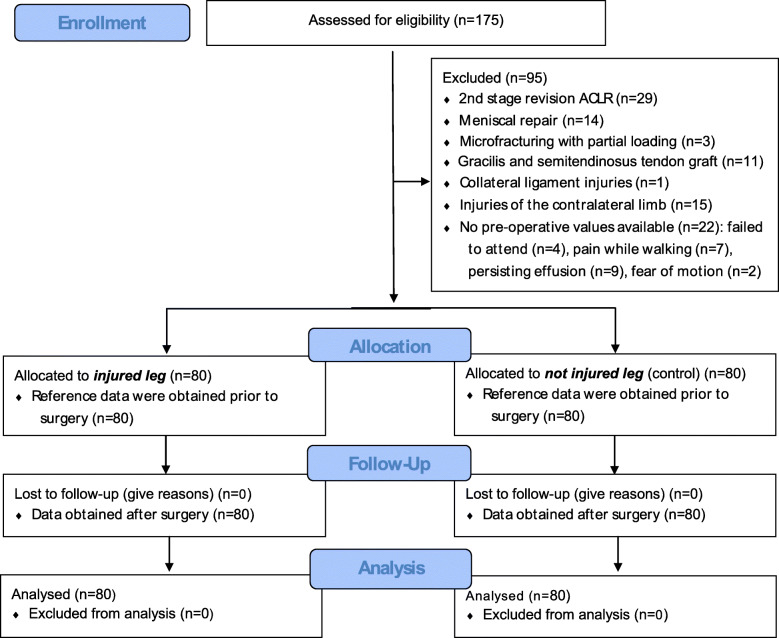
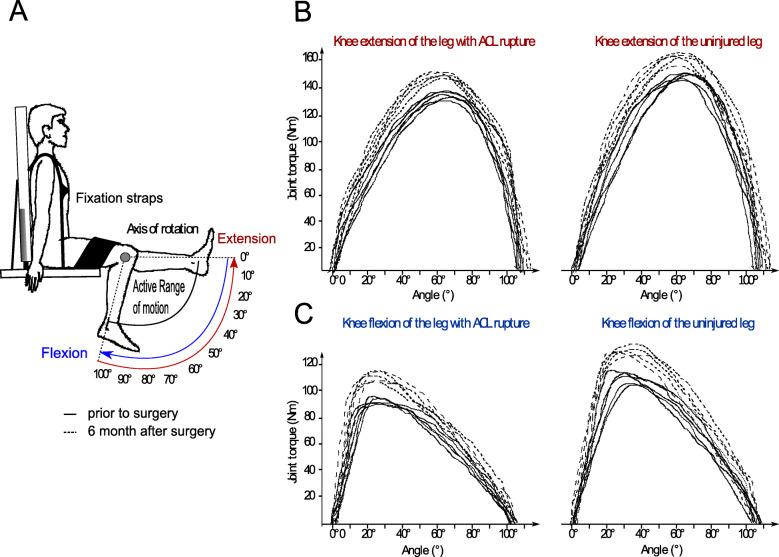
We performed a retrospective analysis of 80 patients with primary, isolated ACLR using a four-stranded hamstring autograft. We performed bilateral isokinetic concentric strength measurement (60°/s) before and six months after ACLR. Primary outcomes were the maximal knee extension and flexion torque, hamstrings-to-quadriceps ratio (H/Q ratio) and the corresponding limb symmetry indices (LSI). Pearson correlations were calculated for pre- and post-surgical values.
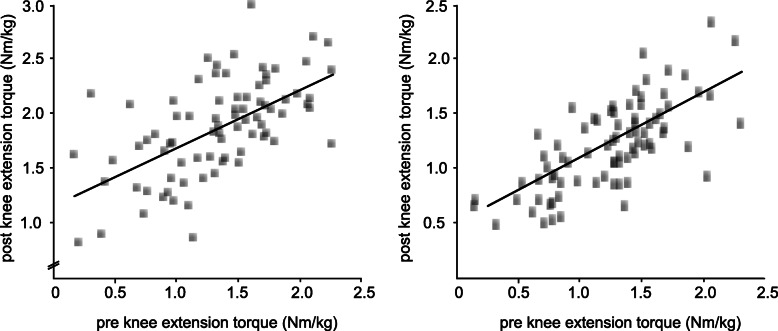
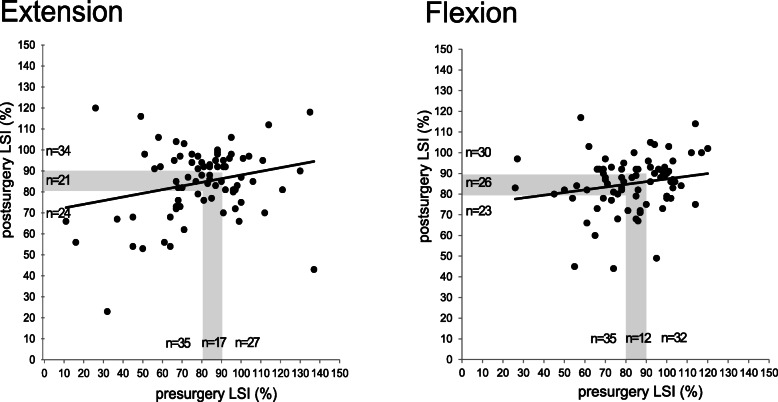
The operated as well as the unaffected leg increased maximal knee extension (+ 18% ± 7% p < 0.05; + 11% ± 5% p < 0.05) and flexion torque (+ 9% ± 5% p < 0.05, + 10% ± 6% p < 0.05) throughout the 6 months of rehabilitation. The H/Q ratio remained unaffected (- 2% ± 3% p = 0.93; - 4% ± 4% p = 0.27). LSI of knee extension strength increased significantly (6% ± 3% p < 0.05), while flexion strength remained unaffected (+ 2% ± 4% p = 0.27). Positive correlations underline the interrelationship between the strength pre- and post-surgery for the knee extension (r = 0.788 p < 0.05) and knee flexion strength (r = 0.637 p < 0.05) after ACLR.
Preoperative leg extension and flexion strength normalized to body mass are strongly correlated to postoperative strength performance after ACLR. Therefore, pre-operative quadriceps and hamstring muscle strength deficits may have a significant negative impact on functional performance following ACLR. This emphasizes the need for intensive preoperative screening and subsequent treatment to achieve the best possible preoperative leg strength before ACLR.
DRKS00020210 .
前交叉韧带(ACL)断裂是运动领域的主要关注点。由于受影响的大多是年轻且活跃的个体,因此强调快速且安全地重返运动(RTS)。加强大腿腹侧和背侧肌肉是ACL重建(ACLR)后成功实现RTS的前提条件,因为持续的肌肉无力可能会增加二次受伤的发生率并影响运动表现。为了增加关于术前肌肉力量的重要性及患者指导方面的证据,本研究的目的是比较ACLR前后的大腿肌肉力量。
我们对80例使用四股绳肌自体移植物进行初次、孤立性ACLR的患者进行了回顾性分析。在ACLR前及术后6个月进行双侧等速向心力量测量(60°/秒)。主要结果是最大膝关节伸展和屈曲扭矩、绳肌与股四头肌比率(H/Q比率)以及相应的肢体对称指数(LSI)。计算手术前后值的Pearson相关性。
在整个6个月的康复过程中,手术侧以及未受影响的腿的最大膝关节伸展(分别增加18%±7%,p<0.05;增加11%±5%,p<0.05)和屈曲扭矩(分别增加9%±5%,p<0.05;增加10%±6%,p<0.05)均有所增加。H/Q比率未受影响(分别降低2%±3%,p=0.93;降低4%±4%,p=0.27)。膝关节伸展力量的LSI显著增加(6%±3%,p<0.05),而屈曲力量未受影响(增加2%±4%,p=0.27)。正相关性强调了ACLR后膝关节伸展(r=0.788 p<0.05)和膝关节屈曲力量(r=0.637 p<0.05)手术前后力量之间的相互关系。
术前按体重标准化的腿部伸展和屈曲力量与ACLR后的术后力量表现密切相关。因此,术前股四头肌和绳肌力量不足可能会对ACLR后的功能表现产生重大负面影响。这强调了在ACLR前进行强化术前筛查及后续治疗以尽可能获得最佳术前腿部力量的必要性。
DRKS00020210