Mathew Zachariah Pulluparampil, Rajan Keerthi, Augustine Cyril, Joseph Bincy, John Sam
Department of Chemistry, St. Berchmans College (Autonomous) Campus, Mahatma Gandhi University, Kottayam, 686101, India.
Department of Chemistry, Rajiv Gandhi Institute of Technology, Kottayam, 686501, India.
Heliyon. 2020 Nov 23;6(11):e05560. doi: 10.1016/j.heliyon.2020.e05560. eCollection 2020 Nov.
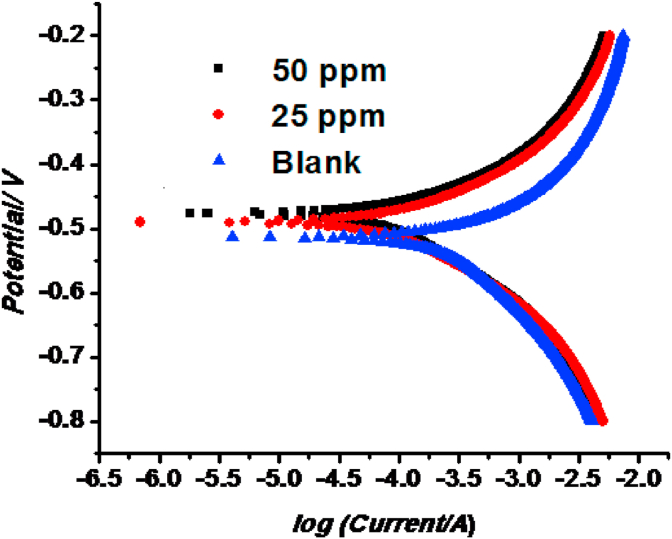
Effective inhibition of metallic corrosion to prevent its consequent loss is one of the serious apprehensions for industries in the modern world. This paper analyses the application of poly(2-ethyl-2-oxazoline) (PEOX) as an effective inhibitor of corrosion, when it is made to be in contact with the surfaces of mild steel (MS). The sustainability of MS against corrosion in 0.1 M Hydrochloric acid solution in the presence of known concentration of PEOX is assessed by potentiodynamic polarization (PDP) measurements, linear polarization studies (LPR), and electrochemical impedance spectroscopy (EIS). It was observed that PEOX behaves as better inhibitor for mild steel corrosion in 0.1 M HCl solution and it show enhanced inhibition efficiency (IE%) 79% at a concentration of 50 ppm. The polarization experiments indicated that addition of PEOX in concentrations varies from 25 ppm to 50 ppm induces a decrease of both cathodic and anodic currents densities. Also, the micrographs recorded by the Scanning Electron Microscopy confirm that molecules of PEOX act as corrosion inhibitors for the surfaces of MS in 0.1 M HCl. The stability of the MS surface in a corrosion-prone environment is traced by measuring the contact angles of water droplets placed on the MS surface, to quantify the extent of deterioration, if any, due to corrosion. The results presented here show that the compound PEOX performs as a mixed-type inhibitor against corrosion at the MS surface in acidic medium. Theoretical studies based on the electronic structure of PEOX in aqueous medium also support its performance as a successful corrosion-inhibitor.
有效抑制金属腐蚀以防止其后续损失是现代世界各行业面临的严重担忧之一。本文分析了聚(2-乙基-2-恶唑啉)(PEOX)在与低碳钢(MS)表面接触时作为一种有效的腐蚀抑制剂的应用。通过动电位极化(PDP)测量、线性极化研究(LPR)和电化学阻抗谱(EIS)评估了在已知浓度的PEOX存在下,低碳钢在0.1 M盐酸溶液中的耐腐蚀可持续性。观察到PEOX在0.1 M HCl溶液中对低碳钢腐蚀表现为更好的抑制剂,并且在浓度为50 ppm时显示出增强的抑制效率(IE%)为79%。极化实验表明,添加浓度在25 ppm至50 ppm之间变化的PEOX会导致阴极和阳极电流密度均降低。此外,扫描电子显微镜记录的显微照片证实,PEOX分子在0.1 M HCl中对低碳钢表面起到腐蚀抑制剂的作用。通过测量放置在低碳钢表面的水滴的接触角来追踪低碳钢表面在易腐蚀环境中的稳定性,以量化由于腐蚀导致的劣化程度(如果有的话)。此处给出的结果表明,化合物PEOX在酸性介质中作为低碳钢表面腐蚀的混合型抑制剂发挥作用。基于PEOX在水性介质中的电子结构的理论研究也支持其作为成功的腐蚀抑制剂的性能。