Jia Bo, Dong Zhi, Wu Di, Zhao Jun, Wu Meina, An Tongtong, Wang Yuyan, Zhuo Minglei, Li Jianjie, Wang Yang, Zhang Jie, Zhao Xinghui, Li Sheng, Li Junfeng, Ma Menglei, Chen Chen, Yang Xue, Zhong Jia, Chen Hanxiao, Wang Jingjing, Chi Yujia, Zhai Xiaoyu, Cui Song, Zhang Rong, Ma Qingwei, Fang Jian, Wang Ziping
Key laboratory of Carcinogenesis and Translational Research (Ministry of Education/ Beijing), Department of Thoracic Medical Oncology, Peking University Cancer Hospital & Institute, 52 Fucheng Road, Haidian District, Beijing, 100142, China.
Key laboratory of Carcinogenesis and Translational Research (Ministry of Education/ Beijing), Department of GI Oncology, Peking University Cancer Hospital & Institute, Beijing, China.
Cancer Cell Int. 2020 Dec 9;20(1):590. doi: 10.1186/s12935-020-01662-5.
Although advanced non-squamous non-small cell lung cancer (NSCLC) patients have significantly better survival outcomes after pemetrexed based treatment, a subset of patients still show intrinsic resistance and progress rapidly. Therefore we aimed to use a blood-based protein signature (VeriStrat, VS) to analyze whether VS could identify the subset of patients who had poor efficacy on pemetrexed therapy.
This study retrospectively analysed 72 advanced lung adenocarcinoma patients who received first-line pemetrexed/platinum or combined with bevacizumab treatment.
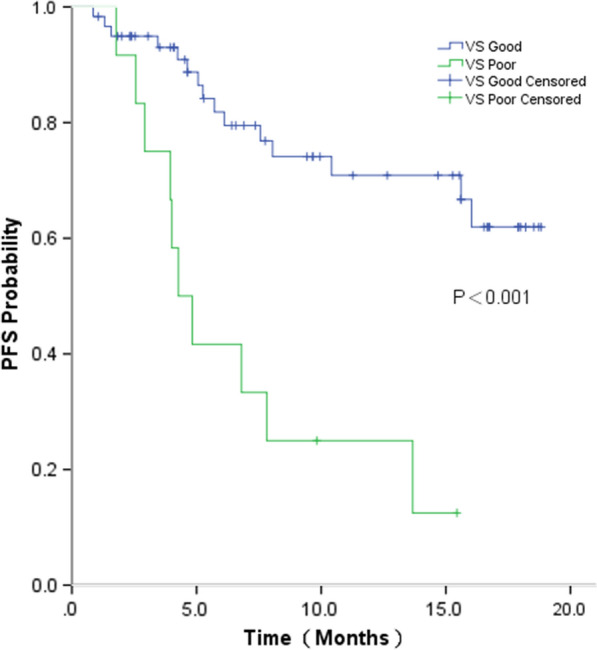
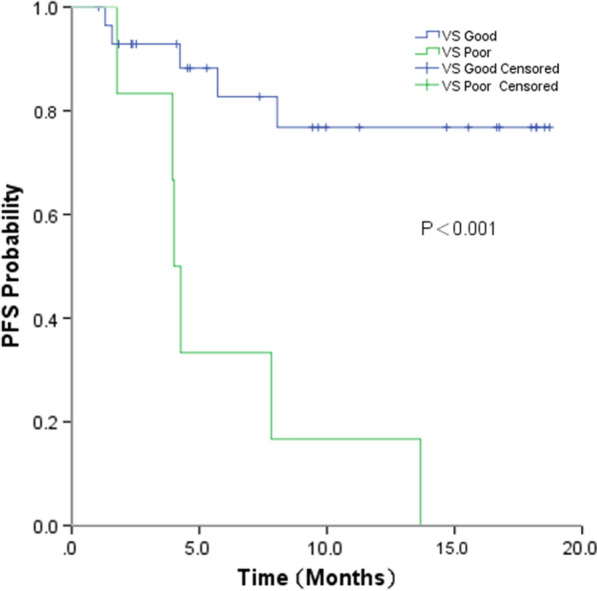
Plasma samples from these patients were analysed using VS and classified into the Good (VS-G) or Poor (VS-P) group. The relationship between efficacy and VS status was further investigated. Of the 72 patients included in this study, 35 (48.6%) were treated with pemetrexed plus platinum and 37 (51.4%) were treated with pemetrexed/platinum combined with bevacizumab. Among all patients, 60 (83.3%) and 12 (16.7%) patients were classified as VS-G and VS-P, respectively. VS-G patients had significantly better median progression-free survival (PFS) (Unreached vs. 4.2 months; P < 0.001) than VS-P patients. In addition, the partial response (PR) rate was higher in the VS-G group than that in the VS-P group (46.7% vs. 25.0%, P = 0.212). Subgroup analysis showed that PFS was also significantly longer in the VS-G group than that in the VS-P group regardless of whether patients received chemotherapy alone or chemotherapy plus bevacizumab.
Our study indicated that VS might be considered as a novel and valid method to predict the efficacy of pemetrexed-based therapy and identify a subset of advanced lung adenocarcinoma patients who had intrinsic resistance to pemetrexed based regimens. However, larger sample studies are still needed to further confirm this result.
尽管晚期非鳞状非小细胞肺癌(NSCLC)患者在接受培美曲塞治疗后生存结果有显著改善,但仍有一部分患者表现出内在耐药性且进展迅速。因此,我们旨在使用基于血液的蛋白质标志物(VeriStrat,VS)来分析VS是否能够识别出对培美曲塞治疗疗效不佳的患者亚组。
本研究回顾性分析了72例接受一线培美曲塞/铂类或联合贝伐单抗治疗的晚期肺腺癌患者。
使用VS对这些患者的血浆样本进行分析,并分为良好(VS-G)组或不良(VS-P)组。进一步研究疗效与VS状态之间的关系。本研究纳入的72例患者中,35例(48.6%)接受培美曲塞加铂类治疗,37例(51.4%)接受培美曲塞/铂类联合贝伐单抗治疗。在所有患者中,分别有60例(83.3%)和12例(16.7%)患者被分类为VS-G和VS-P。VS-G组患者的中位无进展生存期(PFS)显著优于VS-P组(未达到 vs. 4.2个月;P < 0.001)。此外,VS-G组的部分缓解(PR)率高于VS-P组(46.7% vs. 25.0%,P = 0.212)。亚组分析表明,无论患者接受单纯化疗还是化疗加贝伐单抗,VS-G组的PFS也显著长于VS-P组。
我们的研究表明,VS可能被视为一种预测基于培美曲塞治疗疗效的新颖且有效的方法,并识别出对基于培美曲塞方案有内在耐药性的晚期肺腺癌患者亚组。然而,仍需要更大样本的研究来进一步证实这一结果。