MRC Mitochondrial Biology Unit, University of Cambridge, Cambridge, UK.
School of Chemistry, University of Glasgow, Glasgow, UK.
J Biol Chem. 2021 Jan-Jun;296:100169. doi: 10.1074/jbc.RA120.016551. Epub 2020 Dec 13.
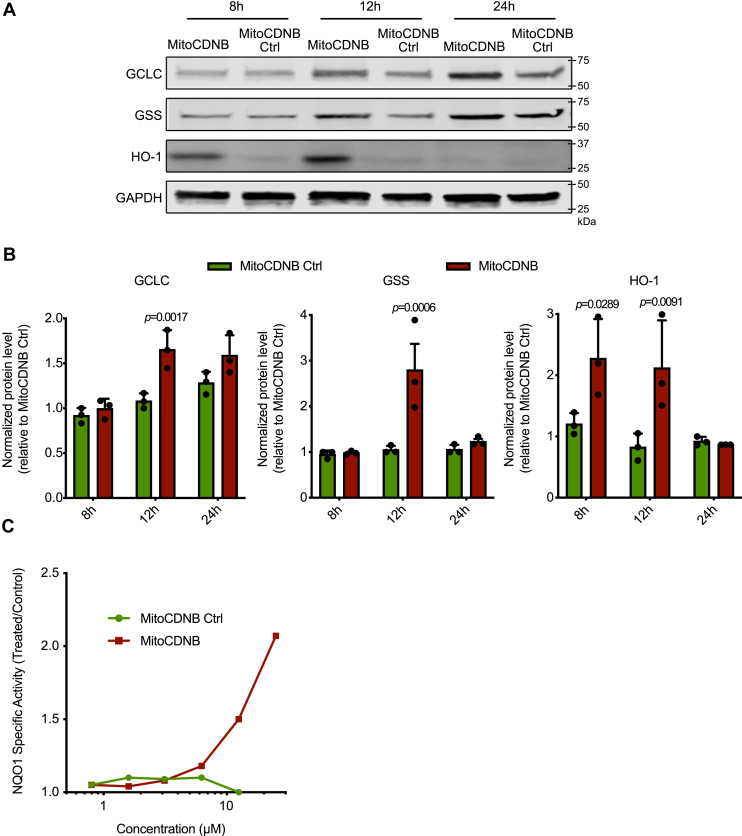
The transcription factor nuclear factor erythroid 2-related factor 2 (Nrf2) regulates the expression of genes involved in antioxidant defenses to modulate fundamental cellular processes such as mitochondrial function and GSH metabolism. Previous reports proposed that mitochondrial reactive oxygen species production and disruption of the GSH pool activate the Nrf2 pathway, suggesting that Nrf2 senses mitochondrial redox signals and/or oxidative damage and signals to the nucleus to respond appropriately. However, until now, it has not been possible to disentangle the overlapping effects of mitochondrial superoxide/hydrogen peroxide production as a redox signal from changes to mitochondrial thiol homeostasis on Nrf2. Recently, we developed mitochondria-targeted reagents that can independently induce mitochondrial superoxide and hydrogen peroxide production mitoParaquat (MitoPQ) or selectively disrupt mitochondrial thiol homeostasis MitoChlorodinitrobenzoic acid (MitoCDNB). Using these reagents, here we have determined how enhanced generation of mitochondrial superoxide and hydrogen peroxide or disruption of mitochondrial thiol homeostasis affects activation of the Nrf2 system in cells, which was assessed by the Nrf2 protein level, nuclear translocation, and expression of its target genes. We found that selective disruption of the mitochondrial GSH pool and inhibition of its thioredoxin system by MitoCDNB led to Nrf2 activation, whereas using MitoPQ to enhance the production of mitochondrial superoxide and hydrogen peroxide alone did not. We further showed that Nrf2 activation by MitoCDNB requires cysteine sensors of Kelch-like ECH-associated protein 1 (Keap1). These findings provide important information on how disruption to mitochondrial redox homeostasis is sensed in the cytoplasm and signaled to the nucleus.
转录因子核因子红细胞 2 相关因子 2(Nrf2)调节参与抗氧化防御的基因表达,以调节基本的细胞过程,如线粒体功能和 GSH 代谢。先前的报告提出,线粒体活性氧的产生和 GSH 池的破坏激活了 Nrf2 途径,表明 Nrf2 感知线粒体氧化还原信号和/或氧化损伤,并向核发出适当的信号。然而,到目前为止,还不可能将线粒体超氧化物/过氧化氢产生作为氧化还原信号与线粒体巯基稳态的变化对 Nrf2 的重叠影响区分开来。最近,我们开发了线粒体靶向试剂,可以独立地诱导线粒体超氧化物和过氧化氢的产生 mitoParaquat(MitoPQ)或选择性地破坏线粒体巯基稳态 MitoChlorodinitrobenzoic acid(MitoCDNB)。使用这些试剂,我们在这里确定了增强的线粒体超氧化物和过氧化氢的产生或破坏线粒体巯基稳态如何影响细胞中 Nrf2 系统的激活,这是通过 Nrf2 蛋白水平、核易位和其靶基因的表达来评估的。我们发现,MitoCDNB 选择性地破坏线粒体 GSH 池并抑制其硫氧还蛋白系统会导致 Nrf2 激活,而单独使用 MitoPQ 增强线粒体超氧化物和过氧化氢的产生则不会。我们进一步表明,MitoCDNB 激活 Nrf2 需要 Kelch-like ECH-associated protein 1(Keap1)的半胱氨酸传感器。这些发现提供了关于细胞质中如何感知线粒体氧化还原稳态的破坏以及如何向核发出信号的重要信息。