Department of Clinical Neuroscience and Therapeutics, Hiroshima University Graduate School of Biomedical and Health Sciences.
Department of Neurology, Chikamori Hospital.
J Atheroscler Thromb. 2022 Jan 1;29(1):99-110. doi: 10.5551/jat.59642. Epub 2020 Dec 9.
The prediction of functional outcome is essential in the management of acute ischemic stroke patients. We aimed to explore the various prognostic factors with multivariate linear discriminant analysis or neural network analysis and evaluate the associations between candidate factors, baseline characteristics, and outcome.
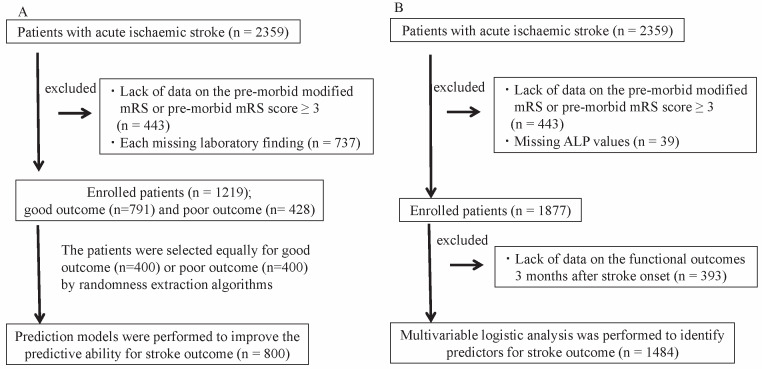
Acute ischemic stroke patients (n=1,916) with premorbid modified Rankin Scale (mRS) scores of 0-2 were analyzed. The prediction models with multivariate linear discriminant analysis (quantification theory type II) and neural network analysis (log-linearized Gaussian mixture network) were used to predict poor functional outcome (mRS 3-6 at 3 months) with various prognostic factors added to age, sex, and initial neurological severity at admission.
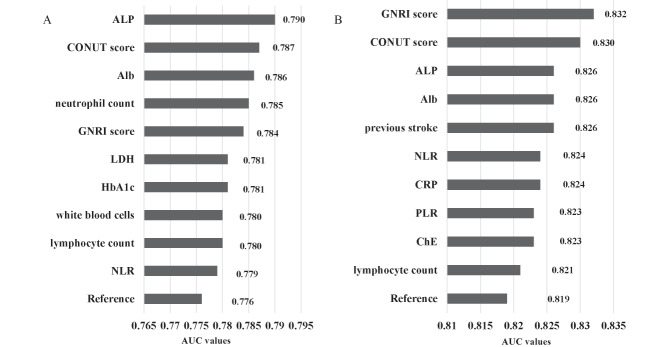
Both models revealed that several nutritional statuses and serum alkaline phosphatase (ALP) levels at admission improved the predictive ability. Of the 1,484 patients without missing data, 560 patients (37.7%) had poor outcomes. The patients with poor outcomes had higher ALP levels than those without (294.3±259.5 vs. 246.3±92.5 U/l, P<0.001). Multivariable logistic analyses revealed that higher ALP levels (1-SD increase) were independently associated with poor stroke outcomes after adjusting for several confounding factors, including the neurological severity, malnutrition status, and inflammation (odds ratio 1.21, 95% confidence interval 1.02-1.49). Several nutritional indicators extracted from prediction models were also associated with poor outcome.
Both the multivariate linear discriminant and neural network analyses identified the same indicators, such as nutritional status and serum ALP levels. These indicators were independently associated with functional stroke outcome.
对急性缺血性脑卒中患者进行功能预后预测至关重要。本研究旨在通过多元线性判别分析或神经网络分析探索各种预后因素,并评估候选因素、基线特征与结局之间的关联。
对 1916 例发病前改良Rankin 量表(mRS)评分为 0-2 的急性缺血性脑卒中患者进行分析。采用多元线性判别分析(定量理论Ⅱ型)和神经网络分析(对数线性化高斯混合网络),将年龄、性别和入院时初始神经功能严重程度与各种预后因素相结合,预测 3 个月时 mRS 3-6 的不良功能结局。
两种模型均表明,入院时的几种营养状况和血清碱性磷酸酶(ALP)水平可改善预测能力。在 1484 例无缺失数据的患者中,560 例(37.7%)预后不良。预后不良的患者 ALP 水平高于无不良预后的患者(294.3±259.5 vs. 246.3±92.5 U/l,P<0.001)。多变量逻辑分析显示,在校正包括神经严重程度、营养不良状态和炎症等多种混杂因素后,ALP 水平升高(1-SD 增加)与较差的卒中结局独立相关(比值比 1.21,95%置信区间 1.02-1.49)。从预测模型中提取的几种营养指标也与不良结局相关。
多元线性判别分析和神经网络分析均确定了相同的指标,如营养状况和血清 ALP 水平。这些指标与功能卒中结局独立相关。