Department of Neurology, Xi'an No.1 Hospital, The First Affiliated Hospital of Northwest University, Xi'an, 710002, China.
Department of Epidemiology and Biostatistics, School of Public Health of Xi'an Jiaotong University Health Science Center, Xi'an, 710061, China.
BMC Neurol. 2022 Jul 7;22(1):249. doi: 10.1186/s12883-022-02779-y.
In recent years, alkaline phosphatase (ALP) has been considered as one of the independent risk factors of acute ischemic stroke (AIS) and leads to worse clinical outcomes in patients with renal failure. In this study, we aim to investigate whether serum ALP level is associated with poor early-term prognosis in relationship of AIS patients with preserved renal function.
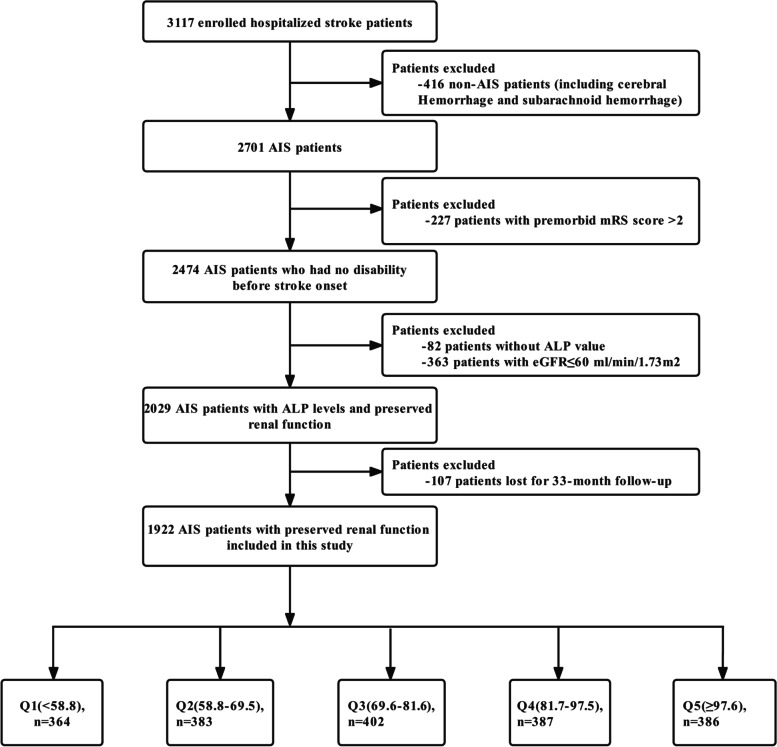
A prospectively collected database of AIS patients hospitalized in the Xi'an district of China from January to December, 2015 was analyzed. The demographics, serum ALP levels and stroke outcomes of all patients at 3 months were reviewed. Patients were routinely followed-up for 3 months. Serum ALP level was analyzed as a continuous variable and quintiles (Q1-Q5). Multivariate logistic regression model and a two-piecewise linear regression model were used to investigate the relationship and to determine the threshold effect regarding serum ALP levels and poor 3-month prognosis of AIS patients with preserved renal function.
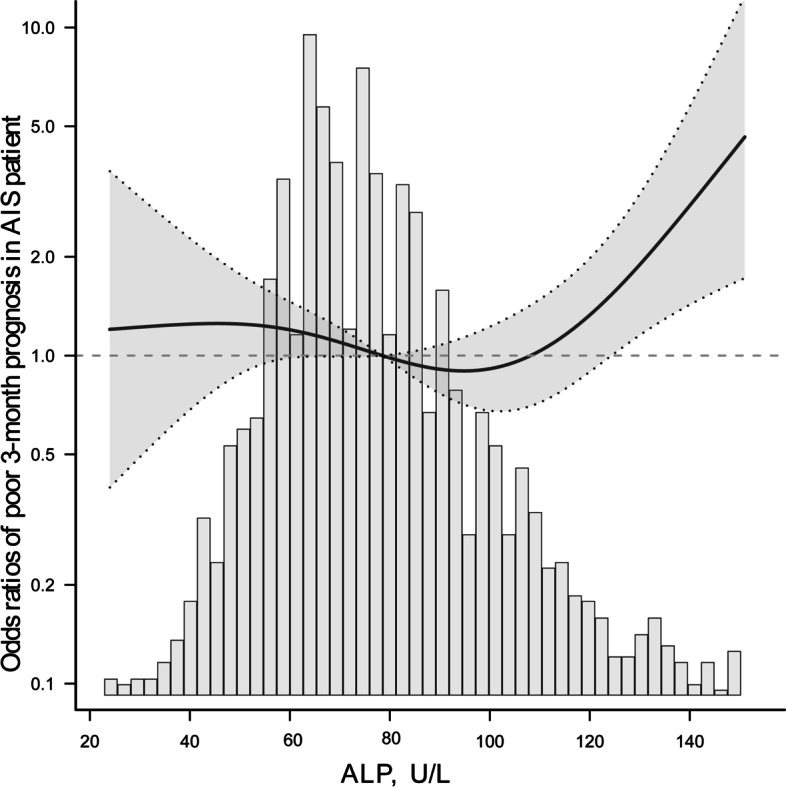
Overall, 1922 AIS patients were enrolled with 62.3% of them being men. The risk of having a poor 3-month prognosis was significantly increased in Q1, Q2, Q3 and Q5, when compared to that in Q4 being as the reference. The highest risk was noted in Q5 (odds ratio 2.21, 95% confidence interval: 1.32-3.73, P = 0.003) after being adjusted for confounders. Further analysis revealed a J-shaped curvilinear relationship between ALP levels and a poor 3-month prognosis of strokes (optimal threshold ALP level = 90 U/L). The relationship between both parameters was not significantly affected by age, sex, drinking, hypertension and leukocyte count (stratified by 10 × 10/L) (P for interaction > 0.05).
Serum ALP was noted as an independent risk factor for a poor 3-month prognosis of AIS patients with preserved renal function. ALP levels higher than 90 U/L could cause an increased risk of a poor 3-month prognosis.
近年来,碱性磷酸酶(ALP)被认为是急性缺血性脑卒中(AIS)的独立危险因素之一,可导致肾衰竭患者的临床结局恶化。本研究旨在探讨血清 ALP 水平与肾功能正常的 AIS 患者不良短期预后的关系。
对 2015 年 1 月至 12 月在中国西安地区住院的 AIS 患者的前瞻性数据库进行了分析。回顾了所有患者在 3 个月时的人口统计学资料、血清 ALP 水平和卒中结局。患者常规随访 3 个月。血清 ALP 水平作为连续变量和五分位数(Q1-Q5)进行分析。多变量 logistic 回归模型和两段线性回归模型用于探讨血清 ALP 水平与肾功能正常的 AIS 患者不良 3 个月预后的关系,并确定其阈值效应。
共纳入 1922 例 AIS 患者,其中 62.3%为男性。与 Q4 作为参考相比,Q1、Q2、Q3 和 Q5 组发生不良 3 个月预后的风险显著增加。调整混杂因素后,Q5 组的风险最高(优势比 2.21,95%置信区间:1.32-3.73,P=0.003)。进一步分析显示,ALP 水平与卒中不良 3 个月预后之间存在 J 形曲线关系(最佳阈值 ALP 水平=90 U/L)。这两个参数之间的关系不受年龄、性别、饮酒、高血压和白细胞计数(分层为 10×10/L)(交互 P>0.05)的显著影响。
血清 ALP 是肾功能正常的 AIS 患者不良 3 个月预后的独立危险因素。ALP 水平高于 90 U/L 可增加不良 3 个月预后的风险。