Hiromoto Yoshitaka, Azuma Yoshiteru, Suzuki Yuichi, Hoshina Megumi, Uchiyama Yuri, Mitsuhashi Satomi, Miyatake Satoko, Mizuguchi Takeshi, Takata Atsushi, Miyake Noriko, Kato Mitsuhiro, Matsumoto Naomichi
Department of Human Genetics, Yokohama City University Graduate School of Medicine, 3-9 Fukuura, Kanazawa, Yokohama, 236-0004, Japan.
Department of Pediatrics, Fukushima Medical University School of Medicine, Fukushima, 960-1295, Japan.
Hum Genome Var. 2020 Dec 3;7(1):43. doi: 10.1038/s41439-020-00131-9.
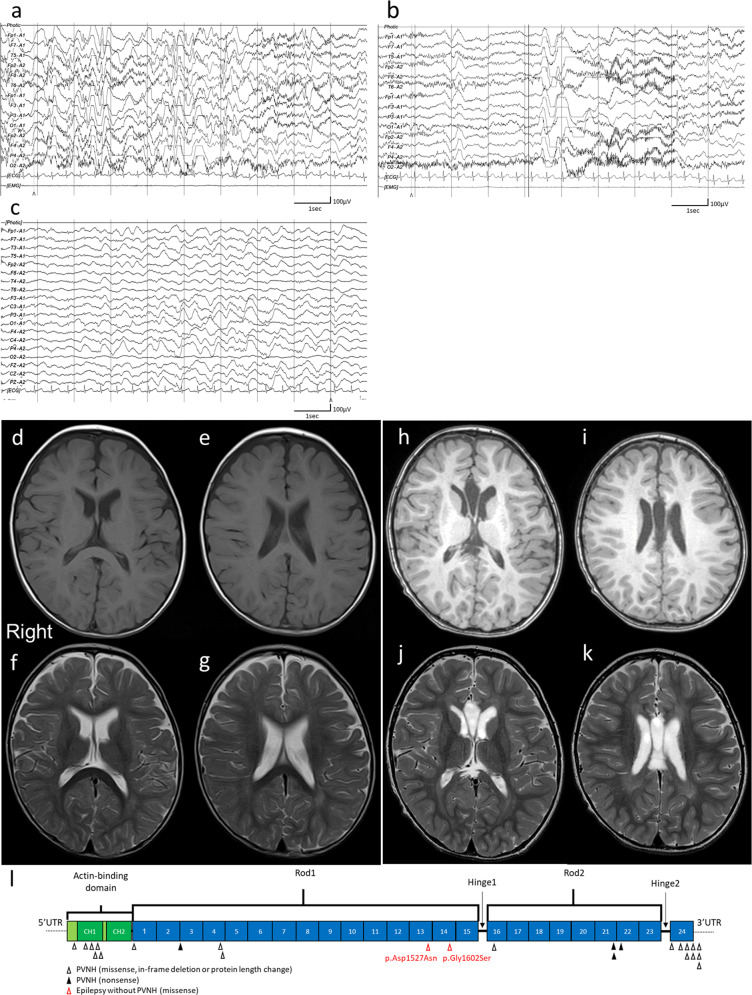
Pathogenic FLNA variants can be identified in patients with seizures accompanied by periventricular nodular heterotopia (PVNH). It is unusual to find FLNA aberrations in epileptic patients without PVNH on brain imaging. We report a boy with cryptogenic West syndrome followed by refractory seizures and psychomotor delay. We performed whole-exome sequencing and identified a de novo missense variant in FLNA. It is noteworthy that this patient showed no PVNH. As no other pathogenic variants were found in epilepsy-related genes, this FLNA variant likely caused West syndrome but with no PVNH.
在伴有脑室周围结节性异位(PVNH)的癫痫患者中可发现致病性FLNA变异。在脑部影像学检查中,未发现PVNH的癫痫患者出现FLNA畸变的情况并不常见。我们报告了一名患有隐源性韦斯特综合征的男孩,随后出现难治性癫痫发作和精神运动发育迟缓。我们进行了全外显子组测序,并在FLNA中鉴定出一种新生错义变异。值得注意的是,该患者未出现PVNH。由于在癫痫相关基因中未发现其他致病性变异,这种FLNA变异可能导致了韦斯特综合征,但未出现PVNH。