
可生物降解食品包装材料以及第四次工业革命对番茄果实和产品处理的前景
Biodegradable Food Packaging Materials and Prospects of the Fourth Industrial Revolution for Tomato Fruit and Product Handling.
作者信息
Chisenga S M, Tolesa G N, Workneh T S
机构信息
School of Engineering, Bioresources Engineering, University of KwaZulu-Natal, Pietermaritzburg, South Africa.
Department of Food Science and Postharvest Technology, Haramaya Institute of Technology, Haramaya University, Dire Dawa, Ethiopia.
出版信息
Int J Food Sci. 2020 Nov 21;2020:8879101. doi: 10.1155/2020/8879101. eCollection 2020.
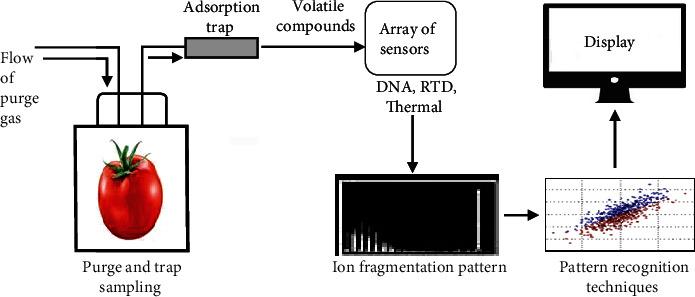
The environment and food safety are major areas of concern influencing the development of biodegradable packaging for partial replacement of petrochemical-based polymers. This review is aimed at updating the recent advances in biodegradable packaging material and the role of virtual technology and nanotechnology in the tomato supply chain. Some of the common biodegradable materials are gelatin, starch, chitosan, cellulose, and polylactic acid. The tensile strength, tear resistance, permeability, degradability, and solubility are some of the properties defining the selection and utilization of food packaging materials. Biodegradable films can be degraded in soil by microbial enzymatic actions and bioassimilation. Nanoparticles are incorporated into blended films to improve the performance of packaging materials. The prospects of the fourth industrial revolution can be realized with the use of virtual platforms such as sensor systems in authentification and traceability of food and packaging products. There is a research gap on the development of a hybrid sensor system unit that can integrate sampling headspace (SHS), detection unit, and data processing of big data for heterogeneous tomato-derived volatiles. Principal component analysis (PCA), linear discriminant analysis (LDA), and artificial neutral network (ANN) are some of the common mathematical models for data interpretation of sensor systems.
环境与食品安全是影响可生物降解包装发展以部分替代石化基聚合物的主要关注领域。本综述旨在更新可生物降解包装材料的最新进展以及虚拟技术和纳米技术在番茄供应链中的作用。一些常见的可生物降解材料有明胶、淀粉、壳聚糖、纤维素和聚乳酸。拉伸强度、抗撕裂性、渗透性、可降解性和溶解性是定义食品包装材料选择和使用的部分特性。可生物降解薄膜可通过微生物酶作用和生物同化作用在土壤中降解。纳米颗粒被掺入混合薄膜中以改善包装材料的性能。利用虚拟平台,如用于食品和包装产品认证及可追溯性的传感器系统,可实现第四次工业革命的前景。在开发一种能整合顶空采样(SHS)、检测单元以及对异质番茄衍生挥发物进行大数据处理的数据处理功能的混合传感器系统单元方面存在研究空白。主成分分析(PCA)、线性判别分析(LDA)和人工神经网络(ANN)是传感器系统数据解释的一些常见数学模型。
 Zotero 插件