Department of Respiratory Medicine, Kumamoto University Hospital, Kumamoto, Japan.
Laboratory of Stem Cell and Neuro-Vascular Biology, Genetics and Developmental Biology Center, National Heart, Lung, and Blood Institute, National Institutes of Health, Bethesda, Maryland, USA.
Thorac Cancer. 2021 Feb;12(3):397-401. doi: 10.1111/1759-7714.13772. Epub 2020 Dec 9.
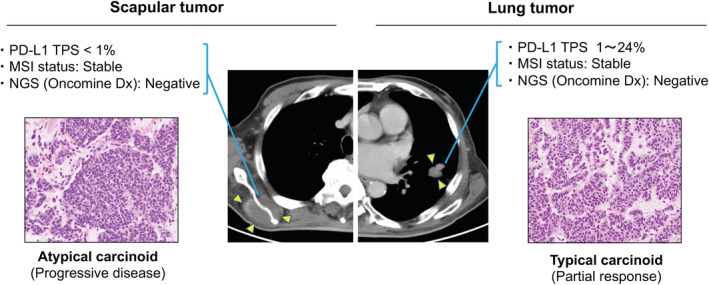
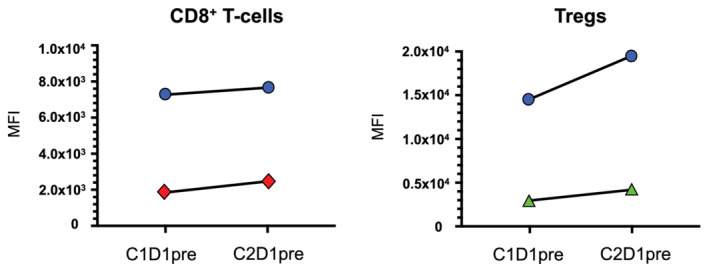
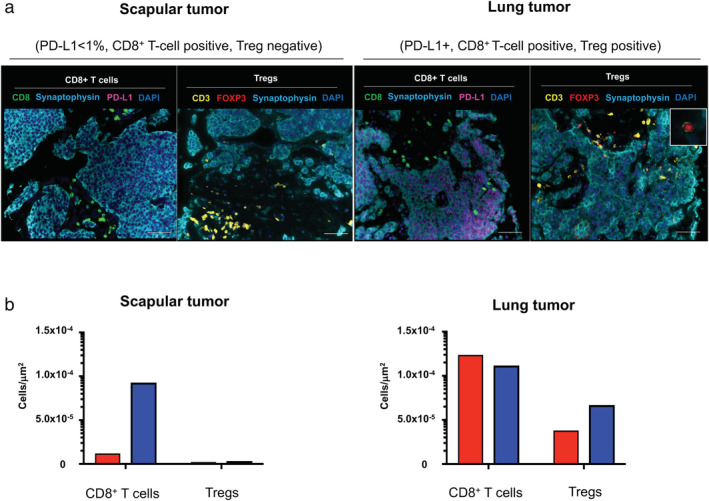
A pulmonary carcinoid tumor is a rare tumor that lacks a validated therapeutic approach for unresectable disease. Understanding the intersite tumor-immune heterogeneity is essential to harness the immune system for cancer therapy. However, little is known about the tumor-immune microenvironment (TIME). Here, we describe a patient who had heterogeneous TIME between primary and metastatic carcinoid tumors which differentially responded to chemoimmunotherapy. A 72-year-old man was diagnosed with an advanced pulmonary carcinoid tumor. CT-guided biopsies of lung and scapular tumors confirmed typical carcinoid (PD-L1, 1%-24%) and atypical carcinoid tumors (PD-L1, negative), respectively. Although the primary lung carcinoid tumor showed a partial response, the scapular tumor was significantly enlarged after two cycles of anti-PD-L1 antibody therapy in combination with carboplatin plus etoposide. We performed quantitative pathology imaging analysis with fluorescent multiplex immunohistochemistry. CD8 T cell infiltration was detected in the PD-L1-positive primary lung tumor nest; however, it was mostly restrained in the stroma in a PD-L1-negative metastatic scapular tumor. Treg infiltrations into both tumor nests and stroma were detected in the lung tumor, which were not detected in the metastatic scapular tumor. This study provides the first evidence of coexistence of heterogeneous TIME within a single individual with a pulmonary carcinoid tumor. This study may provide new insights into the mechanism of primary resistance to chemoimmunotherapy in pulmonary carcinoid tumors.
肺类癌肿瘤是一种罕见的肿瘤,对于不可切除的疾病缺乏经过验证的治疗方法。了解肿瘤免疫异质性对于利用免疫系统进行癌症治疗至关重要。然而,对于肿瘤免疫微环境(TIME)知之甚少。在这里,我们描述了一位患者的原发性和转移性类癌肿瘤之间存在异质性 TIME,它们对化疗免疫治疗的反应不同。一名 72 岁男性被诊断患有晚期肺类癌肿瘤。肺和肩胛骨肿瘤的 CT 引导活检分别证实为典型类癌(PD-L1,1%-24%)和非典型类癌肿瘤(PD-L1,阴性)。尽管原发性肺类癌肿瘤显示部分缓解,但在抗 PD-L1 抗体治疗联合卡铂加依托泊苷治疗两个周期后,肩胛骨肿瘤明显增大。我们使用荧光多重免疫组织化学进行了定量病理学成像分析。在 PD-L1 阳性的原发性肺肿瘤巢中检测到 CD8 T 细胞浸润;然而,在 PD-L1 阴性的转移性肩胛骨肿瘤中,其主要局限于基质中。在肺肿瘤中检测到 Treg 浸润肿瘤巢和基质,但在转移性肩胛骨肿瘤中未检测到。这项研究首次提供了证据,证明在单个肺类癌肿瘤中存在异质性 TIME 的共存。这项研究可能为肺类癌肿瘤对化疗免疫治疗原发性耐药的机制提供新的见解。