Centre for Health, Exercise and Sports Medicine, Department of Physiotherapy, School of Health Sciences, Faculty of Medicine Dentistry & Health Sciences, The University of Melbourne, Melbourne, Australia.
School of Allied Health, Human Services and Sport, La Trobe University, Melbourne, Victoria, Australia.
BMC Musculoskelet Disord. 2020 Dec 10;21(1):830. doi: 10.1186/s12891-020-03809-x.
First metatarsophalangeal (MTP) joint osteoarthritis (OA) is a painful and debilitating condition affecting nearly one in 10 people aged over 50 years. Non-drug, non-surgical treatments are recommended by OA clinical guidelines, yet there have only ever been two randomised controlled trials (RCTs) evaluating such strategies in people with first MTP joint OA. Foot orthoses are a common non-drug, non-surgical strategy used by allied health professionals for people with first MTP joint OA, however, it is unknown whether these devices are effective in improving the symptoms associated with the condition. This clinical trial aimed to determine whether contoured foot orthoses lead to greater reductions in first MTP joint pain on walking compared to sham flat insoles in people with first MTP joint OA.
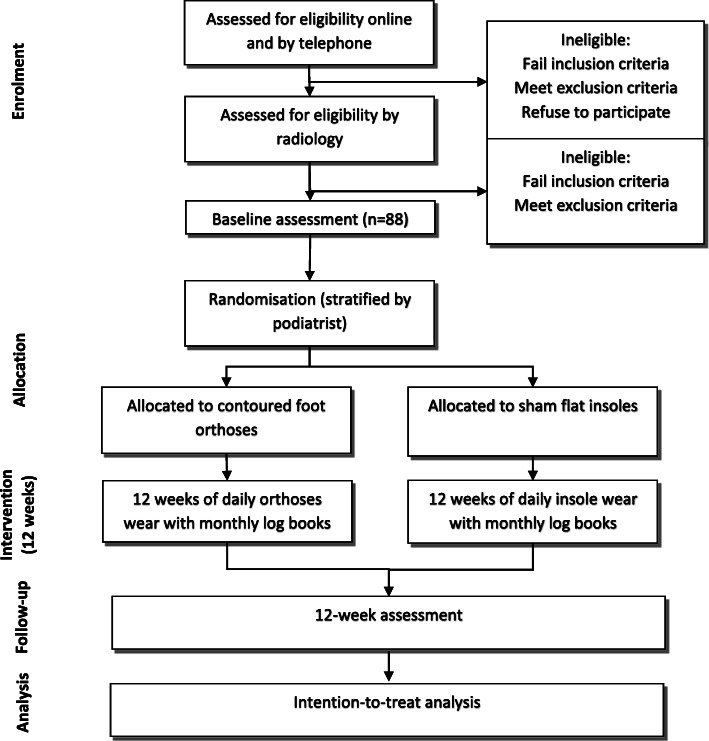
The FORT trial (Foot ORthoses for big Toe joint osteoarthritis) is a two-arm participant- and assessor-blinded, multi-site RCT conducted in Melbourne, Sydney, Brisbane and the Gold Coast, Australia. We are recruiting 88 community-dwelling people with symptomatic radiographic first MTP joint OA. Following baseline assessment, participants are randomized to receive either: i) contoured foot orthoses; or ii) sham flat insoles following baseline assessment. Participants have two visits with a study podiatrist where they are provided with their allocated insoles, to be worn daily for 12 weeks at all times when wearing shoes. The primary outcome is self-reported first MTP joint pain on walking (numerical rating scale), assessed at baseline and 12 weeks. Secondary outcomes include additional measures of first MTP joint and foot pain, physical function, quality of life, participant-perceived global ratings of change (pain and function), and level of physical activity.
This study will provide novel evidence about whether contoured foot orthoses improve pain and other symptoms compared to sham insoles in people with first MTP joint OA. Outcomes will help to inform clinical guidelines and practice about the use of foot orthoses for managing symptoms in this under-researched group of people with OA.
Prospectively registered with the Australian New Zealand Clinical Trials Registry (reference: ACTRN12619000926134 ) on 3/07/2019.
第一跖趾关节(MTP)骨关节炎(OA)是一种疼痛和使人虚弱的疾病,影响着近十分之一的 50 岁以上人群。OA 临床指南推荐非药物、非手术治疗,但对于第一跖趾关节 OA 患者,仅有两项随机对照试验(RCT)评估了此类策略。足部矫形器是一种常见的非药物、非手术策略,被联合健康专业人员用于第一跖趾关节 OA 患者,但尚不清楚这些设备是否能有效改善与该疾病相关的症状。这项临床试验旨在确定在第一跖趾关节 OA 患者中,与 sham 平底鞋垫相比,轮廓足部矫形器是否能更大程度地减轻行走时第一跖趾关节的疼痛。
FORT 试验(足部矫形器治疗大脚趾关节骨关节炎)是一项参与者和评估者双盲、多地点 RCT,在澳大利亚墨尔本、悉尼、布里斯班和黄金海岸进行。我们正在招募 88 名患有症状性放射学第一跖趾关节 OA 的社区居民。在基线评估后,参与者被随机分配到以下两种治疗组:i)轮廓足部矫形器;或 ii)在基线评估后接受 sham 平底鞋垫。参与者会与研究足病医生进行两次就诊,在那里他们会获得分配的鞋垫,并在 12 周内每天穿鞋时随时佩戴。主要结局是自我报告的行走时第一跖趾关节疼痛(数字评分量表),在基线和 12 周时评估。次要结局包括第一跖趾关节和足部疼痛、身体功能、生活质量、参与者感知的整体变化评分(疼痛和功能)以及身体活动水平的其他测量。
这项研究将提供关于在第一跖趾关节 OA 患者中,轮廓足部矫形器是否比 sham 鞋垫更能改善疼痛和其他症状的新证据。研究结果将有助于为临床指南和实践提供信息,了解在这一研究不足的 OA 人群中,使用足部矫形器来管理症状的情况。
前瞻性注册于澳大利亚和新西兰临床试验注册中心(注册号:ACTRN12619000926134),于 2019 年 7 月 3 日注册。