Department of Pharmacy, and Research Institute of Life Pharmaceutical Sciences, Sunchon National University, Suncheon, 57922, Republic of Korea.
Natural Medicine Research Center, Korea Research Institute of Bioscience and Biotechnology, Cheong-ju si, Chungcheongbuk-do, 28116, Republic of Korea.
Sci Rep. 2020 Dec 10;10(1):21695. doi: 10.1038/s41598-020-78782-5.
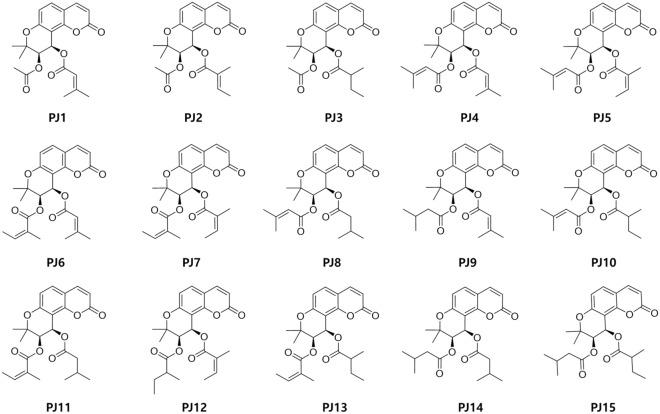
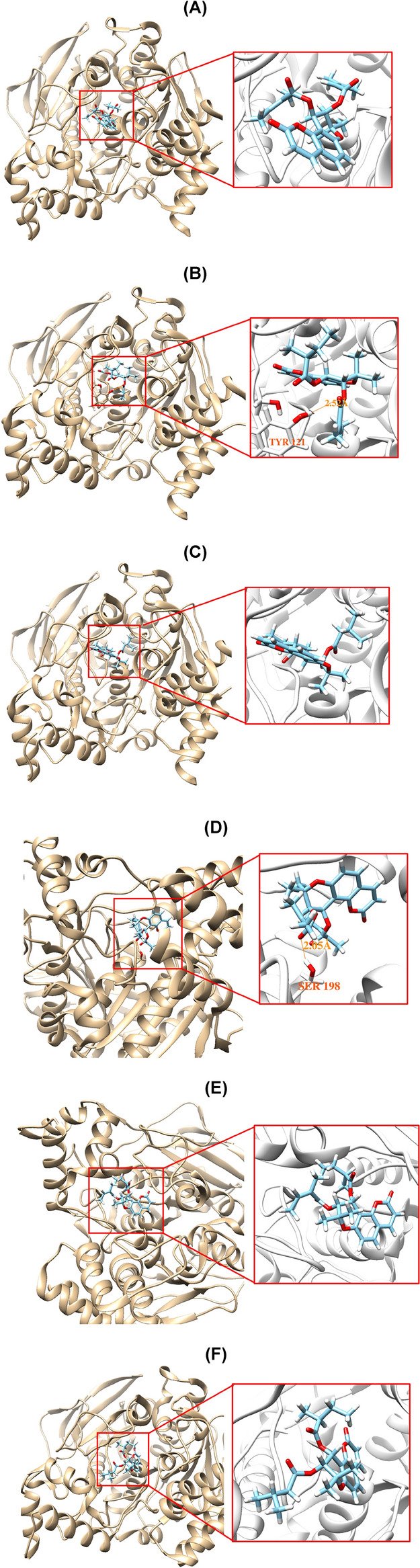
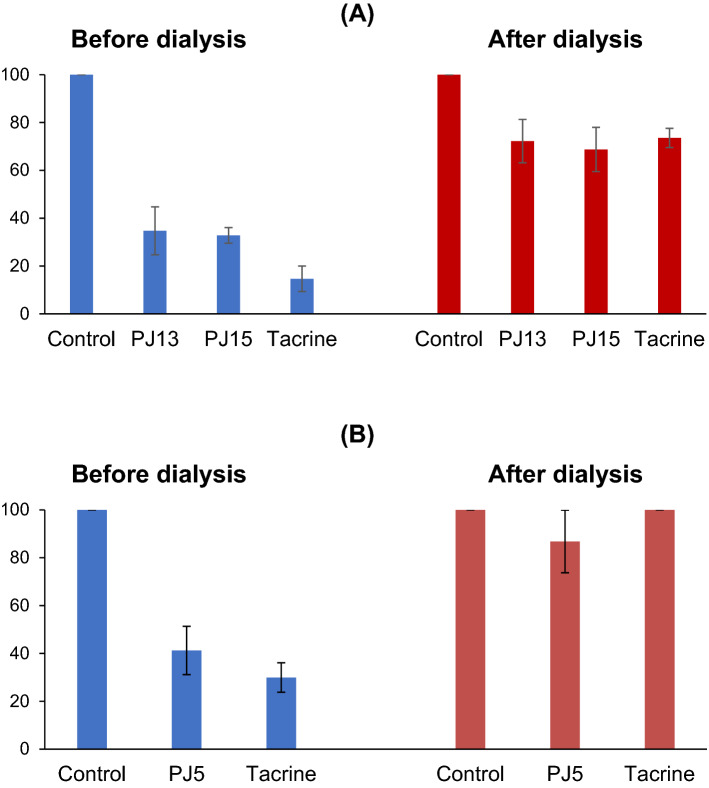
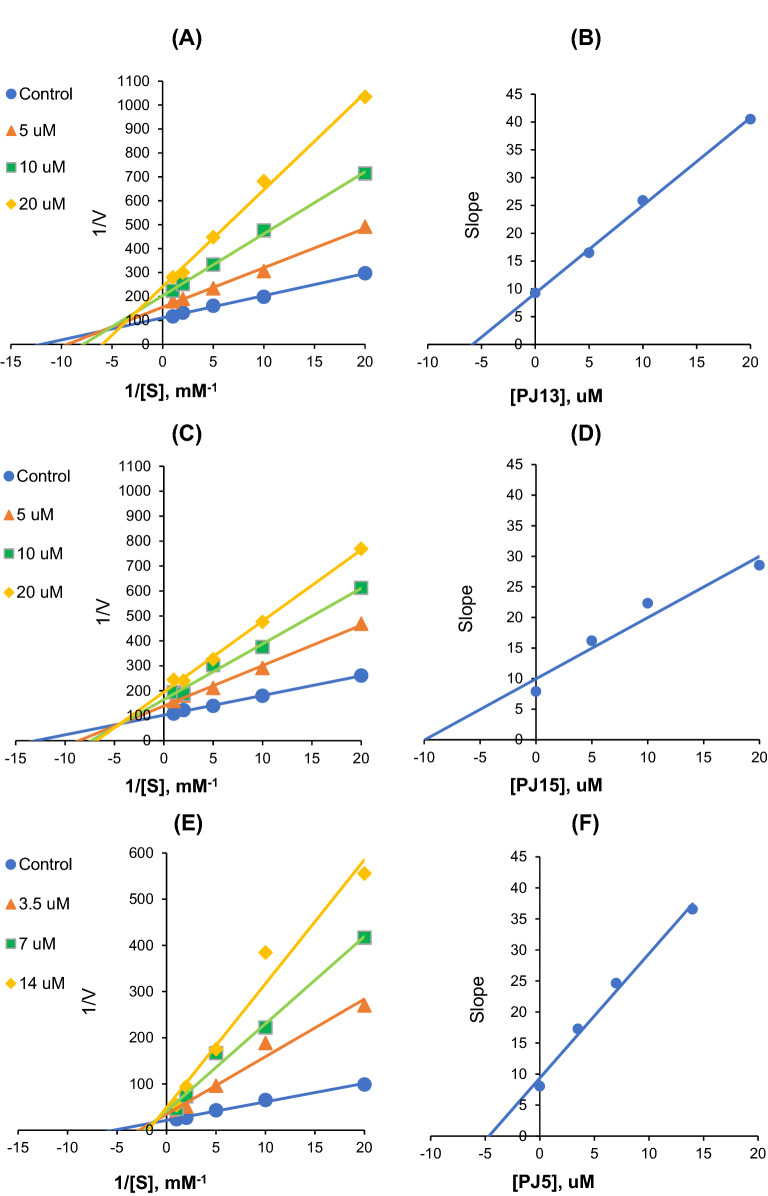
Cholinesterase (ChE) and monoamine oxidase (MAO) inhibitors have been attracted as candidate treatments for Alzheimer's disease (AD). Fifteen khellactone-type coumarins from the roots of Peucedanum japonicum Thunberg were tested for acetylcholinesterase (AChE), butyrylcholinesterase (BChE), and MAO inhibitory activities. Compound 3'-angeloyl-4'-(2-methylbutyryl)khellactone (PJ13) most potently inhibited AChE (IC = 9.28 µM), followed by 3'-isovaleryl-4'-(2-methylbutyroyl)khellactone (PJ15) (IC = 10.0 μM). Compound senecioyl-4'-angeloyl-khellactone (PJ5) most potently inhibited BChE (IC = 7.22 μM) and had the highest selectivity index (> 5.54), followed by 3'-senecioyl-4'-(2-methylbutyryl)khellactone (PJ10) and 3',4'-disenecioylkhellactone (PJ4) (IC = 10.2 and 10.7 μM, respectively). Compounds PJ13, PJ15, and PJ5 showed reversible and mixed-types of inhibition with K values of 5.98, 10.4 (for AChE), and 4.16 µM (for BChE), respectively. However, all 15 compounds weakly inhibited MAO-A and MAO-B. Molecular docking simulation revealed that PJ13 had a higher binding affinity (- 9.3 kcal/mol) with AChE than PJ15 (- 7.8 kcal/mol) or PJ5 (- 5.4 kcal/mol), due to the formation of a hydrogen bond with Tyr121 (distance: 2.52 Å). On the other hand, the binding affinity of PJ5 (- 10.0 kcal/mol) with BChE was higher than for PJ13 (- 7.7 kcal/mol) or PJ15 (- 8.1 kcal/mol), due to the formation of a hydrogen bond with Ser198 (distance: 2.05 Å). These results suggest that PJ13 and PJ5 are potential reversible selective inhibitors of AChE and BChE, respectively, for the treatment of AD.
胆碱酯酶(ChE)和单胺氧化酶(MAO)抑制剂已被认为是治疗阿尔茨海默病(AD)的候选药物。从日本白芷根中分离得到的 15 种花椒内酯型香豆素被测试了对乙酰胆碱酯酶(AChE)、丁酰胆碱酯酶(BChE)和 MAO 的抑制活性。化合物 3′-当归酰基-4′-(2-甲基丁酰基)花椒内酯(PJ13)对 AChE 的抑制作用最强(IC=9.28μM),其次是 3′-异戊酰基-4′-(2-甲基丁酰基)花椒内酯(PJ15)(IC=10.0μM)。化合物 senecioyl-4′-当归酰基花椒内酯(PJ5)对 BChE 的抑制作用最强(IC=7.22μM),且具有最高的选择性指数(>5.54),其次是 3′-senecioyl-4′-(2-甲基丁酰基)花椒内酯(PJ10)和 3′,4′-二异戊烯酰基花椒内酯(PJ4)(IC=10.2 和 10.7μM)。化合物 PJ13、PJ15 和 PJ5 对 AChE 和 BChE 的抑制作用均表现出可逆和混合型,K 值分别为 5.98、10.4(AChE)和 4.16μM(BChE)。然而,这 15 种化合物对 MAO-A 和 MAO-B 的抑制作用较弱。分子对接模拟表明,PJ13 与 AChE 的结合亲和力(-9.3kcal/mol)高于 PJ15(-7.8kcal/mol)或 PJ5(-5.4kcal/mol),这是由于与 Tyr121 形成了氢键(距离:2.52Å)。另一方面,PJ5(-10.0kcal/mol)与 BChE 的结合亲和力高于 PJ13(-7.7kcal/mol)或 PJ15(-8.1kcal/mol),这是由于与 Ser198 形成了氢键(距离:2.05Å)。这些结果表明,PJ13 和 PJ5 分别是潜在的可逆选择性 AChE 和 BChE 抑制剂,可用于治疗 AD。