Sato Yohei, Passerini Laura, Piening Brian D, Uyeda Molly Javier, Goodwin Marianne, Gregori Silvia, Snyder Michael P, Bertaina Alice, Roncarolo Maria-Grazia, Bacchetta Rosa
Department of Pediatrics Division of Hematology, Oncology Stem Cell Transplantation and Regenerative Medicine Stanford University School of Medicine Stanford CA USA.
Mechanisms of Peripheral Tolerance Unit San Raffaele Telethon Institute for Gene Therapy (SR-TIGET) IRCCS San Raffaele Scientific Institute Milan Italy.
Clin Transl Immunology. 2020 Nov 25;9(11):e1214. doi: 10.1002/cti2.1214. eCollection 2020.
Genetic or acquired defects in FOXP3 regulatory T cells (Tregs) play a key role in many immune-mediated diseases including immune dysregulation polyendocrinopathy, enteropathy, X-linked (IPEX) syndrome. Previously, we demonstrated CD4 T cells from healthy donors and IPEX patients can be converted into functional Treg-like cells by lentiviral transfer of (CD4). These CD4 cells have potent regulatory function, suggesting their potential as an innovative therapeutic. Here, we present molecular and preclinical data supporting CD4 cell clinical progression.
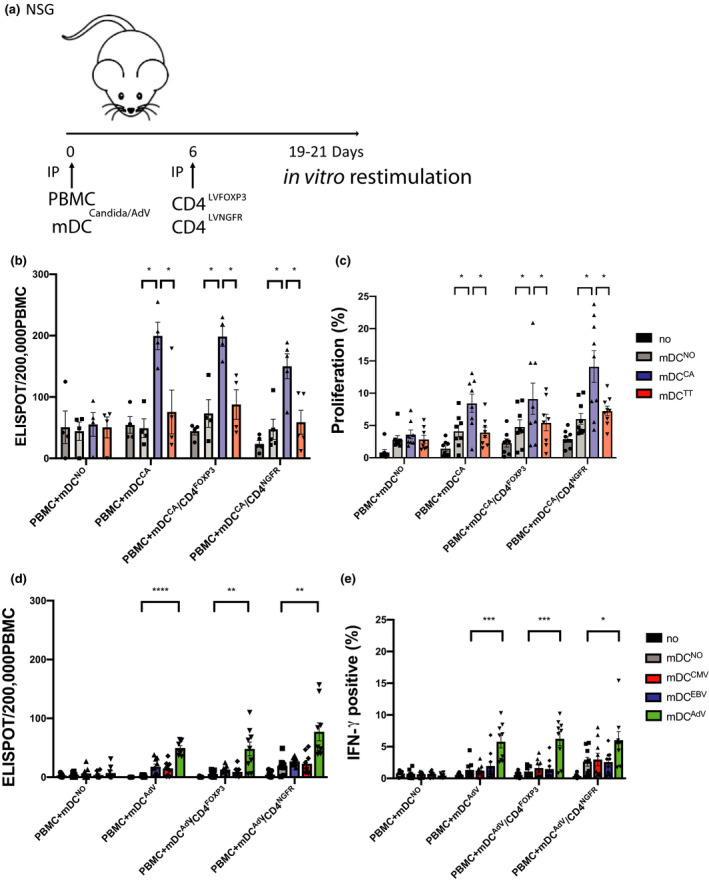
The molecular characterisation of CD4 cells included flow cytometry, qPCR, RNA-seq and TCR-seq. The suppressive function of CD4 cells was assessed in xenograft-versus-host disease (xeno-GvHD) and FOXP3-deficient IPEX-like humanised mouse models. The safety of CD4 cells was evaluated using peripheral blood (PB) humanised (hu)- mice testing their impact on immune response against pathogens, and immune surveillance against tumor antigens.
We demonstrate that the conversion of CD4 T cells to CD4 cells leads to specific transcriptional changes as compared to CD4 T-cell transduction in the absence of FOXP3, including upregulation of Treg-related genes. Furthermore, we observe specific preservation of a polyclonal TCR repertoire during cell production. Both allogeneic and autologous CD4 cells protect from xeno-GvHD after two sequential infusions of effector T cells. CD4 cells prevent hyper-proliferation of CD4 memory T cells in the FOXP3-deficient IPEX-like hu-mice. CD4 cells do not impede expansion of antigen-primed T cells or tumor clearance in the PB hu-mice.
These data support the clinical readiness of CD4 cells to treat IPEX syndrome and other immune-mediated diseases caused by insufficient or dysfunctional FOXP3 Tregs.
叉头框蛋白P3(FOXP3)调节性T细胞(Tregs)的遗传或获得性缺陷在包括免疫失调多内分泌腺病、肠病、X连锁(IPEX)综合征在内的许多免疫介导疾病中起关键作用。此前,我们证明来自健康供体和IPEX患者的CD4 T细胞可通过慢病毒转导(CD4)转化为功能性Treg样细胞。这些CD4细胞具有强大的调节功能,表明它们作为一种创新疗法的潜力。在此,我们展示支持CD4细胞临床进展的分子和临床前数据。
CD4细胞的分子特征分析包括流式细胞术、定量聚合酶链反应(qPCR)、RNA测序(RNA-seq)和T细胞受体测序(TCR-seq)。在异种移植物抗宿主病(xeno-GvHD)和FOXP3缺陷的IPEX样人源化小鼠模型中评估CD4细胞的抑制功能。使用外周血(PB)人源化(hu)小鼠评估CD4细胞的安全性,测试它们对病原体免疫反应的影响以及对肿瘤抗原的免疫监视。
我们证明,与在无FOXP3情况下的CD4 T细胞转导相比,CD4 T细胞向CD4细胞的转化导致特定的转录变化,包括Treg相关基因的上调。此外,我们观察到在细胞产生过程中多克隆TCR库的特异性保留。在连续两次输注效应T细胞后,同种异体和自体CD4细胞均能预防xeno-GvHD。CD4细胞可防止FOXP3缺陷的IPEX样hu小鼠中CD4记忆T细胞的过度增殖。CD4细胞不会妨碍PB hu小鼠中抗原致敏T细胞的扩增或肿瘤清除。
这些数据支持CD4细胞用于治疗IPEX综合征和其他由FOXP3 Tregs不足或功能失调引起的免疫介导疾病的临床可行性。