• 文献检索
  • 文档翻译
  • 深度研究
  • 学术资讯
  • Suppr Zotero 插件Zotero 插件
  • 邀请有礼
  • 套餐&价格
  • 历史记录
应用&插件
Suppr Zotero 插件Zotero 插件浏览器插件Mac 客户端Windows 客户端微信小程序
定价
高级版会员购买积分包购买API积分包
服务
文献检索文档翻译深度研究API 文档MCP 服务
关于我们
关于 Suppr公司介绍联系我们用户协议隐私条款
关注我们

Suppr 超能文献

核心技术专利:CN118964589B侵权必究
粤ICP备2023148730 号-1Suppr @ 2026

文献检索

告别复杂PubMed语法,用中文像聊天一样搜索,搜遍4000万医学文献。AI智能推荐,让科研检索更轻松。

立即免费搜索

文件翻译

保留排版,准确专业,支持PDF/Word/PPT等文件格式,支持 12+语言互译。

免费翻译文档

深度研究

AI帮你快速写综述,25分钟生成高质量综述,智能提取关键信息,辅助科研写作。

立即免费体验

孟加拉国 COVID-19 期间个人防护装备相关废物处理的认知和态度:一项探索性研究。

Perception and Attitudes Toward PPE-Related Waste Disposal Amid COVID-19 in Bangladesh: An Exploratory Study.

机构信息

Department of Environmental Sciences, Jahangirnagar University, Dhaka, Bangladesh.

School of Environment, Tsinghua University, Beijing, China.

出版信息

Front Public Health. 2020 Nov 13;8:592345. doi: 10.3389/fpubh.2020.592345. eCollection 2020.

DOI:10.3389/fpubh.2020.592345
PMID:33304879
原文链接:https://pmc.ncbi.nlm.nih.gov/articles/PMC7691663/
Abstract

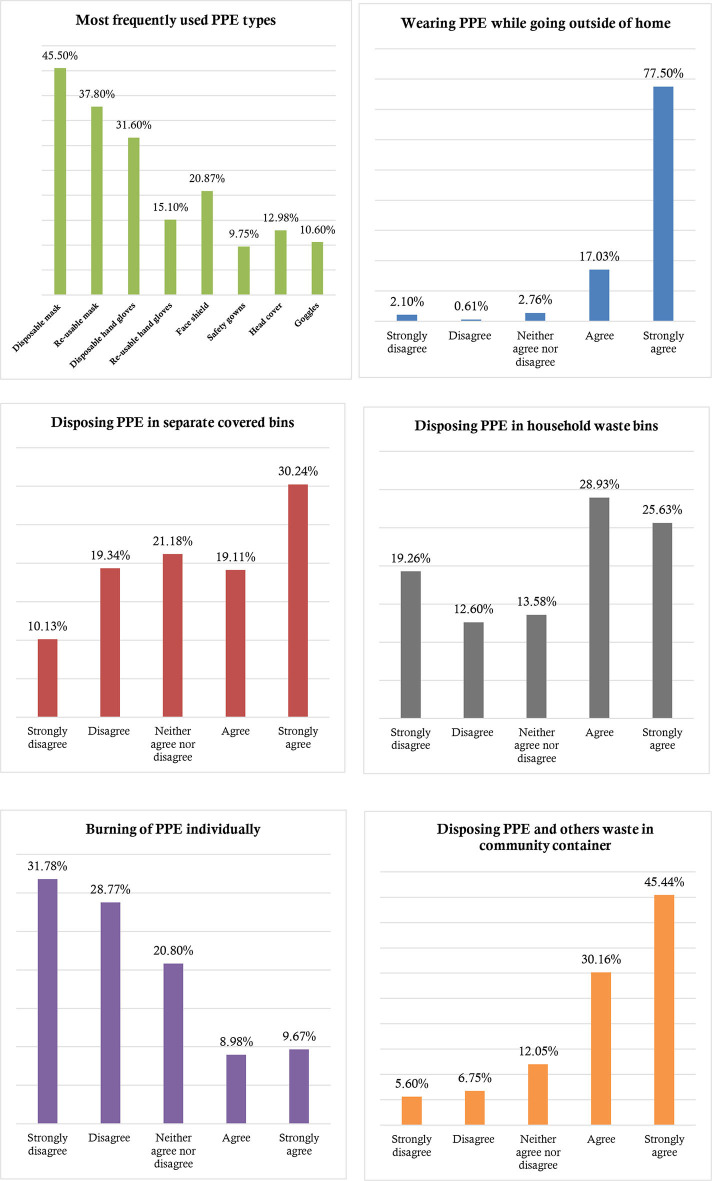
Personal protective equipment (PPE) is an essential item to protect from exposure to infectious pathogens or contaminants, which is frequently used at health care settings and public spheres since the coronavirus disease 2019 (COVID-19) outbreak. There is no prior study investigating public perception and attitudes toward PPE-related waste disposal in Bangladesh. Hence, an online survey was carried out among 1,303 Bangladeshi adult residents to explore the issue. Results stated that face mask and hand gloves were the widely used PPE, where around 45.50% mask and 31.60% hand gloves were disposable. Approximately 94.50% of the participants percepted to use at least one type of PPE while going outside. Only 18.65% of the respondents percepted to burn the PPE-related waste, while most of them reported other less protective disposal measures. Females, urban residents, and participants with higher education were found to have better perception and attitudes toward PPE-related waste disposal. To the best of the authors' knowledge, being the first exploratory study in the country, the present findings are anticipated to be helpful at policy levels with respect to arranging awareness programs.

摘要

个人防护设备(PPE)是保护人们免受传染性病原体或污染物暴露的重要物品,自 2019 年冠状病毒病(COVID-19)爆发以来,它在医疗保健场所和公共领域被频繁使用。目前尚无研究调查孟加拉国人对 PPE 相关废物处理的看法和态度。因此,对 1303 名孟加拉国成年居民进行了在线调查,以探讨这一问题。结果表明,口罩和手套是使用最广泛的 PPE,其中约 45.50%的口罩和 31.60%的手套是一次性的。大约 94.50%的参与者表示在外出时至少使用过一种 PPE。只有 18.65%的受访者认为应该焚烧 PPE 相关废物,而大多数人则报告了其他防护性较差的处理措施。研究发现,女性、城市居民和受教育程度较高的参与者对 PPE 相关废物处理的看法和态度更好。据作者所知,这是该国的第一项探索性研究,预计这些发现将有助于政策层面制定宣传计划。
https://cdn.ncbi.nlm.nih.gov/pmc/blobs/e475/7691663/4dd4d1a4530f/fpubh-08-592345-g0002.jpg
https://cdn.ncbi.nlm.nih.gov/pmc/blobs/e475/7691663/53e38236d007/fpubh-08-592345-g0001.jpg
https://cdn.ncbi.nlm.nih.gov/pmc/blobs/e475/7691663/4dd4d1a4530f/fpubh-08-592345-g0002.jpg
https://cdn.ncbi.nlm.nih.gov/pmc/blobs/e475/7691663/53e38236d007/fpubh-08-592345-g0001.jpg
https://cdn.ncbi.nlm.nih.gov/pmc/blobs/e475/7691663/4dd4d1a4530f/fpubh-08-592345-g0002.jpg

相似文献

1
Perception and Attitudes Toward PPE-Related Waste Disposal Amid COVID-19 in Bangladesh: An Exploratory Study.孟加拉国 COVID-19 期间个人防护装备相关废物处理的认知和态度:一项探索性研究。
Front Public Health. 2020 Nov 13;8:592345. doi: 10.3389/fpubh.2020.592345. eCollection 2020.
2
SARS-CoV-2 pandemic-induced PPE and single-use plastic waste generation scenario.SARS-CoV-2 大流行引发的个人防护装备和一次性塑料废物产生情况。
Waste Manag Res. 2021 Jun;39(1_suppl):3-17. doi: 10.1177/0734242X20980828. Epub 2021 Jan 7.
3
Personal protective equipment usage, recycling and disposal among spine surgeons: An Asia Pacific Spine Society survey.脊柱外科医生个人防护装备的使用、回收与处置:亚太脊柱协会调查
J Orthop Surg (Hong Kong). 2021 Jan-Apr;29(1):2309499020988176. doi: 10.1177/2309499020988176.
4
Occupational health practices among dental care professionals before and during the COVID-19 pandemic.口腔保健专业人员在 COVID-19 大流行之前和期间的职业健康实践。
Work. 2021;68(4):993-1000. doi: 10.3233/WOR-205319.
5
Healthcare worker perception of a global outbreak of novel coronavirus (COVID-19) and personal protective equipment: Survey of a pediatric tertiary-care hospital.医护人员对全球新型冠状病毒(COVID-19)爆发的认知及对个人防护设备的看法:对一家儿科三级保健医院的调查。
Infect Control Hosp Epidemiol. 2021 Mar;42(3):261-267. doi: 10.1017/ice.2020.415. Epub 2020 Aug 12.
6
Amassing the Covid-19 driven PPE wastes in the dwelling environment of Chittagong Metropolis and associated implications.积累在吉大港都会区居住环境中的与 COVID-19 相关的个人防护设备废物及其相关影响。
Chemosphere. 2022 Jun;297:134022. doi: 10.1016/j.chemosphere.2022.134022. Epub 2022 Feb 21.
7
Knowledge and practice of personal protective measures during the COVID-19 pandemic: A cross-sectional study in Saudi Arabia.《COVID-19 大流行期间个人防护措施的知识和实践:沙特阿拉伯的一项横断面研究》
PLoS One. 2020 Dec 11;15(12):e0243695. doi: 10.1371/journal.pone.0243695. eCollection 2020.
8
Water, sanitation, hygiene and waste disposal practices as COVID-19 response strategy: insights from Bangladesh.作为应对新冠疫情策略的水、环境卫生、个人卫生及废物处理措施:来自孟加拉国的见解
Environ Dev Sustain. 2021;23(8):11953-11974. doi: 10.1007/s10668-020-01151-9. Epub 2021 Jan 2.
9
An emerging source of plastic pollution: Environmental presence of plastic personal protective equipment (PPE) debris related to COVID-19 in a metropolitan city.新兴的塑料污染来源:与 COVID-19 相关的大都市环境中塑料个人防护设备 (PPE) 碎片的存在。
Environ Pollut. 2021 Jan 15;269:116160. doi: 10.1016/j.envpol.2020.116160. Epub 2020 Dec 4.
10
Personal protective equipment (PPE) pollution driven by the COVID-19 pandemic in Cox's Bazar, the longest natural beach in the world.由新冠疫情导致的世界最长天然海滩——孟加拉国科克斯巴扎尔的个人防护装备(PPE)污染问题。
Mar Pollut Bull. 2021 Aug;169:112497. doi: 10.1016/j.marpolbul.2021.112497. Epub 2021 May 16.

引用本文的文献

1
Unveiling Coronasomnia: Pandemic Stress and Sleep Problems During the COVID-19 Outbreak.揭示新冠失眠症:COVID-19疫情期间的大流行压力与睡眠问题
Nat Sci Sleep. 2024 May 27;16:543-553. doi: 10.2147/NSS.S459945. eCollection 2024.
2
Recycling facemasks into civil construction material to manage waste generated during COVID-19.将口罩回收再利用制成民用建筑材料,以处理新冠疫情期间产生的废弃物。
Environ Sci Pollut Res Int. 2024 Feb;31(8):12577-12590. doi: 10.1007/s11356-023-31726-8. Epub 2024 Jan 3.
3
Hygiene knowledge and practices and determinants of occupational safety among waste and sanitation workers in Bangladesh during the COVID-19 pandemic.

本文引用的文献

1
Environmental effects of COVID-19 pandemic and potential strategies of sustainability.新冠疫情的环境影响及可持续发展的潜在策略
Heliyon. 2020 Sep;6(9):e04965. doi: 10.1016/j.heliyon.2020.e04965. Epub 2020 Sep 17.
2
Suggested guidelines for emergency treatment of medical waste during COVID-19: Chinese experience.新型冠状病毒肺炎疫情期间医疗废物应急处理建议指南:中国经验
Waste Dispos Sustain Energy. 2020;2(2):81-84. doi: 10.1007/s42768-020-00039-8. Epub 2020 Jun 3.
3
Biomedical waste amid COVID-19: perspectives from Bangladesh.
新冠疫情期间孟加拉国垃圾和环卫工人的卫生知识与实践及职业安全的决定因素
Hyg Environ Health Adv. 2022 Dec;4:100022. doi: 10.1016/j.heha.2022.100022. Epub 2022 Sep 3.
4
Personal protective equipment-derived pollution during Covid-19 era: A critical review of ecotoxicology impacts, intervention strategies, and future challenges.新冠疫情期间个人防护装备带来的污染:生态毒理学影响、干预策略及未来挑战的批判性回顾。
Sci Total Environ. 2023 Aug 20;887:164164. doi: 10.1016/j.scitotenv.2023.164164. Epub 2023 May 13.
5
Stigmatization in the context of the COVID-19 pandemic: a survey experiment using attribution theory and the familiarity hypothesis.新冠疫情背景下的污名化:基于归因理论和熟悉度假设的调查实验。
BMC Public Health. 2023 Mar 18;23(1):521. doi: 10.1186/s12889-023-15234-5.
6
Hydrothermal deconstruction of single-use personal protective equipment: process design and economic performance.一次性个人防护装备的水热解构:工艺设计与经济性能
Process Saf Environ Prot. 2022 Oct;166:565-573. doi: 10.1016/j.psep.2022.08.060. Epub 2022 Aug 27.
7
Knowledge, attitude, and practice towards face mask use among residents of Greater Chennai Corporation, India, March 2021.2021 年 3 月,印度钦奈市居民对面部口罩使用的知识、态度和实践。
Front Public Health. 2022 Jul 28;10:938642. doi: 10.3389/fpubh.2022.938642. eCollection 2022.
8
"You need to dispose of them somewhere safe": Covid-19, masks, and the pit latrine in Malawi and South Africa.“你需要将它们安全地处理掉”:新冠疫情、口罩和马拉维和南非的坑式厕所。
PLoS One. 2022 Feb 22;17(2):e0262741. doi: 10.1371/journal.pone.0262741. eCollection 2022.
9
Waste management beyond the COVID-19 pandemic: Bibliometric and text mining analyses.新冠疫情后的废物管理:文献计量与文本挖掘分析
Gondwana Res. 2023 Feb;114:124-137. doi: 10.1016/j.gr.2021.12.015. Epub 2022 Feb 5.
10
Estimation of the healthcare waste generation during COVID-19 pandemic in Bangladesh.孟加拉国 COVID-19 大流行期间医疗废物产生量的估算。
Sci Total Environ. 2022 Mar 10;811:152295. doi: 10.1016/j.scitotenv.2021.152295. Epub 2021 Dec 9.
新冠疫情下的生物医学废弃物:来自孟加拉国的观点
Lancet Glob Health. 2020 Oct;8(10):e1262. doi: 10.1016/S2214-109X(20)30349-1. Epub 2020 Aug 13.
4
Exploring COVID-19 stress and its factors in Bangladesh: A perception-based study.探索孟加拉国的新冠疫情压力及其影响因素:一项基于认知的研究。
Heliyon. 2020 Jul 10;6(7):e04399. doi: 10.1016/j.heliyon.2020.e04399. eCollection 2020 Jul.
5
Environmentally Sustainable Management of Used Personal Protective Equipment.废旧个人防护装备的环境可持续管理
Environ Sci Technol. 2020 Jul 21;54(14):8500-8502. doi: 10.1021/acs.est.0c03022. Epub 2020 Jun 29.
6
Knowledge, Attitude and Practice Toward COVID-19 Among the Public in the Kingdom of Saudi Arabia: A Cross-Sectional Study.沙特阿拉伯公众对 COVID-19 的知识、态度和实践:一项横断面研究。
Front Public Health. 2020 May 27;8:217. doi: 10.3389/fpubh.2020.00217. eCollection 2020.
7
Covid-19 face masks: A potential source of microplastic fibers in the environment.Covid-19 口罩:环境中微塑料纤维的潜在来源。
Sci Total Environ. 2020 Oct 1;737:140279. doi: 10.1016/j.scitotenv.2020.140279. Epub 2020 Jun 16.
8
Challenges to the prevention of COVID-19 spread in slums of Bangladesh.孟加拉国贫民窟预防新冠病毒传播面临的挑战。
J Public Health (Oxf). 2020 Aug 18;42(3):637-638. doi: 10.1093/pubmed/fdaa088.
9
Knowledge, attitudes, and practices towards COVID-19 among Chinese residents during the rapid rise period of the COVID-19 outbreak: a quick online cross-sectional survey.中国居民在 COVID-19 疫情快速上升期对 COVID-19 的认知、态度和实践:一项快速在线横断面调查。
Int J Biol Sci. 2020 Mar 15;16(10):1745-1752. doi: 10.7150/ijbs.45221. eCollection 2020.
10
Knowledge, attitude, and practice (KAP) of 'teaching laboratory' technicians towards laboratory safety and waste management: a pilot interventional study.“教学实验室”技术人员对实验室安全和废物管理的知识、态度和实践:一项试点干预研究。
J Hosp Infect. 2017 Jun;96(2):192-194. doi: 10.1016/j.jhin.2017.02.007. Epub 2017 Feb 9.