Gao Zhichun, Qin Zhexue, An Zhixia, Hou Changchun, Wang Luyu, Jin Jun
Department of Cardiology, Institute of Cardiovascular Diseases of People's Liberation Army, Chongqing, China.
Department of Cardiology, Xinqiao Hospital, Army Medical University (Third Military Medical University), Chongqing, China.
Front Cardiovasc Med. 2020 Nov 5;7:588761. doi: 10.3389/fcvm.2020.588761. eCollection 2020.
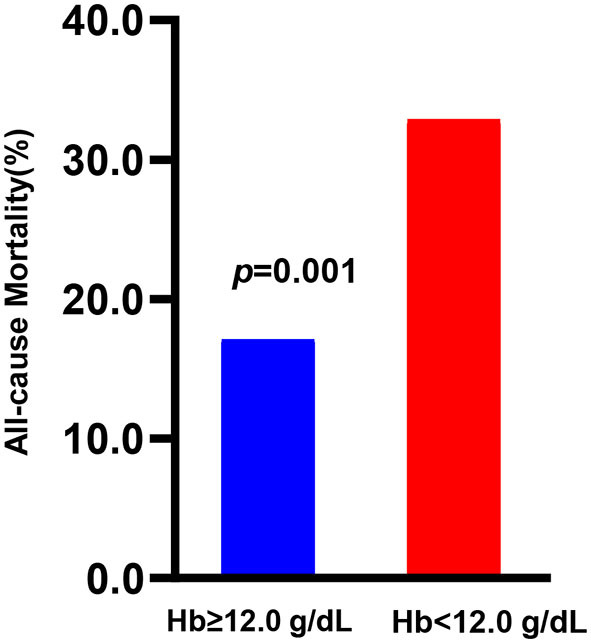
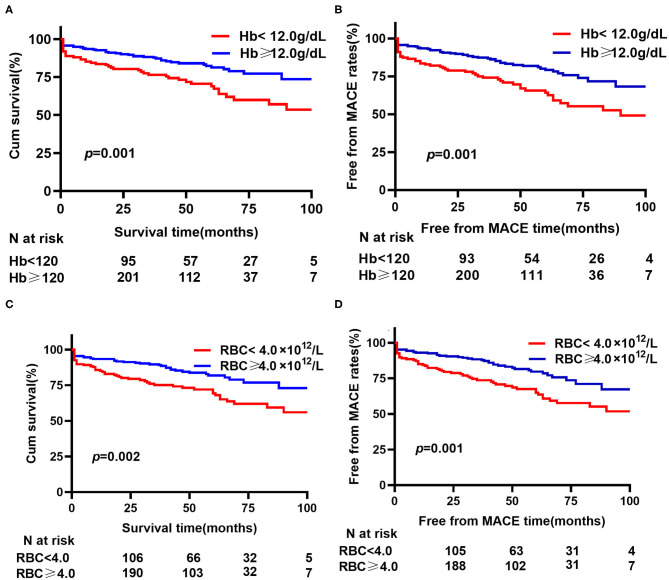
There is scant information available about the prognostic value of preoperative hemoglobin (Hb) levels on the long-term outcomes of acute type B aortic dissection (ABAD) following thoracic endovascular aortic repair (TEVAR). A retrospective analysis of consecutive patients from 2010 to 2018 regarding the relationship between Hb level and long-term outcomes was conducted. The primary endpoint was all-cause mortality. Major adverse cardiovascular events (MACEs) included all-cause death, recurrent ruptures, and secondary procedures. In total, 391 subjects treated by TEVAR were enrolled, with a mean age of 57.1 ± 12.0 years; 79.5% of them were male. Cox multivariate analysis showed that the preoperative Hb level was independently associated with all-cause death [adjusted hazard ratio (HR) 0.797 (per 1 g/dl), 95% confidence interval (CI) 0.693-0.918, = 0.002] and MACEs (adjusted HR 0.795, 95% CI 0.672-0.871, = 0.000). The area under the receiver operating characteristic curve of Hb for all-cause death and MACEs were 0.617 (95% CI 0.548-0.687, = 0.008) and 0.617 (95% CI 0.551-0.684, = 0.005), respectively. In the linear trend test, Hb concentration was significantly related to all-cause mortality ( for trend = 0.001) and MACEs ( for trend = 0.000). Moreover, in Kaplan-Meier analysis, lower Hb levels (< 12 g/dl) were significantly different from higher Hb (≥12 g/dl) levels for both all-cause death (log-rank = 0.001) and MACEs (log-rank = 0.001). Similar results were found when assessing the prognostic value of red blood cell count and anemia. Preoperative Hb may serve as a prognostic marker for long-range adverse outcomes for ABAD patients post-TEVAR.
关于术前血红蛋白(Hb)水平对胸主动脉腔内修复术(TEVAR)后急性B型主动脉夹层(ABAD)长期预后的预测价值,目前可用信息较少。对2010年至2018年连续患者中Hb水平与长期预后的关系进行了回顾性分析。主要终点是全因死亡率。主要不良心血管事件(MACE)包括全因死亡、复发性破裂和二次手术。总共纳入了391例接受TEVAR治疗的患者,平均年龄为57.1±12.0岁;其中79.5%为男性。Cox多因素分析显示,术前Hb水平与全因死亡独立相关[调整后风险比(HR)0.797(每1 g/dl),95%置信区间(CI)0.693 - 0.918,P = 0.002]和MACE(调整后HR 0.795,95% CI 0.672 - 0.871,P = 0.000)。Hb对全因死亡和MACE的受试者工作特征曲线下面积分别为0.617(95% CI 0.548 - 0.687,P = 0.008)和0.617(95% CI 0.551 - 0.684,P = 0.005)。在线性趋势检验中,Hb浓度与全因死亡率(趋势P = 0.001)和MACE(趋势P = 0.000)显著相关。此外,在Kaplan - Meier分析中,较低的Hb水平(< 12 g/dl)在全因死亡(对数秩P = 0.001)和MACE(对数秩P = 0.001)方面与较高的Hb水平(≥12 g/dl)有显著差异。在评估红细胞计数和贫血的预测价值时也发现了类似结果。术前Hb可作为TEVAR术后ABAD患者远期不良结局的预后标志物。