Wegner Rodney E, Xu Linda, Horne Zachary, Yu Alexander, Goss Matthew, Liang Yun, Sohn Jason, Karlovits Stephen M
Division of Radiation Oncology, Allegheny Health Network Cancer Institute, Pittsburgh, Pennsylvania.
Department of Neurosurgery, Allegheny Health Network, Pittsburgh, Pennsylvania.
Adv Radiat Oncol. 2020 Jul 1;5(6):1152-1157. doi: 10.1016/j.adro.2020.06.025. eCollection 2020 Nov-Dec.
The Gamma Knife (GK) Icon allows for the delivery of stereotactic radiosurgery using a thermoplastic mask in combination with intrafraction motion monitoring using high definition motion management. The system pauses treatment if the magnitude of motion in all directions exceeds 1 to 1.5 mm, causing a break in treatment and prolongation of the session. We reviewed the records of patients treated in a frameless manner on our GK Icon system to determine predictors for treatment interruption.
We reviewed the records of patients treated between May 2019 and May 2020 on the GK Icon using a frameless technique for brain metastases, gliomas, schwannomas, and meningiomas. We recorded treatment time as noted in the plan document, actual treatment delivery time, and any pauses in treatment. We tabulated baseline characteristics including age, gender, diagnosis, performance status, and shifts at time of treatment. We used a receiver operating curve analysis to determine a timepoint corresponding with treatment interruption. We then conducted a logistic regression analysis to generate odds ratios for likelihood of treatment.
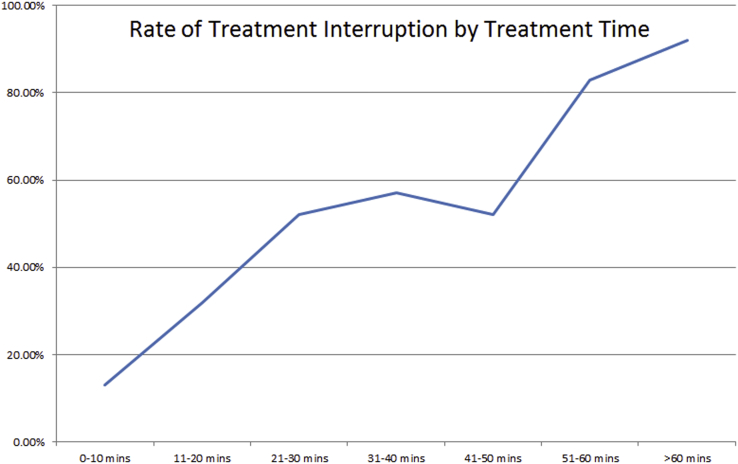
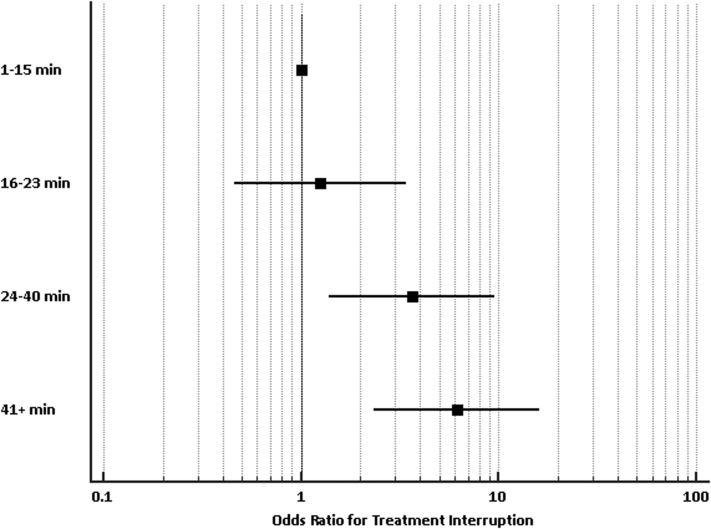
We identified 150 patients meeting inclusion criteria. The majority (82%) were patients with brain metastases. The median age was 63 and the median dose was 27 Gy (16-30 Gy) in 3 fractions (1-5 fractions). The median treatment time was 23 minutes (4-108 minutes). Sixty-nine patients (46%) had at least 1 pause in treatment (range, 1-7). Receiver operating curve analysis revealed treatment time >19 minutes and rotation >0.47 degrees to be associated with interruption. Multivariable logistic regression revealed rotation >0.47 degrees and treatment time >19 minutes as predictive of interruption.
For patients with rotations exceeding 0.47 degrees or an extended treatment time, physicians should expect treatment interruptions, consider fractionation to lessen table time, or use a frame-based approach.
伽玛刀(GK)Icon系统允许使用热塑性面罩进行立体定向放射外科治疗,并结合使用高清运动管理进行分次内运动监测。如果各个方向的运动幅度超过1至1.5毫米,该系统会暂停治疗,导致治疗中断并延长治疗时间。我们回顾了在我们的GK Icon系统上以无框架方式治疗的患者记录,以确定治疗中断的预测因素。
我们回顾了2019年5月至2020年5月期间在GK Icon系统上使用无框架技术治疗脑转移瘤、胶质瘤、神经鞘瘤和脑膜瘤的患者记录。我们记录了计划文档中注明的治疗时间、实际治疗交付时间以及任何治疗中断情况。我们将基线特征制成表格,包括年龄、性别、诊断、功能状态以及治疗时的班次。我们使用受试者工作特征曲线分析来确定与治疗中断相对应的时间点。然后我们进行了逻辑回归分析,以生成治疗可能性的比值比。
我们确定了150名符合纳入标准的患者。大多数(82%)是脑转移瘤患者。中位年龄为63岁,中位剂量为27 Gy(16 - 30 Gy),分3次给予(1 - 5次)。中位治疗时间为23分钟(4 - 108分钟)。69名患者(46%)至少有1次治疗中断(范围为1 - 7次)。受试者工作特征曲线分析显示,治疗时间>19分钟和旋转>0.47度与中断相关。多变量逻辑回归显示,旋转>0.47度和治疗时间>19分钟可预测中断情况。
对于旋转超过0.47度或治疗时间延长的患者,医生应预期会出现治疗中断,考虑分割治疗以减少治疗台时间,或采用基于框架的方法。