Department of Population Health, Department of Anesthesiology, 3901 Rainbow Blvd, Mailstop 1008, Kansas City, KS 66160, USA.
Social and Administrative Sciences Division, University of Wisconsin-Madison School of Pharmacy, 777 Highland Avenue, Madison, WI 53705, USA.
Drug Alcohol Depend. 2021 Jan 1;218:108355. doi: 10.1016/j.drugalcdep.2020.108355. Epub 2020 Oct 17.
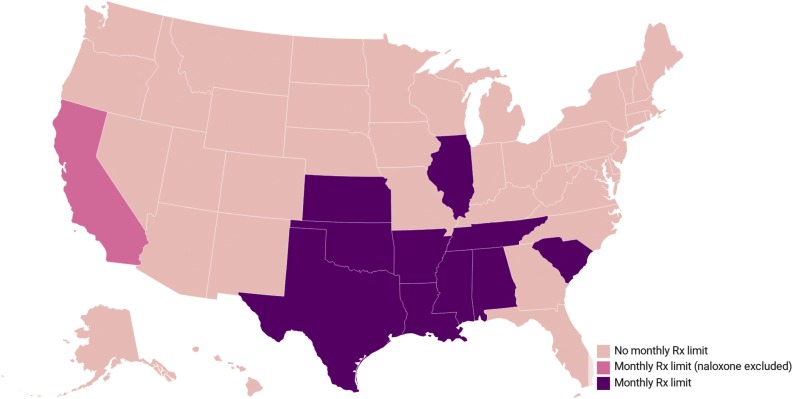
Expanding access to and utilization of naloxone is a vitally important harm reduction strategy for preventing opioid overdose deaths, particularly in vulnerable populations like Medicaid beneficiaries. The objective of this study was to characterize the landscape of monthly prescription fill limit policies in Medicaid programs and their potential implications for expanding naloxone use for opioid overdose harm reduction.
A cross-sectional, multi-modal online and telephonic data collection strategy was used to identify and describe the presence and characteristics of monthly prescription fill limit policies across state Medicaid programs. Contextual characteristics were described regarding each state's Medicaid enrollment, opioid prescribing rates, and overdose death rates. Data collection and analysis occurred between February and May 2020.
Medicaid-covered naloxone fills are currently subject to monthly prescription fill limit policies in 10 state Medicaid programs, which cover 20 % of the Medicaid population nationwide. Seven of these programs are located in states ranking in the top 10 highest per-capita opioid prescribing rates in the country. However, 8 of these programs are located in states with opioid overdose death rates below the national average.
Medicaid beneficiaries at high risk of opioid overdose living in states with monthly prescription fill limits may experience significant barriers to obtaining naloxone. Exempting naloxone from Medicaid prescription limit restrictions may help spur broader adoption of naloxone for opioid overdose mortality prevention, especially in states with high opioid prescribing rates. Achieving unfettered naloxone coverage in Medicaid is critical as opioid overdoses and Medicaid enrollment increase amid the COVID-19 pandemic.
扩大纳洛酮的可及性和使用率是预防阿片类药物过量死亡的一项至关重要的减少伤害策略,特别是在医疗补助受益人群等弱势群体中。本研究的目的是描述医疗补助计划中每月处方配药限量政策的现状及其对扩大纳洛酮用于阿片类药物过量伤害减少的潜在影响。
采用跨学科、多模式的在线和电话数据收集策略,以确定并描述各州医疗补助计划中每月处方配药限量政策的存在及其特征。对各州的医疗补助参保人数、阿片类药物处方率和过量死亡人数进行了背景特征描述。数据收集和分析于 2020 年 2 月至 5 月进行。
在 10 个州的医疗补助计划中,目前对医疗补助覆盖的纳洛酮配药实行每月处方配药限量政策,这些州覆盖了全国 20%的医疗补助参保人数。其中 7 个州位于全国人均阿片类药物处方率最高的前 10 个州之列。然而,这 8 个州的阿片类药物过量死亡率低于全国平均水平。
在实行每月处方配药限量的州,处于阿片类药物过量高风险的医疗补助受益人群可能会面临获取纳洛酮的重大障碍。将纳洛酮豁免于医疗补助处方限制的限制可能有助于更广泛地采用纳洛酮预防阿片类药物过量死亡,特别是在阿片类药物处方率较高的州。在 COVID-19 大流行期间,随着阿片类药物过量和医疗补助参保人数的增加,实现医疗补助计划中纳洛酮的无限制覆盖至关重要。