Department of Life Sciences, University of Modena and Reggio Emilia, Via Campi 103, 41125, Modena, Italy.
Mediteknology (CNR Spin-Off Company), Via Arnesano, 73100, Lecce, Italy.
Sci Rep. 2020 Dec 16;10(1):22019. doi: 10.1038/s41598-020-79042-2.
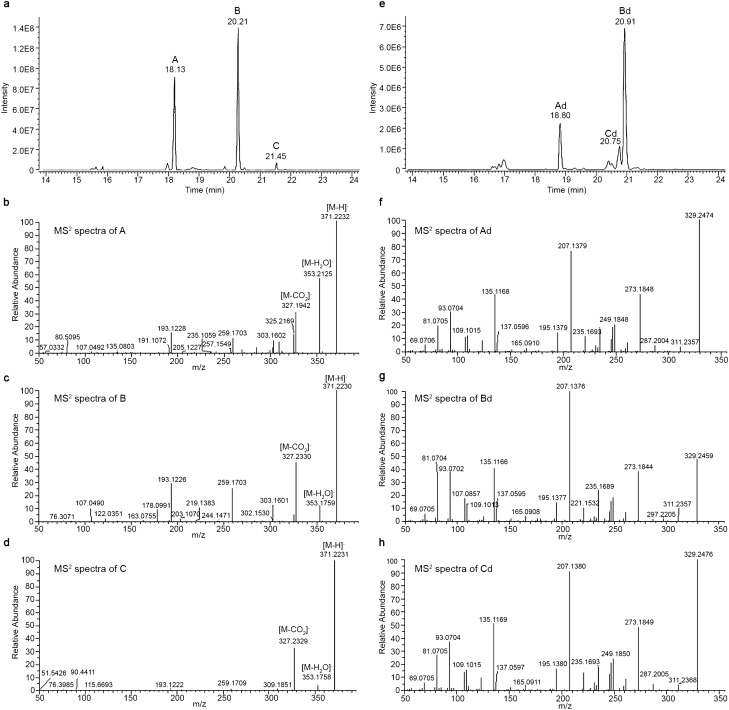
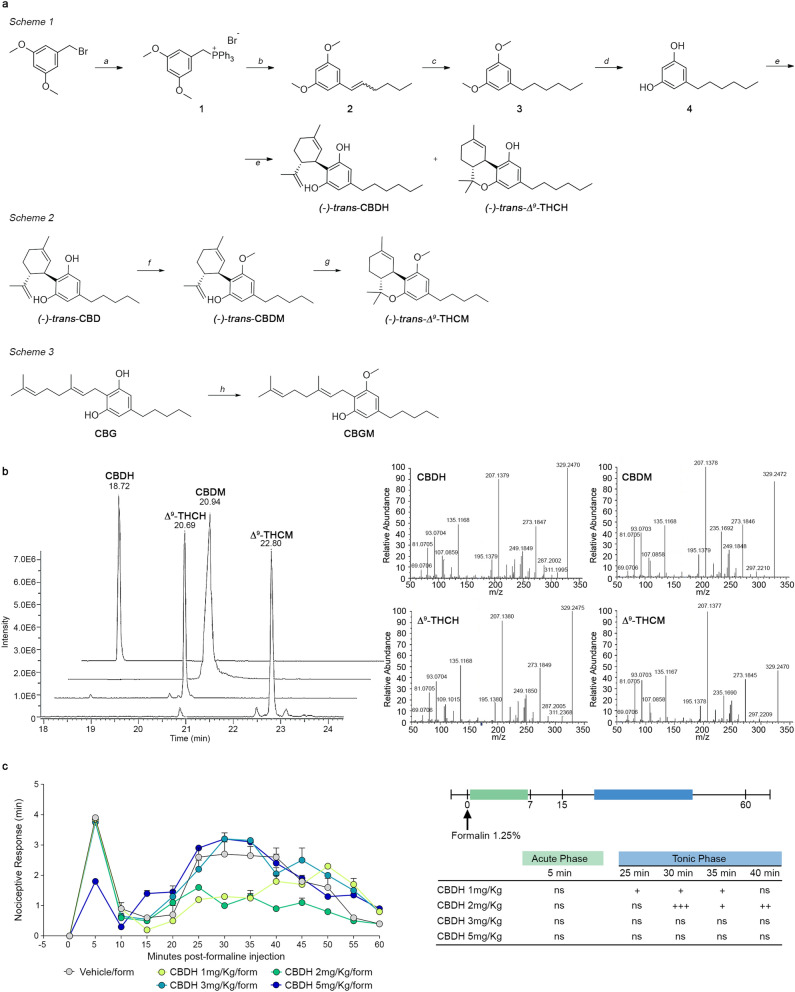
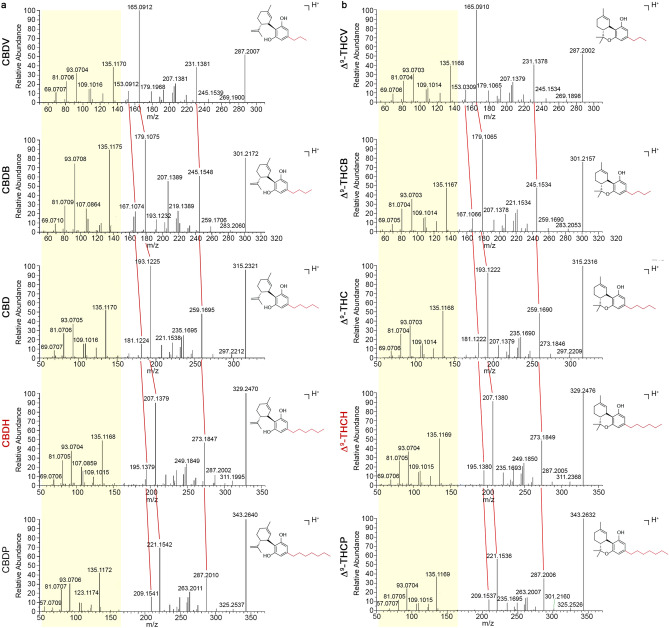
The two most important and studied phytocannabinoids present in Cannabis sativa L. are undoubtedly cannabidiol (CBD), a non-psychotropic compound, but with other pharmacological properties, and Δ-tetrahydrocannabinol (Δ-THC), which instead possesses psychotropic activity and is responsible for the recreative use of hemp. Recently, the homolog series of both CBDs and THCs has been expanded by the isolation in a medicinal cannabis variety of four new phytocannabinoids possessing on the resorcinyl moiety a butyl-(in CBDB and Δ-THCB) and a heptyl-(in CBDP and Δ-THCP) aliphatic chain. In this work we report a new series of phytocannabinoids that fills the gap between the pentyl and heptyl homologs of CBD and Δ-THC, bearing a n-hexyl side chain on the resorcinyl moiety that we named cannabidihexol (CBDH) and Δ-tetrahydrocannabihexol (Δ-THCH), respectively. However, some cannabinoids with the same molecular formula and molecular weight of CBDH and Δ-THCH have been already identified and reported as monomethyl ether derivatives of the canonical phytocannabinoids, namely cannabigerol monomethyl ether (CBGM), cannabidiol monomethyl ether (CBDM) and Δ-tetrahydrocannabinol monomethyl ether (Δ9-THCM). The unambiguously identification in cannabis extract of the n-hexyl homologues of CBD and Δ-THC different from the corresponding methylated isomers (CBDM, CBGM and Δ-THCM) was achieved by comparison of the retention time, molecular ion, and fragmentation spectra with those of the authentic standards obtained via stereoselective synthesis, and a semi-quantification of these cannabinoids in the FM2 medical cannabis variety was provided. Conversely, no trace of Δ-THCM was detected. Moreover, CBDH was isolated by semipreparative HPLC and its identity was confirmed by comparison with the spectroscopic data of the corresponding synthetic standard. Thus, the proper recognition of CBDH, CBDM and Δ-THCH closes the loop and might serve in the future for researchers to distinguish between these phytocannabinoids isomers that show a very similar analytical behaviour. Lastly, CBDH was assessed for biological tests in vivo showing interesting analgesic activity at low doses in mice.
大麻植物中最重要和研究最多的两种植物大麻素无疑是大麻二酚(CBD),一种非精神活性化合物,但具有其他药理学特性,和 Δ-四氢大麻酚(Δ-THC),它具有精神活性,是大麻娱乐用途的原因。最近,在一种药用大麻品种中分离出 CBD 和 THC 的同源系列化合物,这四种新的植物大麻素在间苯二酚部分具有丁基(在 CBDB 和 Δ-THCB 中)和庚基(在 CBDP 和 Δ-THCP 中)脂肪链。在这项工作中,我们报告了一系列新的植物大麻素,填补了 CBD 和 Δ-THC 的戊基和庚基同系物之间的空白,在间苯二酚部分带有正己基侧链,我们分别将其命名为大麻二酚己醇(CBDH)和 Δ-四氢大麻酚己醇(Δ-THCH)。然而,一些具有与 CBDH 和 Δ-THCH 相同分子式和分子量的大麻素已经被鉴定并报道为经典植物大麻素的单甲醚衍生物,即大麻二酚单甲醚(CBGM)、大麻二酚单甲醚(CBDM)和 Δ-四氢大麻酚单甲醚(Δ9-THCM)。通过比较保留时间、分子离子和碎片光谱与通过立体选择性合成获得的纯标准品的保留时间、分子离子和碎片光谱, unambiguously 鉴定大麻提取物中 CBD 和 Δ-THC 的正己基同系物与相应的甲基化异构体(CBDM、CBGM 和 Δ-THCM)不同,并提供了 FM2 药用大麻品种中这些大麻素的半定量分析。相反,没有检测到 Δ-THCM 的痕迹。此外,通过半制备 HPLC 分离出 CBDH,并通过与相应合成标准品的光谱数据进行比较来确认其身份。因此,正确识别 CBDH、CBDM 和 Δ-THCH 可以为未来的研究人员提供帮助,使他们能够区分这些具有非常相似分析行为的植物大麻素异构体。最后,在体内对 CBDH 进行了生物测试,结果显示在低剂量下对小鼠具有有趣的镇痛活性。