Department of Psychology, University of Warwick, Coventry, UK.
Department of Psychiatry, Royal College of Surgeons in Ireland, Dublin, Ireland.
Schizophr Bull. 2021 Apr 29;47(3):776-784. doi: 10.1093/schbul/sbaa174.
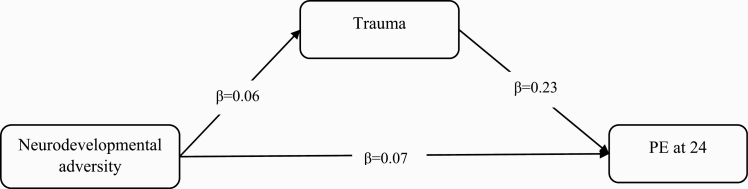
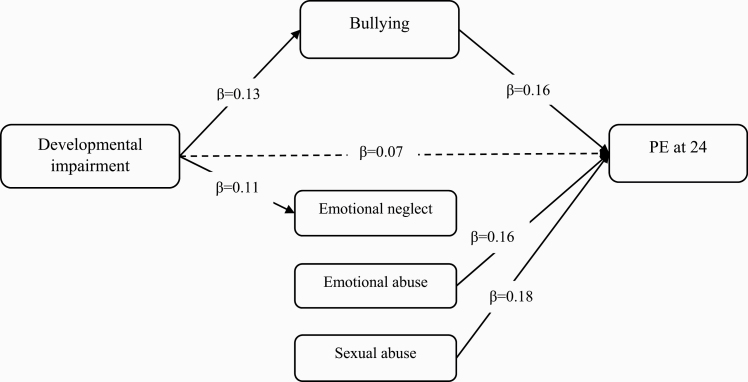
Exposure to neurodevelopmental adversity and childhood trauma are both independently associated with psychosis. However, there is little research on the mechanism underlying their relationship with each other. The current study investigated both the independent and joint effects of neurodevelopmental adversity and childhood trauma to better understand the etiology of psychosis. A large population-based cohort (N = 3514) followed from birth was assessed on psychotic experiences (PE) at 24 years. Neurodevelopmental adversity included obstetric complications (birth weight, gestational age, in-utero influenza exposure, resuscitation) and developmental impairment (cognitive and motor impairments). Trauma exposure included caregiver and peer inflicted trauma up to 17 years. Multiple regression models tested their independent and interactive effect on PE, and path analysis estimated the indirect effect of neurodevelopmental adversity on PE via trauma. Neurodevelopmental adversity (OR = 1.32, 95%CI: 1.08-1.62) and trauma (OR = 1.97, 95%CI: 1.65-2.36) independently increased the odds of PE. There was also an indirect relationship between neurodevelopmental adversity and PE via increased exposure to childhood trauma (β = 0.01, 95%CI: 0.004-0.024). In particular, peer bullying mediated the association between developmental impairment to PE (β = 0.02, 95%CI: 0.01-0.03). In conclusion, children with neurodevelopmental adversity, in particular those with developmental impairment, are more likely to be exposed to trauma. This new etiological understanding of psychosis suggests that PE may be partially modifiable through reducing exposure to peer bullying, especially in children with developmental impairment.
暴露于神经发育逆境和儿童创伤均与精神病独立相关。然而,关于它们彼此之间关系的机制研究甚少。本研究调查了神经发育逆境和儿童创伤的独立和共同作用,以更好地理解精神病的病因。一个大型基于人群的队列(N=3514)从出生开始进行随访,在 24 岁时评估其精神病体验(PE)。神经发育逆境包括产科并发症(出生体重、胎龄、宫内流感暴露、复苏)和发育障碍(认知和运动障碍)。创伤暴露包括照顾者和同伴在 17 岁之前造成的创伤。多元回归模型检验了它们对 PE 的独立和交互作用,路径分析估计了神经发育逆境通过创伤对 PE 的间接影响。神经发育逆境(OR=1.32,95%CI:1.08-1.62)和创伤(OR=1.97,95%CI:1.65-2.36)独立增加了 PE 的几率。神经发育逆境和 PE 之间也存在通过增加儿童期创伤暴露的间接关系(β=0.01,95%CI:0.004-0.024)。特别是,同伴欺凌介导了发育障碍与 PE 之间的关联(β=0.02,95%CI:0.01-0.03)。总之,有神经发育逆境的儿童,特别是有发育障碍的儿童,更有可能受到创伤的影响。这一新的精神病发病机制理解表明,PE 可能部分可以通过减少同伴欺凌的暴露来改变,特别是在有发育障碍的儿童中。