Fan Ying, Cheng Jiaoqi, Zeng Huihong, Shao Lijian
Department of Occupational Health and Toxicology, Medical College of Nanchang University, Nanchang, China.
Department of Histology and Embryology, Medical College of Nanchang University, Nanchang, China.
Front Physiol. 2020 Dec 1;11:593630. doi: 10.3389/fphys.2020.593630. eCollection 2020.
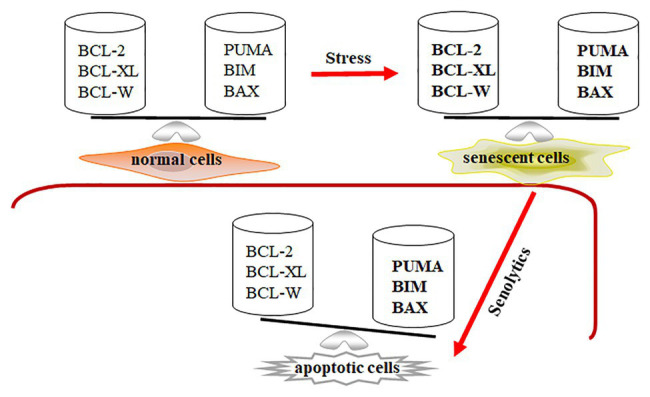
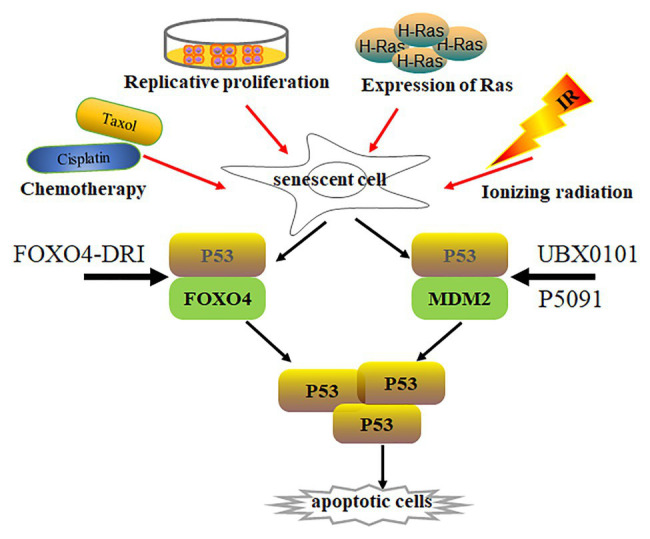
Senescent cells with replicative arrest can be generated during genotoxic, oxidative, and oncogenic stress. Long-term retention of senescent cells in the body, which is attributed to highly expressed BCL-family proteins, chronically damages tissues mainly through a senescence-associated secretory phenotype (SASP). It has been documented that accumulation of senescent cells contributes to chronic diseases and aging-related diseases. Despite the fact that no unique marker is available to identify senescent cells, increased p16 expression has long been used as an and marker of senescent cells. We reviewed five existing p16 reporter mouse models to detect, isolate, and deplete senescent cells. Senescent cells express high levels of anti-apoptotic and pro-apoptotic genes compared to normal cells. Thus, disrupting the balance between anti-apoptotic and pro-apoptotic gene expression, such as ABT-263 and ABT-737, can activate the apoptotic signaling pathway and remove senescent cells. Mitochondrial abnormalities in senescent cells were also discussed, for example mitochondrial DNA mutation accumulation, dysfunctional mitophagy, and mitochondrial unfolded protein response (mtUPR). The mitochondrial-targeted tamoxifen, MitoTam, can efficiently remove senescent cells due to its inhibition of respiratory complex I and low expression of adenine nucleotide translocase-2 (ANT2) in senescent cells. Therefore, senescent cells can be removed by various strategies, which delays chronic and aging-related diseases and enhances lifespan and healthy conditions in the body.
具有复制性停滞的衰老细胞可在基因毒性、氧化和致癌应激过程中产生。衰老细胞在体内的长期留存归因于高表达的BCL家族蛋白,主要通过衰老相关分泌表型(SASP)对组织造成慢性损害。已有文献记载,衰老细胞的积累会导致慢性疾病和衰老相关疾病。尽管目前尚无独特的标志物可用于识别衰老细胞,但长期以来,p16表达增加一直被用作衰老细胞的标志物。我们综述了五种现有的p16报告基因小鼠模型,以检测、分离和清除衰老细胞。与正常细胞相比,衰老细胞表达高水平的抗凋亡和促凋亡基因。因此,破坏抗凋亡和促凋亡基因表达之间的平衡,如ABT-263和ABT-737,可激活凋亡信号通路并清除衰老细胞。我们还讨论了衰老细胞中的线粒体异常,例如线粒体DNA突变积累、线粒体自噬功能障碍和线粒体未折叠蛋白反应(mtUPR)。线粒体靶向他莫昔芬(MitoTam)可有效清除衰老细胞,因为它能抑制呼吸复合体I,且衰老细胞中腺嘌呤核苷酸转位酶-2(ANT2)表达较低。因此,可通过多种策略清除衰老细胞,从而延缓慢性疾病和衰老相关疾病,并延长机体寿命,改善健康状况。