Kusano Kengo, Yamane Teiichi, Inoue Koichi, Takegami Misa, Nakao Yoko M, Miyamoto Yoshihiro, Shoda Morio, Nogami Akihiko
Department of Cardiovascular Medicine National Cerebral and Cardiovascular Center Osaka Japan.
Division of Cardiology Department of Internal Medicine The Jikei University School of Medicine Tokyo Japan.
J Arrhythm. 2020 Oct 16;36(6):953-961. doi: 10.1002/joa3.12445. eCollection 2020 Dec.
To analyze the type of ablation procedure, acute outcomes, and complications related to catheter ablation in Japan during the year of 2018.
The Japanese Catheter Ablation (J-AB) registry is a voluntary, nationwide, multicenter, prospective, observational registry, performed by the Japanese Heart Rhythm Society (JHRS) in collaboration with the National Cerebral and Cardiovascular Center using a Research Electronic Data Capture system. The procedural outcome and complications during hospitalizations were collected.
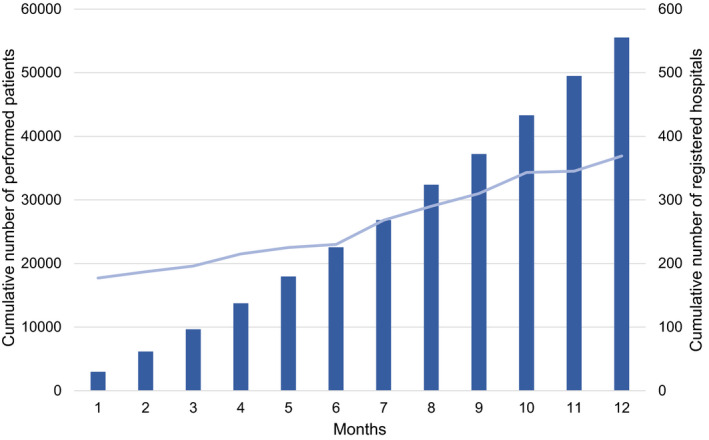
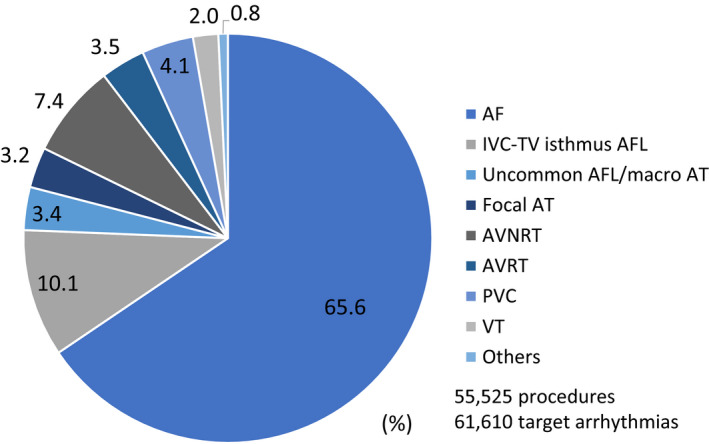
A total of 55 525 procedures (mean age of 64.5 years and 66.5% male) from 369 hospitals were collected. The total number of target arrhythmias was 61 610 including atrial fibrillation (AF, 65.6%), atrial flutter (AFL) or atrial tachycardia (16.7%), atrioventricular nodal reentrant tachycardia (7.4%), atrioventricular reentrant tachycardia (3.5%), premature ventricular contractions (4.1%), and ventricular tachycardia (VT, 2.0%). Over a 90% acute success rate was observed among all arrhythmias except for VT due to structural heart disease, and notably, an over 99% success rate was achieved for pulmonary vein isolation of AF and inferior vena cava-tricuspid valve isthmus block for isthmus-dependent AFL. Acute complications during hospitalization were observed in 1558 patients (2.8%), including major bleeding (Bleeding Academic Research Consortium: BARC criteria ≥2) in 1.1%, cerebral or systemic embolisms in 0.2%, and death in 0.1%. Acute complications were more often observed with AF ablation ( < .001), especially the first AF ablation session and with structural heart disease ( < .001).
The J-AB registry provided real-world data regarding the acute outcomes and complications of ablation for the various types of arrhythmias in Japan.
分析2018年日本导管消融的消融手术类型、急性结局及相关并发症。
日本导管消融(J-AB)登记系统是一项由日本心律协会(JHRS)与国立脑神经和心血管中心合作,使用研究电子数据采集系统进行的自愿性、全国性、多中心、前瞻性观察登记系统。收集住院期间的手术结局和并发症情况。
共收集了来自369家医院的55525例手术(平均年龄64.5岁,男性占66.5%)。目标心律失常总数为61610例,包括心房颤动(房颤,65.6%)、心房扑动(房扑)或房性心动过速(16.7%)、房室结折返性心动过速(7.4%)、房室折返性心动过速(3.5%)、室性早搏(4.1%)和室性心动过速(室速,2.0%)。除结构性心脏病所致室速外,所有心律失常的急性成功率均超过90%,值得注意的是,房颤肺静脉隔离术和峡部依赖性房扑的下腔静脉-三尖瓣峡部阻滞成功率超过99%。1558例患者(2.8%)出现住院期间急性并发症,包括严重出血(出血学术研究联盟:BARC标准≥2级)1.1%、脑或系统性栓塞0.2%、死亡0.1%。急性并发症在房颤消融术中更常见(<0.001),尤其是首次房颤消融手术以及合并结构性心脏病时(<0.001)。
J-AB登记系统提供了日本各类心律失常消融急性结局和并发症的真实世界数据。