Li Dai-Lin, Hu Liang, Wang Lei, Chen Chin-Ling
Key Laboratory of Environmental Biotechnology (XMUT), Fujian Province University, Xiamen University of Technology, Xiamen 361005, China.
School of Computer and Information Engineering, Xiamen University of Technology, Xiamen 361005, China.
Comput Struct Biotechnol J. 2020 Dec 2;18:3950-3958. doi: 10.1016/j.csbj.2020.11.039. eCollection 2020.
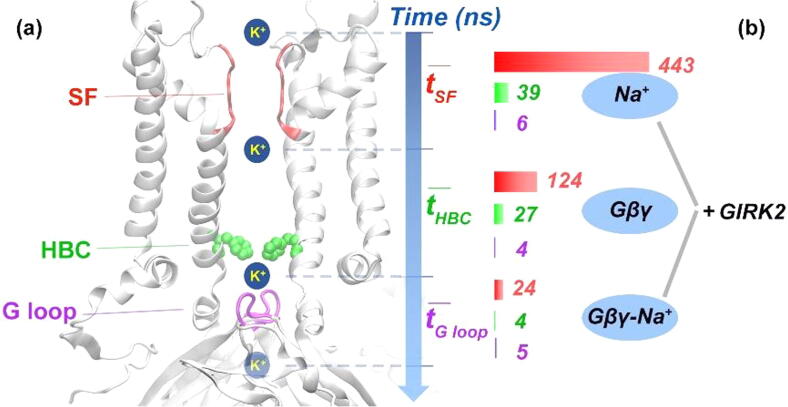
G protein-gated inwardly rectifying potassium channels (GIRK) are essential for the regulation of cellular excitability, a physiological function that relies critically on the conduction of K ions, which is dependent on two molecular mechanisms, namely selectivity and gating. Molecular Dynamics (MD) studies have shown that K conduction remains inefficient even with open channel gates, therefore further detailed study on the permeation events is required. In this study, all-atom MD simulations were employed to investigate the permeation mechanism through the GIRK2 selectivity filter (SF) and its open helix bundle crossing (HBC) gate. Our results show that it is the SF rather than the HBC or the G-loop gate that determines the permeation efficiency upon activation of the channel. SF-permeation is accomplished by a water-K coupled mechanism and the entry to the S1 coordination site is likely affected by a SF tilt. Moreover, we show that a 4-K occupancy in the SF-HBC cavity is required for the permeation through an open HBC, where three K ions around E152 help to abolish the unfavorable cation-dipole interactions that function as an energy barrier, while the fourth K located near the HBC allows for the inward transport. These findings facilitate further understanding of the dynamic permeation mechanisms through GIRK2 and potentially provide an alternative regulatory approach for the Kir3 family given the overall high evolutionary residue conservation.
G蛋白门控内向整流钾通道(GIRK)对于调节细胞兴奋性至关重要,这一生理功能严重依赖钾离子的传导,而钾离子传导取决于两种分子机制,即选择性和门控。分子动力学(MD)研究表明,即使通道门打开,钾离子传导效率仍然低下,因此需要对通透过程进行更详细的研究。在本研究中,我们采用全原子MD模拟来研究通过GIRK2选择性过滤器(SF)及其开放螺旋束交叉(HBC)门的通透机制。我们的结果表明,决定通道激活后通透效率的是SF,而不是HBC或G环门。SF通透是通过水-钾耦合机制完成的,进入S1配位位点可能受SF倾斜的影响。此外,我们表明,通过开放的HBC进行通透需要在SF-HBC腔内有4个钾离子占据,其中E152周围的3个钾离子有助于消除作为能量屏障的不利阳离子-偶极相互作用,而位于HBC附近的第4个钾离子则允许向内运输。鉴于整体高度的进化残基保守性,这些发现有助于进一步理解通过GIRK2的动态通透机制,并可能为Kir3家族提供一种替代调节方法。