Martincuks Antons, Li Pei-Chuan, Zhao Qianqian, Zhang Chunyan, Li Yi-Jia, Yu Hua, Rodriguez-Rodriguez Lorna
Department of Immuno-Oncology, Beckman Research Institute, City of Hope Comprehensive Cancer Center, Duarte, CA, United States.
Department of Surgery, City of Hope Comprehensive Cancer Center, Duarte, CA, United States.
Front Oncol. 2020 Dec 1;10:589601. doi: 10.3389/fonc.2020.589601. eCollection 2020.
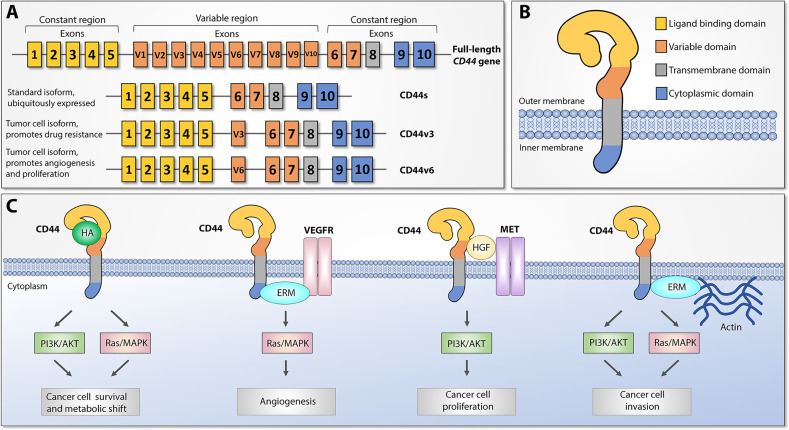
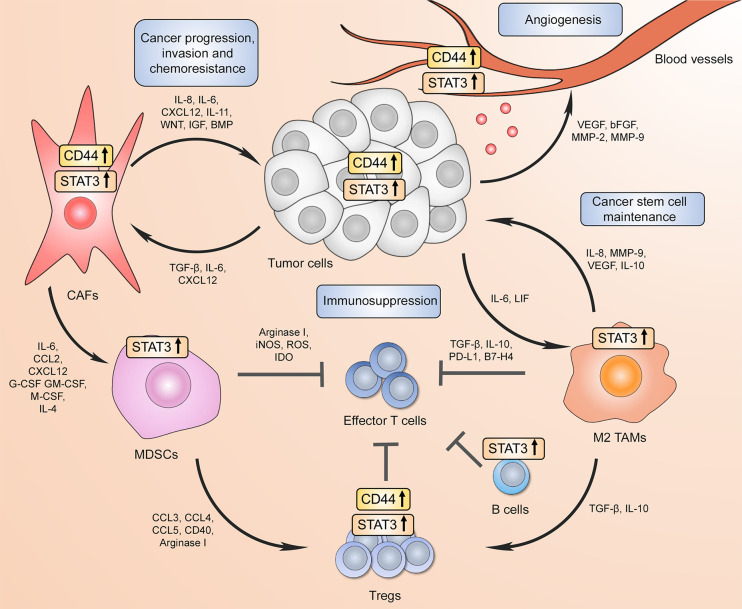
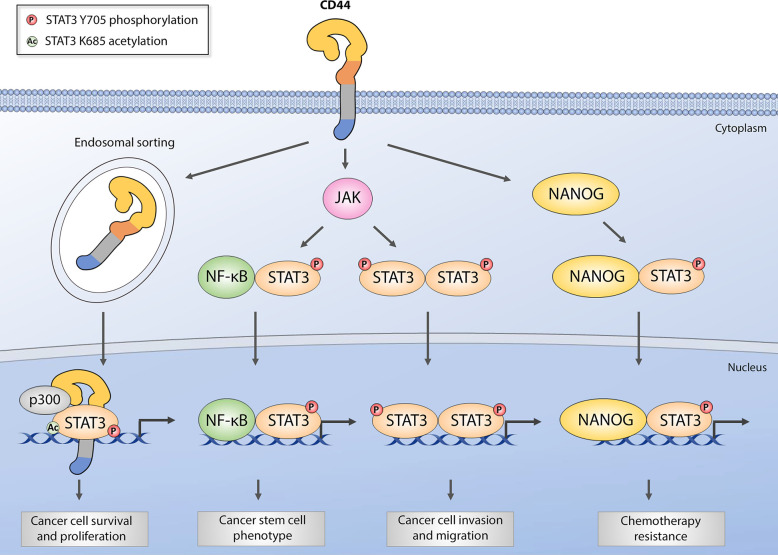
Despite significant progress in cancer therapy over the last decades, ovarian cancer remains the most lethal gynecologic malignancy worldwide with the five-year overall survival rate less than 30% due to frequent disease recurrence and chemoresistance. CD44 is a non-kinase transmembrane receptor that has been linked to cancer metastatic progression, cancer stem cell maintenance, and chemoresistance development via multiple mechanisms across many cancers, including ovarian, and represents a promising therapeutic target for ovarian cancer treatment. Moreover, CD44-mediated signaling interacts with other well-known pro-tumorigenic pathways and oncogenes during cancer development, such as signal transducer and activator of transcription 3 (STAT3). Given that both CD44 and STAT3 are strongly implicated in the metastatic progression and chemoresistance of ovarian tumors, this review summarizes currently available evidence about functional crosstalk between CD44 and STAT3 in human malignancies with an emphasis on ovarian cancer. In addition to the role of tumor cell-intrinsic CD44 and STAT3 interaction in driving cancer progression and metastasis, we discuss how CD44 and STAT3 support the pro-tumorigenic tumor microenvironment and promote tumor angiogenesis, immunosuppression, and cancer metabolic reprogramming in favor of cancer progression. Finally, we review the current state of therapeutic CD44 targeting and propose superior treatment possibilities for ovarian cancer.
尽管在过去几十年中癌症治疗取得了显著进展,但卵巢癌仍然是全球最致命的妇科恶性肿瘤,由于疾病频繁复发和化疗耐药,其五年总生存率低于30%。CD44是一种非激酶跨膜受体,在包括卵巢癌在内的多种癌症中,通过多种机制与癌症转移进展、癌症干细胞维持和化疗耐药性的发展相关联,是卵巢癌治疗中一个有前景的治疗靶点。此外,在癌症发展过程中,CD44介导的信号传导与其他众所周知的促肿瘤发生途径和癌基因相互作用,如信号转导和转录激活因子3(STAT3)。鉴于CD44和STAT3都与卵巢肿瘤的转移进展和化疗耐药性密切相关,本综述总结了目前关于CD44和STAT3在人类恶性肿瘤中功能相互作用的现有证据,重点是卵巢癌。除了肿瘤细胞内源性CD44和STAT3相互作用在驱动癌症进展和转移中的作用外,我们还讨论了CD44和STAT3如何支持促肿瘤发生的肿瘤微环境,并促进肿瘤血管生成、免疫抑制和癌症代谢重编程以利于癌症进展。最后,我们综述了目前靶向CD44治疗的现状,并提出了卵巢癌更优的治疗可能性。